
An electric car can show estimated range and still leave a used-car buyer with an unanswered question: how much of the battery’s original capability remains? The dashboard helps a driver complete today’s trip. It is not a standardized battery health certificate.
That distinction is becoming important as the first large waves of electric vehicles enter second and third ownership. Regulators in Europe, California, and the United Nations vehicle-regulation system are building rules around battery durability, onboard information, warranties, and lifecycle data. The difficult part is making a health number comparable across vehicles rather than merely easy to display.
Battery health is not the same as charge level
State of charge describes how full a battery is now. State of health, usually shortened to SOH, describes how its present capability compares with a reference condition. For an EV, the most useful capacity measure is the energy the vehicle can actually deliver within its permitted operating window, not the theoretical energy stored in every cell.
A battery can lose usable energy as it ages, but capacity is only one part of performance. Its ability to deliver power, accept rapid charging, maintain balanced cell groups, and operate without fault codes also matters. A single percentage may therefore hide several different measurements. A buyer should know what the percentage represents, which reference was used, and under what conditions it was calculated.
Why the range display cannot diagnose degradation
The range estimate is affected by recent speed, acceleration, road gradient, outside temperature, cabin heating or cooling, tire pressure, payload, and software assumptions. Cold weather can temporarily reduce available energy and increase heating demand without representing permanent battery loss. A gentle driver may see a generous estimate from a degraded pack, while a healthy vehicle driven quickly in winter may show a low one.
Charging records are not a clean shortcut either. Energy reported by a public charger includes conversion and thermal-management losses, and the starting and ending charge percentages are themselves estimates. This resembles the broader measurement problem discussed in our guide to EV charging reliability metrics: the visible number is useful only when its definition and test boundary are clear.
The battery management system estimates what it cannot see directly
An EV’s battery management system measures voltage, current, and temperature, then uses models to estimate charge and available energy. It may count current flowing into and out of the pack, observe voltage behavior, track cell balance, and update its estimates after suitable charge and discharge events. Software also protects the battery by reserving energy at the top and bottom of the physical cell range.
These estimates are not direct readings from a capacity sensor. Results can depend on recent use, temperature, calibration opportunities, software revisions, and each manufacturer’s definition of usable capacity. An aftermarket tool may expose useful data while still lacking the context needed for a fair comparison with another brand.
UNECE created a common durability framework
UN Global Technical Regulation No. 22 establishes an international framework for in-vehicle battery durability in light-duty electrified vehicles. It defines onboard measures including the state of certified energy and state of certified range, often abbreviated SOCE and SOCR. It also provides a structure for monitoring durability and demonstrating that vehicles meet minimum performance requirements over time.
The certified reference is crucial. If a vehicle reports remaining energy relative to the same value used in its regulatory certification, the result has a documented baseline. That is more meaningful than a dealer inventing a score from estimated dashboard range. UNECE’s technical rationale for GTR No. 22 explains why energy and range retention are central consumer concerns while recognizing that battery deterioration must be assessed over a vehicle’s life.
A global technical regulation does not automatically make every country’s implementation identical. Governments incorporate requirements through their own legal systems, schedules, vehicle classes, and enforcement procedures. Still, shared definitions give manufacturers, regulators, and diagnostic services a common starting point.
California connects data, durability, and warranty rules
California’s Advanced Clean Cars II package covers model-year 2026 and later light-duty zero-emission and plug-in hybrid vehicles. The final regulatory materials include separate provisions for data standardization, battery labeling, in-use compliance, corrective action and recall, and warranty requirements. Together, those pieces treat battery condition as both a consumer-information issue and an enforceable durability issue.
Data access alone is not enough if each manufacturer uses an incompatible definition. A durability target is hard to enforce without a consistent way to observe the pack’s condition. Warranty language is also more useful when the covered metric and diagnostic process are clear. California’s program therefore points toward used-EV inspections based on regulated data rather than improvised road tests.
Europe is linking health data to the battery passport
The EU Batteries Regulation identifies state of certified energy as the state-of-health parameter for electric-vehicle batteries. From February 18, 2027, each EV battery placed on the market or put into service must have an electronic battery passport. The regulation provides for individual battery information, including state of health, to be available to parties with a legitimate interest, while other model-level information is public.
A passport is a data framework, not a guarantee that every diagnostic question has been solved. Access rights, machine-readable formats, updates, and independent verification will determine its practical value. Our earlier explanation of EV battery passports examines how lifecycle records can support repair and recycling. Reliable health measurements are the layer that can make those records useful to a buyer today.
A useful used-EV report needs more than one percentage
A credible report should identify the vehicle and battery, the software version, the certified or new-battery reference, the measured or estimated usable energy, and the conditions under which the result was obtained. It should state whether the result came from onboard data, a controlled discharge test, service diagnostics, or an external estimate.
It should also disclose cell imbalance, relevant fault codes, charging and power limits, and any uncertainty range. Battery age, mileage, warranty status, repair events, and temperature provide context. A short drive and a dashboard photo cannot replace this information.
The most rigorous capacity test may take hours and consume a substantial charge, so not every retail inspection will perform one. A practical system can use trustworthy onboard indicators for routine screening and reserve controlled testing for disputed, unusual, or high-value cases. The report should make that difference visible.
Limits: a health score is not a safety certificate
Capacity retention does not prove that a pack has no safety defect, water intrusion, damaged enclosure, isolation fault, or weak module. It also cannot predict an exact remaining life. Batteries age through interacting effects of time, temperature, charge level, cycling, and use pattern, so two packs with the same current capacity can follow different future paths.
A good SOH result does not promise the original fast-charging curve, and a reduced result does not automatically mean the vehicle is unusable. Drivers with short daily trips may find a lower-capacity pack entirely adequate. The value of standardized reporting is not to assign every vehicle a pass or fail label; it is to give buyers consistent evidence for range expectations, price, warranty decisions, and repair planning.
What to watch next
The next test is interoperability. Watch whether independent workshops and vehicle owners receive practical access to standardized data, whether results remain comparable after software updates, and whether regulators can validate onboard estimates against physical tests. Europe must turn battery-passport rules into working systems by 2027, while California’s 2026-and-later requirements will generate experience with in-use data and enforcement.
Heavy vehicles will need their own approach because trucks and buses have different duty cycles, battery sizes, and commercial consequences. UNECE now lists a separate Global Technical Regulation No. 25 for heavy-duty electrified vehicle battery durability. The direction is clear: battery health is moving from a proprietary dashboard estimate toward regulated, explainable evidence. The winners will be systems that show not only a number, but also what was measured and why the result can be trusted.
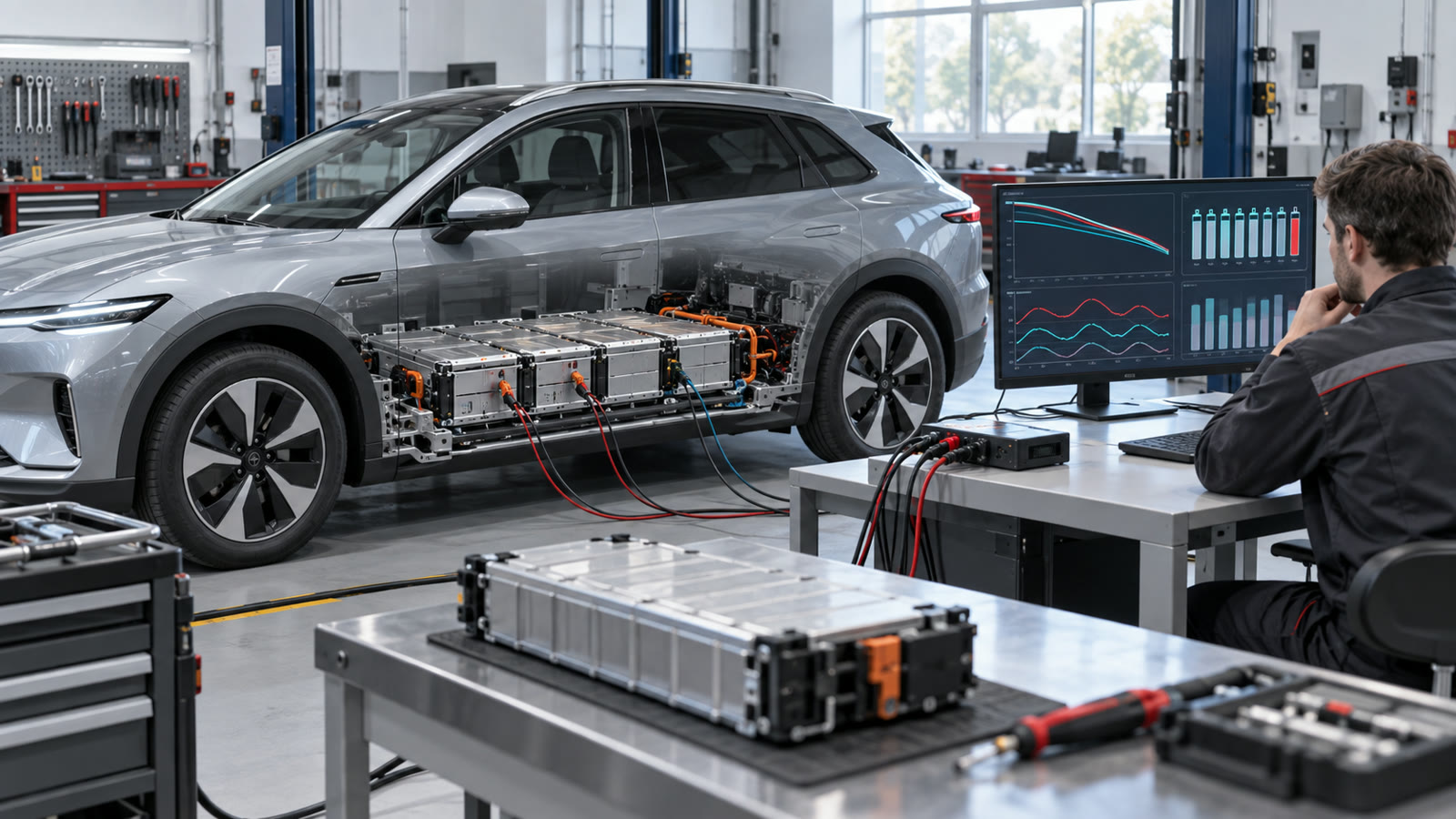
Featured image: AI-generated editorial illustration of a professional EV battery diagnostic process, not a test of a specific vehicle or service.
Primary sources
- UNECE: UN Global Technical Regulation No. 22
- UNECE: Technical report on the development of GTR No. 22
- California Air Resources Board: Advanced Clean Cars II rulemaking
- California Air Resources Board: Advanced Clean Cars II program
- European Union: Regulation (EU) 2023/1542 concerning batteries and waste batteries
- UNECE: UN Global Technical Regulation No. 25
Leave a Reply