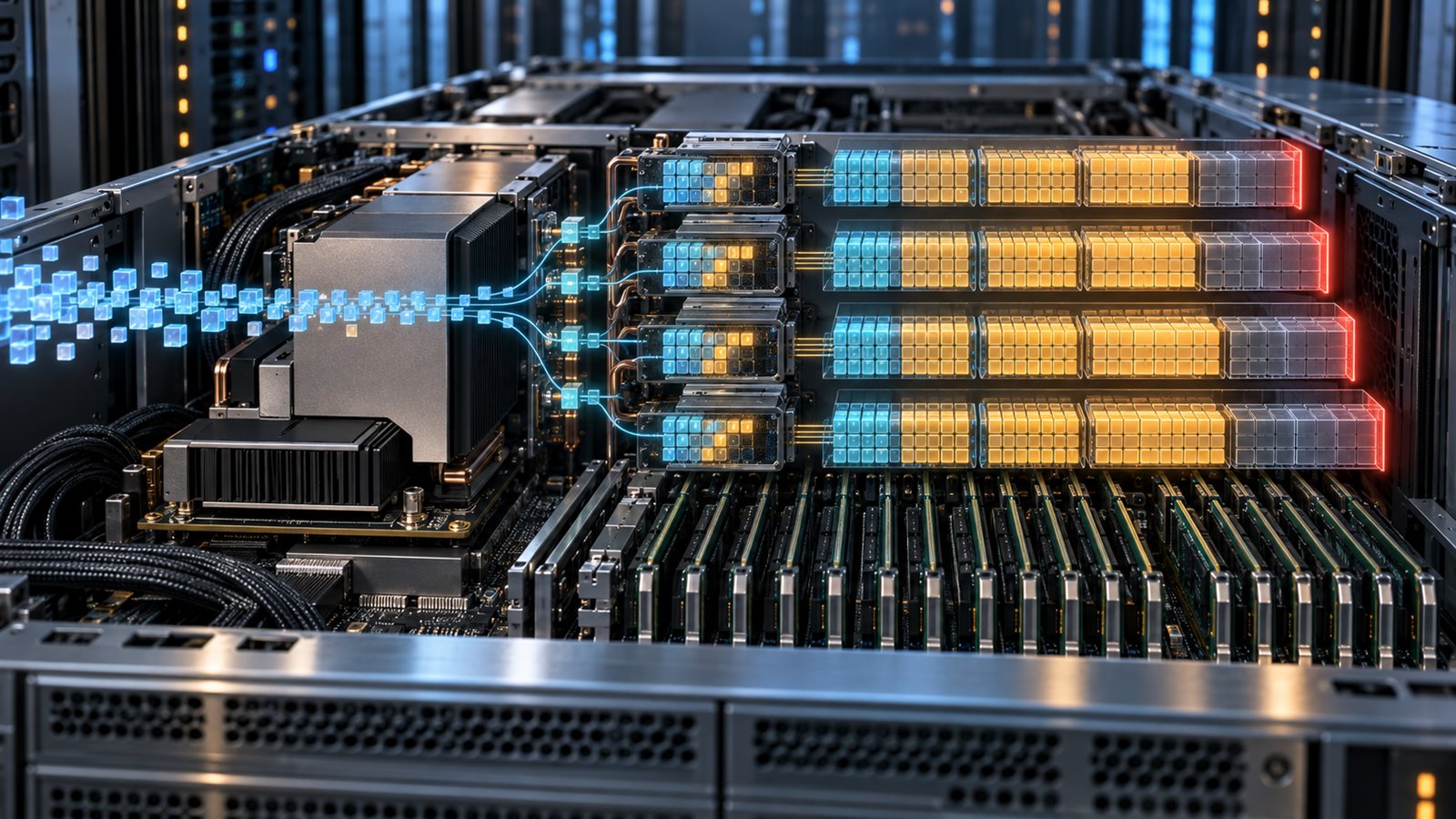
A chatbot’s answer often arrives a few words at a time. Behind that familiar stream is a costly sequence of model calculations. Speculative decoding tries to shorten that sequence: a fast assistant proposes several tokens, and the main model checks them together. When enough proposals survive, the system advances farther with each expensive verification step.
The appeal is faster output without simply replacing the model you asked for with a smaller one. But the details matter. Verification here means checking a proposed continuation against a model’s probability distribution, not checking whether the answer is true. And a technique that speeds up one conversation can be less helpful on a busy server.
Why generating an answer can be slow
An autoregressive language model predicts the next token using the text already available. A token might be a word, part of a word, or punctuation. After producing one, ordinary decoding repeats the process with that token added to the context. This dependency makes the output stage difficult to parallelize in the straightforward way used for processing many already-known tokens.
The original ICML paper on speculative decoding tackled this serial bottleneck by letting a cheaper model do provisional work. The larger model still controls the accepted output. This is a change to the generation procedure, not a promise that a small model has suddenly acquired the larger model’s capabilities.
It also does not eliminate the cost of reading a long prompt or storing context. Our explanation of long context windows and KV-cache memory covers a separate pressure that remains relevant even when output tokens arrive faster.
Draft several tokens, then verify the sequence
Imagine the assistant proposing a short continuation. The target model can score those proposed positions in one forward pass. The acceptance procedure works from left to right; it does not freely assemble an answer from whichever later tokens look appealing.
For sampled generation, exact verification is more sophisticated than asking whether the models chose the same favorite word. The draft and target probabilities enter a rejection-sampling procedure. If a proposal is rejected, the procedure supplies a correction and continues from the accepted prefix rather than trusting the rejected continuation.
The original speculative sampling research explains how this can recover the target model’s distribution while allowing multiple tokens to pass through one target evaluation. The savings depend on the draft being both cheap and useful. A fast assistant that repeatedly suggests unsuitable continuations creates extra work.
Preserving a distribution is not preserving every answer
In the exact formulation, speculative decoding is designed to preserve what the target model would sample statistically. That is different from guaranteeing that every run produces the same sentence. Random sampling already permits different valid outputs, and numerical behavior adds another complication.
The vLLM documentation describes theoretical losslessness up to hardware numerical precision. It also warns that floating-point behavior and batch changes can affect probabilities and outputs. A blanket claim of identical text under every deployment setting goes beyond that guarantee.
Most importantly, a target model can confidently accept an inaccurate answer. This mechanism does not inspect a scientific paper, authenticate a citation, or consult a database. Retrieval-augmented generation and grounding evaluation address a different question: what evidence an answer uses, and whether that evidence actually supports it.
Why a longer draft is not always better
Successful proposals let the system skip some target-generation steps, but drafting and verifying them still consume resources. If a long block is rejected near its beginning, much of that work does not advance the answer. Draft length therefore needs to be considered alongside acceptance rate, not advertised as a speed control by itself.
Load changes the tradeoff too. With a small batch, a server can be constrained by moving model data rather than performing arithmetic. At larger batches, the same hardware may become more compute-bound, making extra speculative calculations less attractive.
vLLM’s current adaptive verification documentation explicitly discusses this distinction. Its adaptive implementation chooses draft lengths using confidence estimates and a profiled compute budget. The documented feature currently requires DSpark models with a confidence head and is disabled by default; it is not a universal switch for every model.
An assistant model is not the only drafting option
The familiar setup uses a separate small model, but the broader idea has other implementations. Hugging Face documents prompt-lookup decoding, which proposes repeated sequences from the input itself. That can be useful when an output reuses source text, such as in some summarization or translation tasks, without loading another drafting model.
It also documents self-speculative decoding using early layers of a model trained to support early-exit predictions. Tokenizer compatibility needs attention: conventional assistant arrangements commonly share a tokenizer, while universal assisted decoding converts between representations and handles alignment.
These options in the Transformers assisted-decoding guide are implementation choices, not interchangeable guarantees. For someone trying a local model, the useful first question is whether the selected model and serving software support the intended method, rather than whether the model is described broadly as “speculative-ready.”
What a meaningful speed comparison should show
A smooth-looking demo is not enough. Separate the wait before the first token from the pace of subsequent output. Then distinguish the experience of one user from total throughput across many users. The MLCommons endpoint benchmark makes this distinction between per-user interactivity and aggregate throughput explicit.
A useful comparison should report the target and drafting setup, hardware, concurrency, prompt lengths, output lengths, sampling settings, and the non-speculative baseline. Ask whether the reported result is a quiet single-user session or a loaded service. Acceptance rate helps explain a result, but cannot replace end-to-end timing or resource measurements.
MLPerf Inference v6.0 introduced a standardized speculative-decoding configuration for its DeepSeek-R1 Interactive workload. The MLCommons announcement specifies the official multi-token-prediction head with EAGLE-style decoding. That controlled benchmark is more interpretable than an unspecified speed headline, but it does not validate every assistant-model pairing.
Limitations and what to watch next
Speculative decoding is best understood as an opportunity to use otherwise expensive generation steps more efficiently. It is not a substitute for enough memory, an evidence-based answer, or a properly measured deployment. This article explains published methods and documentation; it does not report hands-on performance testing.
For a local enthusiast, a sensible trial compares the same target model on the same representative prompts with speculation enabled and disabled. Measure responsiveness and memory use, and retain a fallback configuration. Model quantization changes numerical representation; speculation changes how proposed output is checked. Results from combining them should be measured as a combination, not attributed automatically to either technique.
Watch for better workload-aware controls, clearer compatibility documentation, and benchmarks that report both latency and throughput. The important advance will not be the longest possible draft. It will be a system that knows when a draft is likely to save useful time, and when ordinary decoding is the better choice.
Primary and authoritative sources
- Leviathan, Kalman, and Matias: Fast Inference from Transformers via Speculative Decoding
- Chen and colleagues: Accelerating Large Language Model Decoding with Speculative Sampling
- vLLM: Speculative decoding and lossless guarantees
- vLLM: Adaptive verification
- Hugging Face Transformers: Assisted decoding
- MLCommons: Endpoint performance and interactivity
- MLCommons: MLPerf Inference v6.0 and speculative decoding
Featured image is an AI-generated editorial metaphor, not a photograph of actual speculative-decoding hardware.