
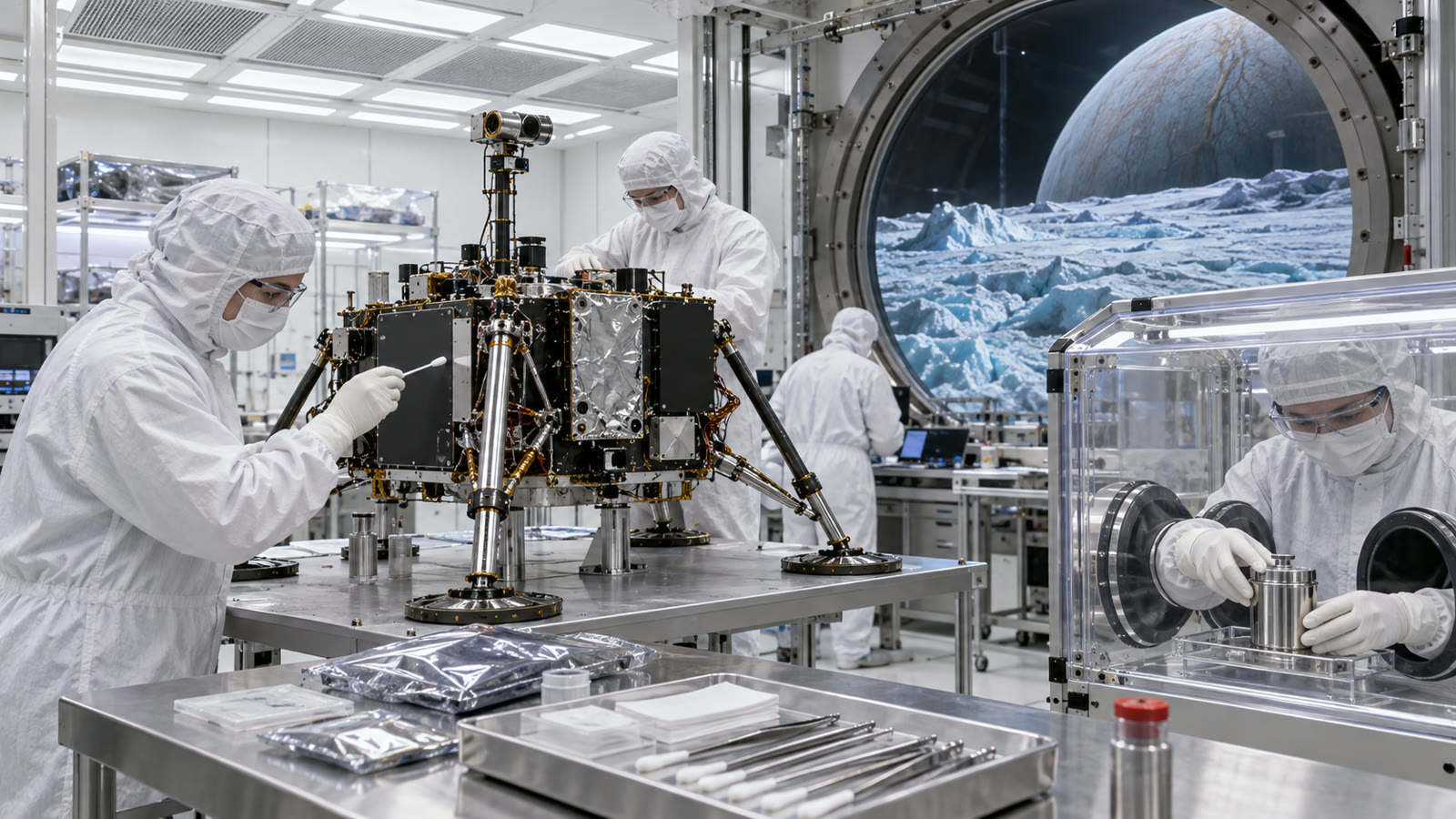
A spacecraft can look spotless and still carry microorganisms or organic material from Earth. That matters when the destination is an icy moon that may contain liquid water and chemistry relevant to life. A terrestrial microbe could compromise later experiments, while an Earth-made organic compound could imitate the signal a mission was sent to find.
Planetary protection turns that scientific problem into engineering requirements. The 2026 version of the international COSPAR policy adds a clearer framework for icy worlds, extending the discussion beyond the familiar cases of Europa and Enceladus. The result is not a demand to make every spacecraft perfectly sterile. It is a risk-informed system for deciding what must be controlled, measured, documented, and contained.
The 2026 policy gives icy worlds a formal framework
The 2026 COSPAR Policy on Planetary Protection defines icy worlds as bodies whose outermost layer is predominantly water ice by volume and whose mass is sufficient to make them nearly round. That broader group can include bodies with very different interiors and surface conditions.
Under the new framework, an icy-world mission starts at Category III unless its team can justify Category II. Category III generally covers flybys and orbiters where contamination could compromise future investigations; Category IV applies mainly to probes and landers with direct-contact concerns. The policy uses both mission type and destination to set the category, rather than treating every cold object alike.
COSPAR also moved away from using the mere presence of liquid water as the only trigger for concern. Its current policy considers temperature and water activity together when evaluating whether terrestrial organisms could replicate. It uses conservative lower limits of minus 28 degrees Celsius and a water activity of 0.5. These are screening boundaries with margins, not claims that scientists know every possible limit of life.
Planetary protection preserves evidence, not scenery
Forward contamination means carrying Earth organisms or organic constituents to another world. The immediate danger is scientific: future investigators might mistake imported material for native biology or lose confidence in a genuine finding. Backward contamination concerns extraterrestrial material returned to the Earth-Moon system and the possibility that it could adversely affect the terrestrial biosphere.
This is narrower than general environmental stewardship. COSPAR states that the policy does not cover cultural heritage, ordinary space debris, or planetary defense. Our guide to orbital debris mitigation describes a different safety problem. Trajectory design can serve both fields, but planetary protection focuses on biological and organic contamination that could damage science or create a return hazard.
A clean room is controlled, not sterile
Clean rooms reduce airborne particles through filtered air, controlled entry, special garments, cleaning procedures, and disciplined handling. They are essential because people, tools, packaging, dust, and moisture can all introduce contamination. However, a room built to protect sensitive electronics from particles is not automatically biologically clean enough for planetary protection.
NASA’s mission implementation guidance describes routine sampling of exposed spacecraft surfaces with swabs or wipes. Engineers coordinate sampling at the last physical access, before a component is closed or mated where it can no longer be reached. Cleaned hardware may be double-bagged, draped, filtered, or placed behind a bio-barrier to prevent recontamination.
The distinction resembles the lunar dust problem but with a different target. Dust can abrade seals, obscure optics, and enter mechanisms, as our article on lunar dust systems engineering explains. Planetary protection asks whether biological or organic material could reach a scientifically sensitive environment, even when the hardware looks visually clean.
Bioburden has to be counted
Bioburden is the number of microorganisms on or inside an item of interest. Surface contamination, organisms enclosed in nonmetallic materials, and difficult-to-access volumes can require different estimates. A mission allocates allowable burden across assemblies, records what can reach the target, and verifies selected surfaces through an approved assay.
For Mars, the traditional standard assay counts a defined group of heat-resistant, culturable microorganisms used as biological indicators. The COSPAR policy specifies the heat treatment and culture conditions behind that measurement. The method creates continuity across missions, but it is not a census of every living cell or every organic molecule. Many organisms do not grow under one laboratory condition, and DNA-based detection cannot by itself prove that a detected organism is alive.
This is why a contamination budget needs both measurement and assumptions. Engineers document sampled area, recovery efficiency, unsampled surfaces, enclosed materials, cleaning history, and uncertainty. A single negative swab cannot demonstrate that an entire spacecraft is sterile.
Sterilization is a hardware compatibility problem
Dry heat microbial reduction is effective for suitable hardware, but high temperature and long exposure can damage adhesives, lubricants, batteries, coatings, sensors, and electronics. Solvent wiping reaches exposed surfaces but not every seam or enclosed volume. Vaporized hydrogen peroxide can treat some temperature-sensitive components, yet materials still need compatibility testing and the process must reach the intended surface.
NASA’s current planetary protection research includes alternatives such as ultrashort-pulse laser treatment for spacecraft surfaces. The attraction is rapid treatment inside a clean-room workflow, including components that cannot be baked. Research success does not make a method flight-qualified: it still needs repeatable dose control, material compatibility, biological effectiveness, and verification on realistic geometry.
Mission architecture is part of contamination control
Planetary protection begins before a spacecraft enters a clean room. An orbiter may use trajectory biasing so an early launch failure or navigation error does not send hardware directly into a sensitive target. Teams can analyze impact probability, isolate high-burden components, select compatible materials, limit contact with target material, and design barriers that open only after landing.
Category IV missions generally require more extensive documentation, bioassays, contamination probability analysis, organic inventories, and direct hardware controls than Category III missions. The objective is a traceable chain from policy to design decisions, assembly records, sampling results, launch configuration, operations, and end-of-mission disposition.
Sample return reverses the containment problem
Category V applies when material returns to Earth. An unrestricted return can be assigned to a body judged not to present an indigenous-life concern. A restricted return requires a much stronger chain of containment. The current COSPAR policy calls for preventing destructive Earth impact and containing unsterilized material and any hardware that directly contacted the target.
NASA’s active NPR 8715.24 requirements include planning, verification, assurance, and special provisions for restricted sample return. Returned material must be analyzed in containment, and release depends on an evidence-based safety process. That is not proof that extraterrestrial life exists; it is a precaution for managing uncertainty without compromising the sample or Earth’s biosphere.
What the rules cannot guarantee
No assay sees every organism, no model predicts every failure, and no cleaning process reaches every material equally. Planetary protection cannot promise zero contamination. It reduces and documents risk to a level judged appropriate for the mission and destination.
COSPAR’s policy is an international, voluntary, non-legally binding standard. National agencies and licensing authorities decide how it enters mission requirements, contracts, and approvals. NASA’s updated Planetary Protection Handbook emphasizes performance-based guidance, but mission teams still need to demonstrate that their chosen controls satisfy applicable requirements.
What to watch next
The 2026 icy-world framework now has to be translated into mission-specific categories and practical designs. Watch for better low-temperature microbial reduction, faster assays that distinguish living cells from residual DNA, improved models for organisms hidden inside materials, and containment systems that can be verified throughout a sample’s journey.
Human exploration will be harder. People continuously release microorganisms, depend on waste and life-support systems, and cannot operate entirely inside sealed biological barriers. COSPAR says planetary protection goals should not be relaxed for human Mars missions even though the implementation must differ. The long-term challenge is to make contamination measurable enough that exploration and credible life-detection science can coexist.
Featured image: AI-generated editorial illustration of an icy-world spacecraft undergoing contamination-control procedures, not a photograph of a specific mission.
Leave a Reply