
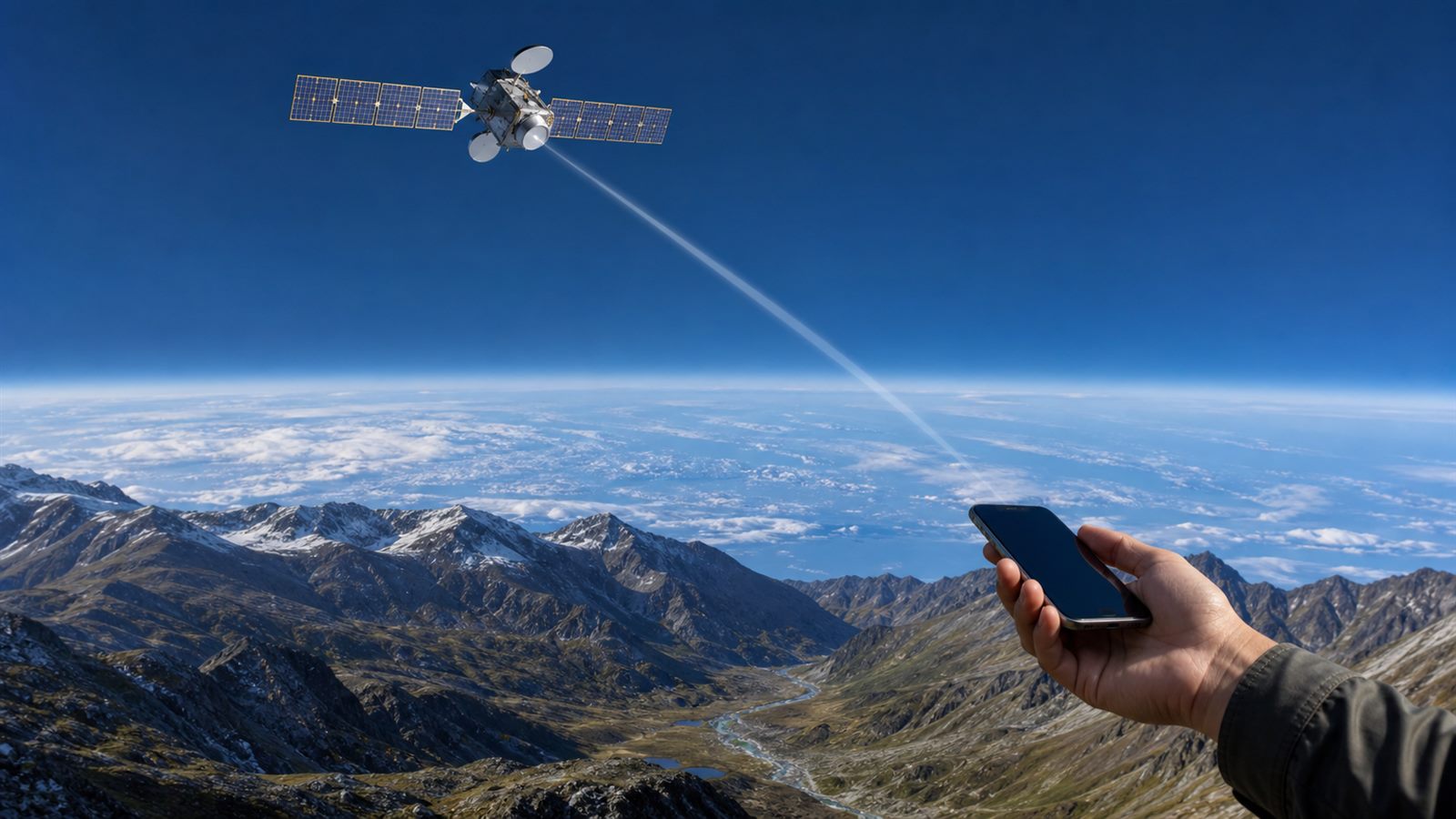
A mobile phone normally talks to a nearby tower. Satellite-to-phone service changes that path: when terrestrial coverage disappears, the handset can connect through a spacecraft and a ground gateway to reach the mobile network. The experience may eventually feel like ordinary roaming, even though the radio link travels hundreds or thousands of kilometers farther.
This idea is becoming less proprietary and more standardized. The 3rd Generation Partnership Project, or 3GPP, added normative non-terrestrial network requirements in Release 17 and continued enhancements in later releases. In the United States, the Federal Communications Commission created a framework called Supplemental Coverage from Space, or SCS, that lets satellite and terrestrial mobile operators cooperate in licensed mobile spectrum.
The result is not a replacement for cell towers. It is a new coverage layer for places where a tower is unavailable, damaged, or uneconomic.
Two Paths Toward a Satellite Link
Non-terrestrial network, or NTN, is the broad 3GPP term for radio access that uses satellites or airborne platforms. A compatible handset or Internet of Things device communicates over a service link to the platform. The platform may relay the signal directly to a ground gateway or through other satellites before it reaches the core network.
The FCC’s SCS framework addresses a particular regulatory model. A satellite operator partners with a terrestrial wireless licensee and uses authorized mobile spectrum on a secondary basis to fill gaps in that carrier’s coverage. The mobile provider remains part of the customer relationship, while the satellite supplies a path where the ground network cannot.
These approaches can overlap technically, but they are not identical. One starts from global mobile standards; the other establishes how specific spectrum and licenses may be used in the United States. Consumers will mostly notice the outcome: whether their carrier, phone, region, and service plan support a connection.
Why Ordinary Phones Are a Difficult Radio Target
A conventional satellite terminal has a visible antenna, a larger battery, and enough power to aim a strong signal toward space. A smartphone has a small antenna built around a screen, cameras, and other radios. It may be held at an awkward angle, placed in a pocket, or surrounded by buildings and trees.
The satellite must detect that weak uplink while moving rapidly relative to the user. The system has to compensate for delay and Doppler shift, coordinate beams over wide areas, hand a connection between spacecraft, and avoid harmful interference with terrestrial networks using related frequencies.
Low Earth orbit reduces distance compared with traditional geostationary satellites, but the link still has far less capacity than a dense urban cell network. This is why early direct-to-phone experiences tend to prioritize emergency messages, short texts, basic data, or limited voice rather than promising continuous high-definition video everywhere.
Standards Make Roaming More Realistic
Release 17 was the first 3GPP release with normative NTN requirements. Its work covers radio access, architecture, network selection, roaming, service continuity, and support for both 5G New Radio and lower-rate satellite IoT connections. Release 18 added enhancements, while Release 19 continues work on further NTN capabilities.
A common standard does not make every network interchangeable overnight. Operators still choose spectrum, satellite architecture, authentication, billing, emergency handling, and supported devices. Chipsets and phones must implement the relevant features, and networks must pass conformance and interoperability testing.
Still, standardization matters. It gives handset, modem, satellite, and carrier suppliers a shared technical foundation rather than requiring a completely separate device for every service. It also supports the broader infrastructure story in the new space economy, where value increasingly comes from networks and data services rather than launch alone.
Regulation Has to Protect Both Networks
The FCC’s 2024 SCS order established a licensing route for collaborations between satellite operators and terrestrial carriers. SCS operations are secondary, so they must protect primary terrestrial services from harmful interference. The framework also addresses spectrum leases, geographic coverage, and interim routing for emergency communications.
In April 2026, the FCC granted a limited waiver that allows certain devices already authorized before June 29, 2024, to connect to SCS services without first receiving a separate Part 25 authorization. The order is a practical example of regulation adapting to existing phones while retaining device records and interference accountability.
Other regions use their own spectrum and communications rules. International coordination matters because a satellite beam does not stop at a national border. Operators must control where particular frequencies are active and comply with the authorization in each market.
Coverage Does Not Mean Unlimited Capacity
A satellite can illuminate a huge area, but every user in that beam shares finite spectrum and spacecraft power. A ground tower covers less territory and can reuse frequencies across many small cells. That makes terrestrial infrastructure better for concentrated demand.
Direct-to-phone satellite service is therefore strongest as a complement: remote roads, farms, hiking areas, maritime edges, disaster zones, and regions where a damaged backhaul link has taken towers offline. It may also support low-rate sensors and logistics equipment outside normal coverage.
Weather, terrain, foliage, buildings, phone orientation, satellite visibility, and local network policy can all affect availability. Users should not assume that a coverage map guarantees an indoor connection or that emergency access works identically in every country. A clear view of the sky remains valuable.
What It Means for Space Infrastructure
Connecting consumer phones demands more than adding a radio payload. Constellations need gateways, spectrum coordination, network software, accurate timing, cybersecurity, collision avoidance, and a plan for replacing spacecraft. The orbital-safety issues in our space debris overview become more important as communications constellations grow.
Operators also need service monitoring that distinguishes a phone problem, a gateway outage, a satellite handover, and congestion. Mobile subscribers expect a network, not a science experiment. Reliability will be measured by successful messages and calls under difficult conditions, not by the number of satellites announced.
What Buyers Should Check
Before relying on a service, check the supported country, carrier, phone model, software version, message or voice capability, emergency terms, and whether an additional subscription is required. Confirm what happens when the phone enters satellite mode and whether the user must point or hold it in a particular way.
For remote travel, satellite access should be one layer in a safety plan rather than the only one. Battery management, offline maps, weather awareness, and a dedicated emergency device may still be appropriate for high-risk journeys.
What to Watch Next
The useful milestones are broader standards-based handset support, reliable handover between terrestrial and satellite links, better emergency location routing, and transparent capacity limits. Watch whether services progress from short messages to dependable voice and data without sacrificing battery life.
Space-based navigation and communications are also expanding beyond Earth, as explained in our article on lunar networks. On Earth, the near-term goal is simpler but consequential: make a phone more likely to work when the last cell tower disappears.
Leave a Reply