
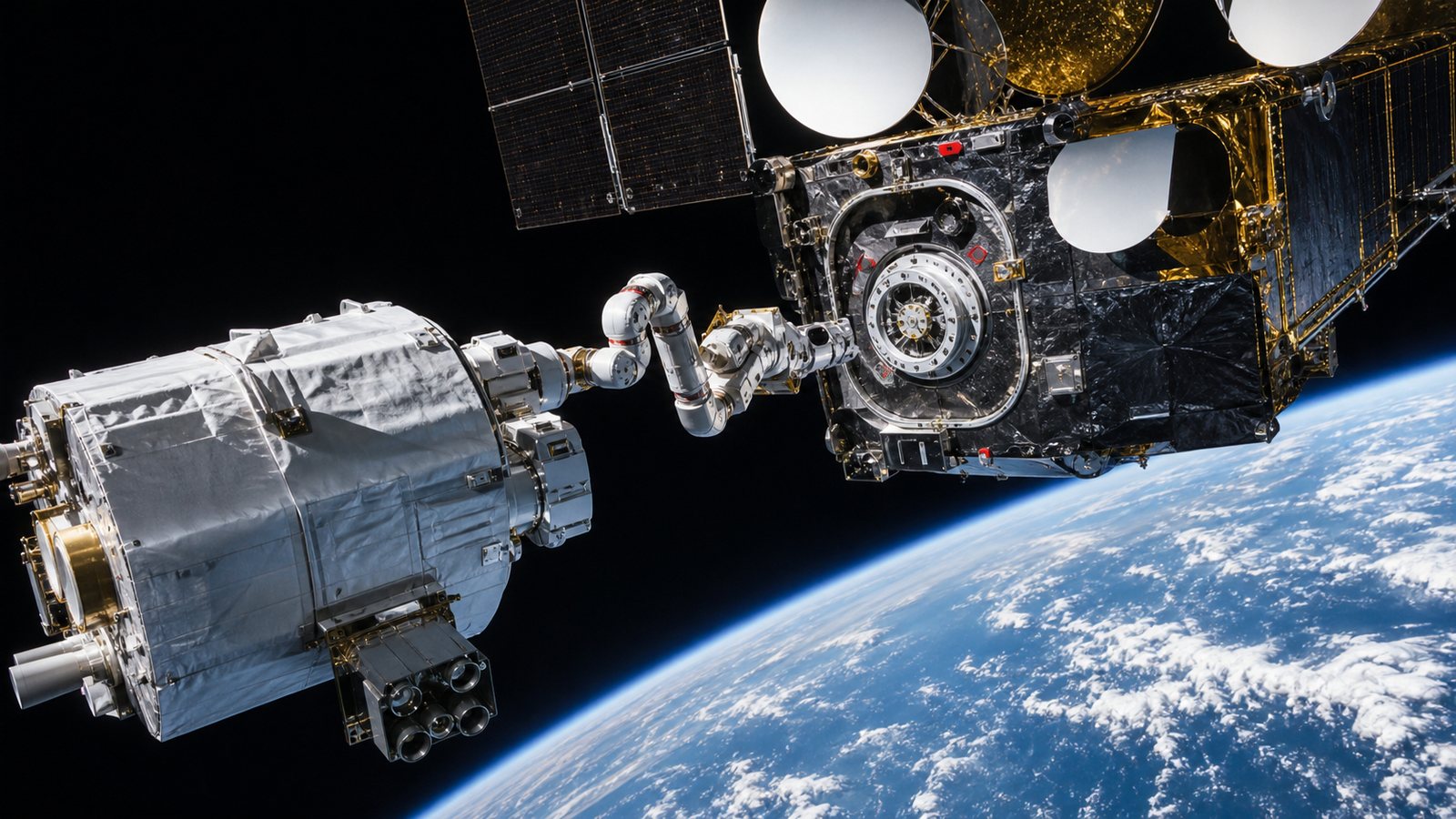
Satellites are usually launched as sealed machines. When fuel runs low, a component fails, or a mission needs a new capability, operators have few options beyond careful workarounds and eventual retirement. In-space servicing promises a different model: inspect, refuel, reposition, repair, or upgrade a spacecraft after launch.
The difficult part is not proving that two objects can meet in orbit. That has been demonstrated repeatedly. The challenge is turning exceptional missions into a dependable service market. Common interfaces, agreed rendezvous practices, transparent operating rules, and spacecraft designed to be serviced will matter as much as robotic arms.
Servicing Covers More Than Refueling
NASA uses the broader term in-space servicing, assembly, and manufacturing, or ISAM. Its ISAM overview includes inspection, relocation, refueling, repair, upgrading, assembly, and manufacturing. Those capabilities address different problems. A mission-extension vehicle can provide propulsion and attitude control, while another servicer might add fuel, attach a new payload, or examine damage before an operator decides what to do.
Assembly and manufacturing also change what can be launched. A telescope, antenna, or solar array assembled in orbit is not restricted to fitting inside one rocket fairing in its final shape. That possibility links servicing to the wider development of high-capacity optical space networks, which may eventually need large apertures and maintainable infrastructure rather than isolated disposable spacecraft.
None of this makes every satellite repairable. Radiation-damaged electronics buried inside a sealed structure are a different problem from an empty propellant tank or a failed external mechanism. A useful servicing strategy begins with a clear, reachable task.
Space Has Already Supplied Important Proof Points
Astronaut servicing of the Hubble Space Telescope showed how upgrades can transform a mission when a spacecraft is deliberately designed with accessible equipment. Robotic operations around the International Space Station have added another body of experience. In commercial geostationary orbit, mission-extension vehicles have docked with client satellites and taken over propulsion functions.
NASA’s 2025 ISAM State of Play treats these examples as part of an emerging capability, not evidence that the market is already routine. Each mission still involves specialized engineering, close coordination, regulatory work, and a valuable client spacecraft. The next step is repeatability.
ESA’s RISE mission, planned for launch in 2029, is intended to demonstrate rendezvous and docking with a geostationary client and then provide life-extension services. It is another test of whether servicing can move from one-off achievement toward an operational product.
Cooperative Spacecraft Change the Risk Equation
A cooperative client can provide navigation aids, known grapple points, accessible valves, docking geometry, and software modes for a safe approach. A non-cooperative satellite may have none of those features. It may be tumbling, offer little reliable position data, or contain protrusions and delicate surfaces that were never meant to be touched.
That difference affects sensors, control algorithms, robotic tooling, mission duration, and insurance. Servicing a prepared satellite can resemble using an engineered port. Servicing an unprepared one is closer to working around an unknown machine without the benefit of a shared manual.
Design-for-service does add mass, cost, testing, and cybersecurity responsibilities before launch. Operators need confidence that the future service value outweighs those penalties. Standard interfaces reduce that uncertainty by making a compatible port useful to more than one prospective servicer.
Standards Need to Cover Behavior as Well as Hardware
A universal connector alone will not create safe orbital servicing. Missions also need conventions for approach corridors, hold points, collision avoidance, abort behavior, communications, navigation data, fault handling, and post-mission disposal. Operators and regulators need to understand who remains responsible at each stage.
ISO 24330:2022 provides programmatic principles and practices for rendezvous, proximity operations, and on-orbit servicing. Its scope is relevant to spacecraft operators, manufacturers, service providers, insurers, and other participants. Such guidance does not prescribe one docking mechanism, but it creates a common vocabulary for assessing a mission.
Technical standards must also evolve alongside orbital debris and traffic-safety practices. A servicer that extends one satellite’s life should not create a new long-lived object or make collision coordination harder for everyone else.
Prepared Interfaces Must Remain Secure
A service port creates a deliberate path into a spacecraft’s physical or digital systems. Authentication is therefore essential. A client must distinguish its authorized servicer from an unexpected object, and the service transaction should expose only the commands and data needed for the job.
That calls for protected communications, strong identity management, carefully limited command authority, and safe fallback modes. Long mission lives make cryptographic agility important: an interface designed today may still be active after current algorithms or keys need replacement.
Operational records also matter. Insurers and future owners may need reliable evidence of what was attached, transferred, changed, or inspected. This resembles the data-governance challenge of building interoperable lunar communications and navigation services: shared infrastructure works only when technical compatibility and trust develop together.
The Economics Depend on Remaining Mission Value
A servicing mission makes sense when the value preserved exceeds the total cost and risk. A healthy geostationary communications satellite with years of useful payload life but little fuel can be an attractive client. A low-cost spacecraft in a rapidly refreshed constellation may be cheaper to replace.
Launch prices are only one variable. Operators must consider lost revenue, replacement lead time, orbital-slot value, regulatory approvals, insurance, integration work, and the chance that an inspection reveals a problem that cannot be repaired. Standardized interfaces can lower engineering cost, but they cannot turn every satellite into a viable customer.
Servicers also face a utilization problem. A vehicle that can reach only one client geometry or orbit may spend too much time traveling or waiting. Compatible fleets, depots, and multiple service types could improve utilization, but those are business hypotheses that real missions must test.
What to Watch Next
Watch for satellite procurements that require serviceable interfaces before launch, not merely missions that demonstrate a clever capture afterward. Also watch whether interface specifications remain open enough for multiple providers, whether insurers reward prepared clients, and whether regulators clarify responsibility during rendezvous and docking.
The most meaningful milestones will be quiet ones: a second service using the same interface, a shorter planning cycle, a client selected without custom capture hardware, and a clear end-of-life plan for both vehicles. In-space servicing can extend valuable missions and enable larger infrastructure, but scale will come from predictable compatibility rather than spectacular individual rescues.
Leave a Reply