
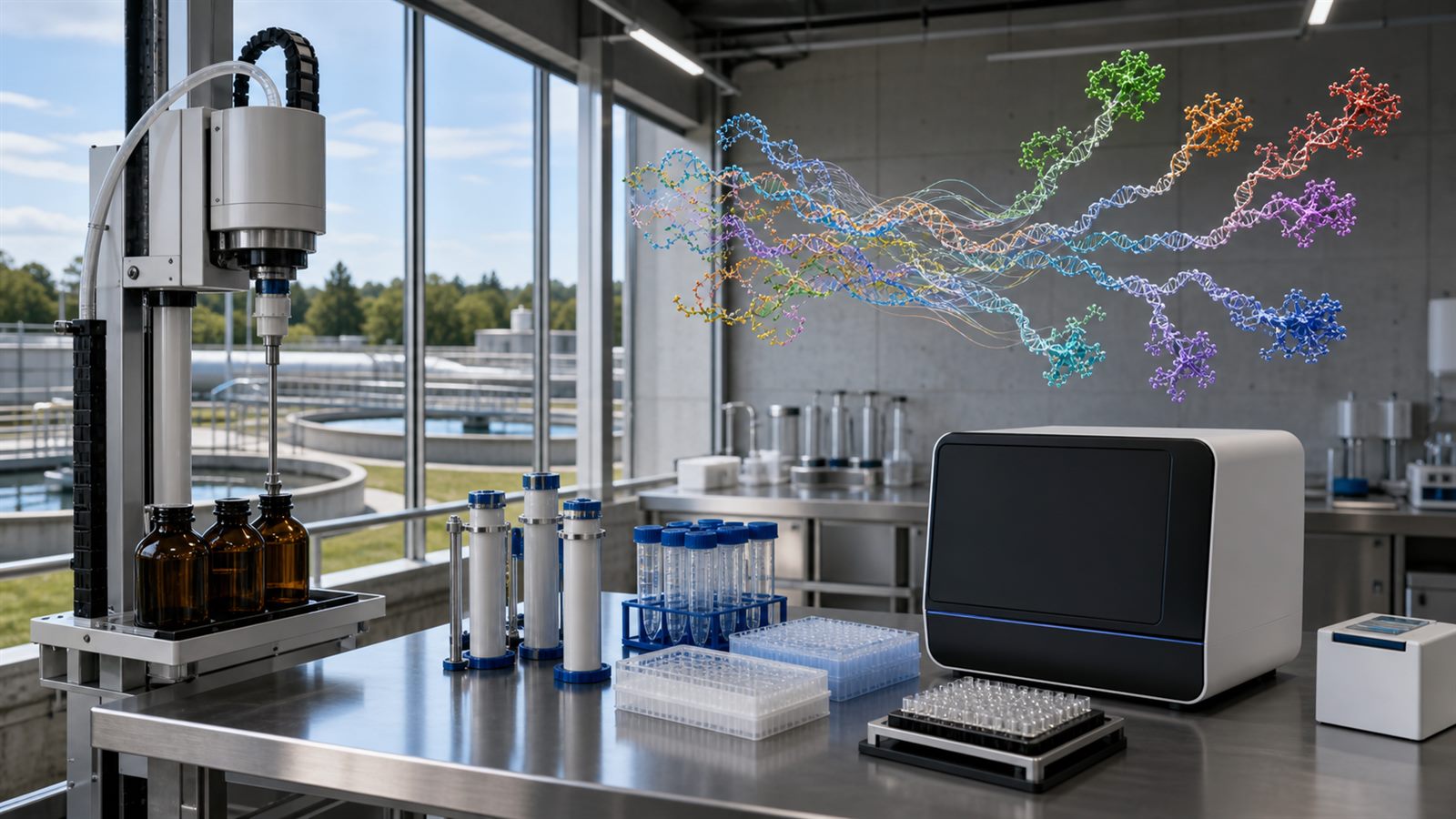
A vial collected at a wastewater treatment plant can contain biological traces from thousands of people. Public-health laboratories can measure selected pathogens in that mixed sample, and sequencing can reveal some of the genetic variation circulating across the connected community. The result is a population signal that does not depend on everyone seeking care or taking a clinical test.
That reach makes wastewater surveillance valuable, but it also makes the data easy to misread. A sewer sample is not a census of infections, and a sequence fragment is not a diagnosis. Useful programs combine sampling design, molecular biology, sequencing, bioinformatics, sewer knowledge, clinical surveillance, privacy safeguards, and a clear plan for public-health action.
The sewer network acts as a pooled sampler
People with some infections shed viral, bacterial, or other biological material through toilets, sinks, showers, and laundry. Those traces move through sewer pipes and mix before treatment. An autosampler can collect small portions over time to create a composite sample that better represents changing flow than one bottle filled at a single moment.
The catchment, or area draining to the sampling point, determines what population the result can represent. A sample at a large treatment plant aggregates a broad community. A sample farther upstream can provide more local information, but smaller catchments raise technical, operational, and ethical questions.
Detection and sequencing answer different questions
Quantitative polymerase chain reaction, known as qPCR, and digital PCR look for predefined genetic targets. They can sensitively estimate how much target material is present, making them useful for routine trend monitoring. The assay must already know what sequence to search for.
Sequencing reads many fragments and can help identify lineages, mutations, or multiple targets. Targeted amplicon sequencing amplifies selected genome regions, while hybrid capture uses probes to enrich related sequences. Shotgun metagenomics attempts to read material more broadly without focusing on one pathogen. These approaches trade sensitivity, breadth, cost, speed, and interpretability.
Wastewater is a difficult molecular mixture
Pathogen nucleic acids may be rare compared with bacterial, plant, animal, and human material in sewage. Chemicals in the sample can interfere with extraction or amplification. RNA also degrades during travel, storage, and processing. A pathogen that is easy to detect in a clinical swab may be hard to reconstruct from fragmented community wastewater.
An original comparative study of viral sequencing methods found that untargeted deep sequencing did not provide enough coverage for robust genomic monitoring of low-concentration human viruses in the tested samples. Targeted amplification gave stronger coverage for individual viruses, while hybrid capture offered a way to enrich several viral targets. Method choice must follow the surveillance question.
A mixed sample contains mixed lineages
A clinical sequence can often be associated with one infection. Wastewater may contain fragments from many people infected with several lineages. Bioinformatics tools estimate the combination that best explains observed mutations, but fragments do not always show which mutations occurred together in the same genome.
Low-abundance lineages can be missed, and closely related variants can be hard to separate. Primer-binding changes may cause parts of a genome to drop out during targeted amplification. Results should therefore include uncertainty and quality measures rather than a single overly precise percentage.
Concentration is not the same as case count
People shed different amounts of a pathogen at different stages of infection. Sewage flow changes with rainfall, groundwater intrusion, industry, tourism, commuting, and water use. Travel time and temperature affect decay. The number of people connected to a catchment can also change.
Laboratories may normalize results using flow, population estimates, or biological markers, but no correction removes every source of variation. Trends at one site are usually more reliable than direct comparisons between sites using different collection and laboratory methods. Wastewater can show that a community signal is rising or falling without converting cleanly into a number of infected individuals.
Timing can provide useful early awareness
Wastewater does not require a person to recognize symptoms, obtain a test, or report a result. For that reason, a rising signal can sometimes appear before increases become visible in clinical data. The lead time varies with shedding, sampling frequency, laboratory turnaround, healthcare behavior, and the pathogen being monitored.
CDC describes wastewater monitoring as a complement to other public-health surveillance. That word matters. Hospital admissions, laboratory tests, syndromic reports, genomic sequences from patients, and field investigations provide context that a sewer measurement cannot supply on its own.
Metadata makes results comparable
A sequence file without collection context has limited value. Analysts need the date, sampling method, location or catchment, matrix, storage conditions, concentration method, extraction process, sequencing platform, controls, and quality metrics. Standard fields make it easier to combine data and understand why laboratories disagree.
The US National Center for Biotechnology Information provides a BioSample package for wastewater pathogen genomic surveillance. Shared vocabularies and minimum metadata requirements turn isolated experiments into data that can support national and international analysis.
Community surveillance requires privacy governance
Wastewater monitoring is designed to observe pooled biological signals, not identify individuals. Large catchments and fragmented mixed material reduce identifiability, but expanding sequencing capability still deserves governance. Programs should define which targets are justified, how geography is reported, how long raw data is retained, and who can access it.
Small sites such as buildings, schools, prisons, or workplaces can create greater privacy and stigma concerns than city-scale plants. A technically possible analysis is not automatically appropriate. Public reporting should avoid implying that a neighborhood or institution is responsible for a health threat.
Multipathogen programs need prioritization
A sequencing platform can tempt a program to monitor everything detectable. WHO guidance instead emphasizes prioritization and integration with wider surveillance. A target is more useful when it is shed into wastewater, remains detectable, has a validated method, fills an information gap, and can trigger a reasonable response.
Monitoring many targets also creates quality-control and interpretation burdens. Assays, enrichment panels, reference databases, and reporting rules need maintenance as genomes change. Sustainable staffing and financing matter as much as the sequencer.
Public dashboards should communicate trends, not certainty
A dashboard can show relative activity, recent direction, sampling coverage, and confidence. It should also explain missing data, reporting delay, method changes, and the difference between detection and disease burden. A low signal may reflect low circulation, poor recovery, sparse sampling, or a changed assay.
The same evidence discipline applies to other screening technologies. As our review of multi-cancer blood tests explains, detecting a biological signal does not by itself prove improved outcomes. Surveillance needs a defined decision pathway.
Sequencing connects biotechnology to public infrastructure
Wastewater genomics combines treatment plants, cold-chain logistics, automated sample preparation, molecular assays, sequencers, cloud or local computing, and epidemiology. It resembles the broader biotechnology and AI discovery stack, but its output must function as a public service rather than a laboratory demonstration.
More detailed molecular maps are not always more useful. Spatial proteomics preserves location inside tissue; wastewater deliberately mixes location and people across a catchment. Each technology gains meaning from understanding what its sample represents.
Limitations
Coverage is uneven where sewer systems are absent, fragmented, or poorly mapped. Septic systems and informal sanitation may leave populations outside the network. Results can also be distorted by industrial discharges, stormwater, travel, and institutional facilities within a catchment.
Sequencing cannot prove that a detected organism is alive, infectious, or causing illness. It may not resolve rare lineages or novel pathogens without enough signal and suitable reference methods. Programs should not use community wastewater as a substitute for individual diagnosis or clinical care.
What to watch next
Watch for validated multipathogen panels, better recovery controls, standardized metadata, transparent lineage-deconvolution uncertainty, faster reporting, privacy rules for small catchments, and evidence that wastewater signals led to useful actions. WHO’s 2026 landscape analysis also puts governance, ethics, institutional leadership, and sustainable financing at the center of future programs.
Wastewater sequencing is powerful because it turns a shared infrastructure system into a biological observatory. Its credibility will depend on resisting the urge to turn a mixed community signal into claims the sample cannot support.
Sources: CDC Wastewater Monitoring Program; CDC information on wastewater data and privacy; WHO 2026 global landscape analysis of wastewater and environmental surveillance; WHO guidance on prioritization, implementation, and integration; Comparison of metagenomic and targeted sequencing methods for wastewater viruses; NCBI BioSample package for wastewater genomic surveillance metadata.
Leave a Reply