
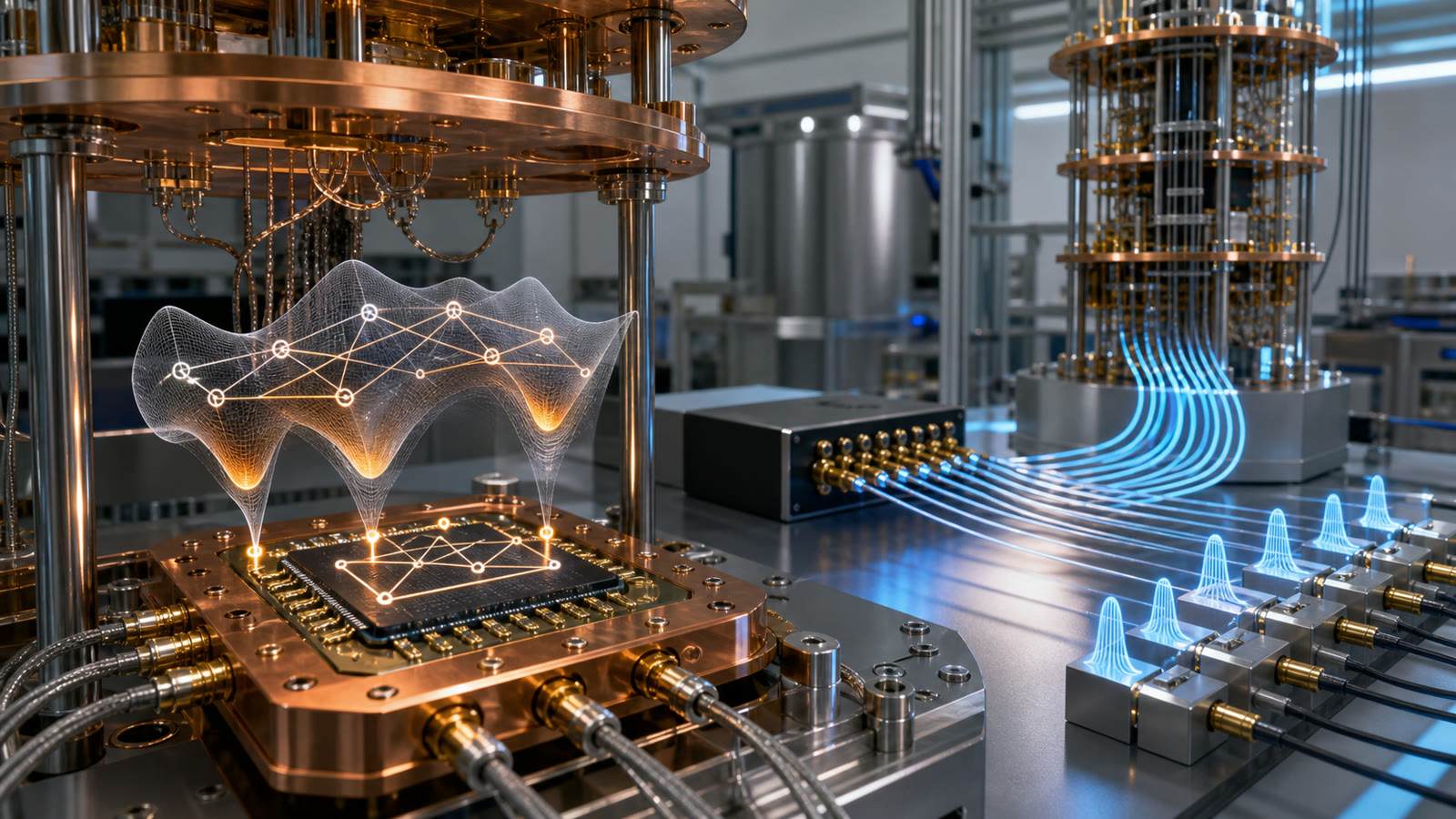
Quantum annealers and gate-model quantum computers are often discussed as though they were competing versions of the same machine. They are not. Both use quantum physics, but they expose very different ways to describe a problem, control hardware, and judge a useful result. That distinction matters whenever a headline compares qubit counts or claims that one architecture has solved an optimization problem faster than another.
A quantum annealer is a specialized system for exploring low-energy configurations of a mathematical model. A gate-model machine applies a programmed sequence of quantum operations, or gates, to qubits before measuring them. One is closer to a configurable physical optimizer; the other is closer to a programmable quantum processor. Neither description automatically makes one superior. It means that comparisons must include the problem formulation, hardware restrictions, classical support work, solution quality, and total elapsed time.
Quantum annealing begins with an energy landscape
Many optimization tasks can be written as a quadratic unconstrained binary optimization problem, usually shortened to QUBO, or as an equivalent Ising model. The variables take binary values, while linear and pairwise terms assign a score to every possible configuration. Lower scores correspond to lower energy. The job is to find the minimum, or at least a sufficiently low-energy answer.
In a superconducting quantum annealer, programmable biases influence individual qubits and couplers define relationships between connected qubits. The system begins under an initial Hamiltonian, a mathematical description of its energy, and gradually shifts toward the problem Hamiltonian. According to D-Wave’s technical introduction to quantum annealing, the measured bit string at the end represents a low-energy state of the submitted problem. Repeating the process produces a collection of candidate solutions rather than a guaranteed perfect answer in every run.
This architecture can also be used for sampling low-energy states, where the goal is not necessarily one optimum. That makes annealing relevant to some probabilistic and physics problems as well as scheduling, routing, allocation, and other combinatorial tasks.
Gate-model computers execute circuits
A gate-model computer takes a different route. A developer expresses an algorithm as a circuit containing single-qubit and multi-qubit operations. A compiler then maps those operations onto the gates and connections supported by a specific processor. Measurement converts the final quantum state into classical results, and many circuit repetitions are normally required to estimate probabilities.
This circuit abstraction can represent a much broader range of algorithms, including quantum simulation, phase estimation, search routines, and error-corrected programs. It also brings familiar engineering constraints. Google’s Cirq documentation shows that circuits must be transformed for a device’s available operations and connectivity. On current hardware, noise and limited circuit depth restrict how much useful computation can be completed before errors dominate.
The long-term gate-model goal is a fault-tolerant computer built from logical qubits. That is why raw physical-qubit comparisons can mislead, as our guide to full quantum resource estimates explains. An annealer with many specialized qubits and a gate-model processor with fewer programmable qubits are not interchangeable capacity figures.
Problem mapping can consume the apparent scale
A real optimization problem rarely matches an annealer’s hardware graph perfectly. If two logical variables must interact but their physical qubits are not directly connected, the mapping process may represent one logical variable with a chain of physical qubits. This is called minor embedding. Longer chains consume hardware, introduce additional parameters, and can break into inconsistent values that require interpretation.
Gate-model processors have a related mapping cost. A compiler may add swap operations to bring nonadjacent qubits together, increasing circuit depth and exposure to noise. The details differ, but both architectures demonstrate the same lesson: the number of hardware qubits does not equal the size of a useful application. Topology, control precision, and mapping overhead determine how much of the machine a problem can actually use.
The fastest quantum step is not the full runtime
Quantum anneals can be extremely short, but quoting only the annealing interval leaves out important work. The system must be programmed, allowed to settle, annealed, read out, and often sampled repeatedly. D-Wave’s operation and timing documentation separates programming time, per-sample anneal time, readout time, delay, and total QPU access time.
An application also pays for classical steps outside the processor: converting business constraints into a QUBO, embedding the model, choosing penalty weights, decoding chains, evaluating candidate answers, and possibly iterating through a hybrid solver. Gate-model workflows similarly include circuit compilation, queueing, repeated shots, error processing, and classical optimization. A fair performance claim must state which of those stages are included.
Optimization results need more than one stopwatch
Optimization is usually about the trade-off between time and answer quality. Two solvers may reach different objective values, or one may find a good answer quickly while another improves for longer. A useful benchmark therefore reports the best-known value, the gap from that reference, the distribution across repeated runs, problem size, and time to reach a defined target.
A peer-reviewed Los Alamos National Laboratory study compared quantum annealing and gate-model approaches on Max-Cut problems by tracking solution quality as a function of time. Its framework is valuable because it treats performance as a profile, not a single winner-takes-all number. The same discipline is central to our earlier discussion of independent quantum benchmarks.
Classical baselines must be strong and problem-specific
A quantum result has little meaning without a capable classical comparison. Generic simulated annealing may be a useful reference, but it is not always the best classical method for a structured scheduling, graph, or constraint problem. Modern mixed-integer solvers, graph algorithms, tensor-network methods, GPU heuristics, and carefully tuned domain-specific techniques can set much tougher baselines.
The comparison must also use equivalent objectives and constraints. A simplified QUBO may be easier to run on quantum hardware but may omit details that a production classical model handles. Data loading and solution validation belong in the accounting. Researchers should publish enough information to reproduce the instances, parameter choices, hardware access assumptions, and stopping rules.
Where quantum annealing fits today
Annealers are useful research platforms for testing optimization formulations, sampling energy landscapes, studying quantum dynamics, and building hybrid workflows. NASA’s Quantum Artificial Intelligence Laboratory investigates optimization and hybrid quantum-classical algorithms for areas such as planning, scheduling, flight-gate assignment, and trajectory deconfliction. NASA also emphasizes physics-inspired classical methods that can work at application scale now.
That is a more realistic picture than either extreme of the public debate. Quantum annealing is not a universal replacement for classical optimization, but it is also not simply a failed version of a gate-model computer. It is a specialized architecture whose value depends on whether a problem maps well to its energy function and connectivity, and whether the complete system improves a meaningful metric.
Important limitations and common misconceptions
An annealer does not automatically find the global optimum. Thermal effects, control errors, small energy gaps, embedding choices, and finite sampling can move results away from the ground state. More physical qubits do not erase those constraints. Likewise, a gate-model machine’s greater programmability does not mean current noisy hardware can run every theoretically known algorithm at a useful scale.
It is also unsafe to assume that an optimization problem is a good quantum candidate merely because it is difficult. Structure matters. Some hard-looking instances yield quickly to specialized classical techniques, while a compact mathematical model may become much larger after hardware mapping. Claims of advantage should survive strong baselines, repeated tests, and independent access to the same workload.
What to watch next
The most informative progress will come from denser and more controllable hardware graphs, lower analog error, better embedding tools, and benchmark reports that publish end-to-end timing and solution distributions. Cross-model studies should compare annealers, gate-model algorithms, and leading classical solvers under the same target-quality rules.
For readers, the practical filter is simple: ask what mathematical problem was submitted, how much mapping was required, which runtime stages were counted, how answer quality was measured, and which classical methods were challenged. Those questions reveal far more than the qubit total. Quantum annealing and gate-model computing can both advance, but they should be judged as distinct tools rather than different-sized versions of one machine.
Leave a Reply