
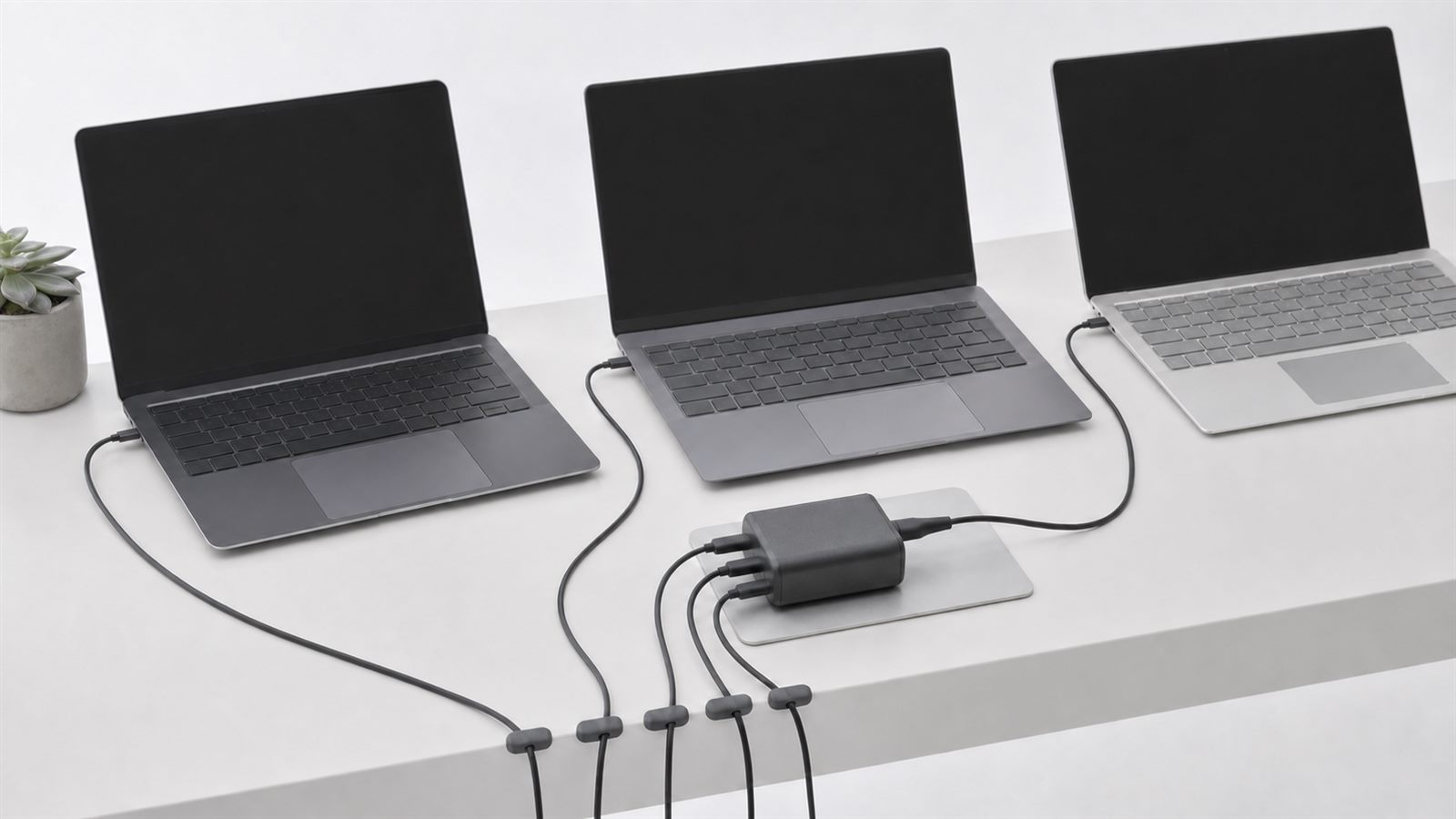
USB-C ports have appeared on laptops for years, but a familiar connector has never guaranteed that any charger, cable, and computer will work together at full speed. Europe鈥檚 common-charger rules are intended to make that experience more predictable. Since April 28, 2026, the requirements also apply to covered laptops first placed on the European Union market.
The change is broader than replacing one socket. It combines a common USB-C receptacle, harmonized fast-charging technology, clearer information about power requirements, and the option to buy a device without another charger. Buyers still need to match wattage and cable capability, and not every USB-C accessory becomes equivalent overnight.
Laptops Joined the Rules in April 2026
The EU Common Charger Directive entered into force in 2022. Its requirements began applying in December 2024 to categories including mobile phones, tablets, digital cameras, headphones, portable speakers, e-readers, keyboards, mice, earbuds, handheld game consoles, and portable navigation devices. Laptops received a longer transition period and joined on April 28, 2026.
The rules apply to covered equipment capable of wired charging when it is first placed on the EU market on or after the relevant date. They do not require consumers to discard existing laptops or chargers, and they do not make older products illegal to keep using. Inventory and market-placement details can be more specific than the date printed on a retail receipt, so businesses handle compliance rather than individual buyers interpreting product law.
The laptop change complements the EU repairability and energy-label rules for smartphones and tablets. Both policies try to make long-lived hardware easier to compare and support, but charging interoperability and repairability remain separate requirements.
USB-C Describes the Connector, Not the Power
USB-C is the small reversible receptacle on the device. It can carry power and data, but the connector shape alone does not reveal how much power a port accepts, whether it supports video, or which data speed it provides. A cable with USB-C plugs at both ends may be designed for basic charging, high-power charging, fast data, video, or only some of those functions.
The common-charger framework therefore also addresses charging technology. For covered devices that need more than basic power, USB Power Delivery provides a standardized negotiation between the charger and the device. They agree on a supported voltage and current before higher power flows. That negotiation lets one charger serve different products without sending laptop-level power into a device that did not request it.
A compliant laptop may still charge slowly from a low-power phone adapter because the charger cannot supply what the computer requests. It may also use more energy during a demanding task than the adapter provides, causing the battery to charge very slowly or continue discharging. The common port improves compatibility; it does not erase differences in device power needs.
Cables Can Be the Hidden Bottleneck
High-power charging requires a cable designed and identified for the required current and voltage. Modern USB Power Delivery specifications can support up to 240 watts under the appropriate Extended Power Range profile, but the laptop, charger, and cable all have to support the negotiated level.
A thin or older cable may safely limit the session below the charger鈥檚 headline rating. That is a feature, not a failure, when the system correctly detects capability. Problems arise when cables are poorly made, inaccurately described, or lack clear markings. Buyers should use reputable cables with an explicit power rating rather than assuming every USB-C cable can replace a laptop lead.
Fast Charging Should Not Depend on One Brand
The European Commission says the rules are designed to prevent manufacturers from unjustifiably restricting charging speed when a compatible charger is used. Covered equipment that supports harmonized fast charging should use the common USB Power Delivery approach so that the basic charging relationship is not locked to a proprietary adapter.
Manufacturers can still optimize battery temperature, charging curves, and power limits for their hardware. A computer may reduce charging speed when the battery is hot, nearly full, or running a heavy workload. Two compliant laptops can therefore behave differently with the same charger for legitimate technical reasons.
The guidance also does not forbid every additional connector. A covered device may include another charging receptacle as long as it also includes the required USB-C solution. The practical test for a buyer is whether the USB-C port can provide the promised everyday charging function without a proprietary accessory.
The Box Does Not Have to Include Another Charger
Consumers must be able to purchase covered equipment without a charging device. This is intended to let people reuse a compatible charger and reduce the number of unused adapters. Packaging information uses a pictogram to indicate whether a charger is included, while a label communicates the minimum and maximum power required for efficient charging and the supported charging protocol.
Unbundling is useful only when the buyer can interpret the information. A person replacing a 65-watt laptop should check whether an existing charger can supply the new computer鈥檚 stated requirement and whether a multi-port adapter divides its total output when several devices are connected.
A 100-watt charger with four ports does not necessarily provide 100 watts to each port simultaneously. Its controller may redistribute power whenever another device is connected, briefly interrupting or reducing laptop charging. That behavior can be normal, but manufacturers should describe the allocation clearly.
One Charger Can Reduce Clutter, Not Eliminate It
The policy goal is fewer unnecessary chargers and less electronic waste. The European Commission estimated that discarded and unused chargers accounted for about 11,000 tonnes of waste annually and that avoiding unnecessary charger purchases could save consumers about 250 million euros per year. Those are policy estimates, not a promise about any individual household.
People may still need more than one adapter. A traveler might use a compact charger, while a workstation uses a higher-power unit with multiple displays and peripherals. Households also replace chargers that fail. The benefit is that these purchases can serve several compatible products rather than being tied to a single model.
As our overview of consumer electronics beyond the smartphone notes, people increasingly own a collection of wearables, spatial devices, computers, and accessories. A common power layer makes that collection easier to maintain even when the products themselves remain very different.
Some Devices Remain Outside the Current Scope
The 2026 European Commission review examined whether to extend the rules to categories such as AR and VR headsets, drones, game controllers, wearables, electric toothbrushes, and remote-controlled toys. It found that technical and safety conditions differ. Wet environments create concerns for toothbrushes, while very small wearables often charge through a pad or case rather than a port on the device.
The report also noted that a USB-C receptacle does not guarantee perfect interoperability if products do not fully implement the specifications. This is why standards compliance, accurate labeling, and enforcement matter alongside the visible port.
Wearables illustrate the design trade-off discussed in our article on wearable technology and health data. A small sealed device may reasonably use a charging puck, while the power input on that puck can still move toward a common connector.
What Buyers Should Check
Read the laptop鈥檚 minimum and maximum charging power, then check the output available from the specific charger port. Match the cable rating as well. If the computer uses a dock, include the power consumed by attached devices and remember that the dock itself may reserve some capacity.
What to Watch Next
Watch enforcement of laptop labeling, real cross-brand charging behavior, and the Commission鈥檚 decisions on additional product categories. External power-supply ecodesign rules scheduled for later years are intended to complement the device-side requirements and push chargers themselves toward greater interoperability.
The most useful outcome will be boring in the best way: a buyer reads a clear power label, connects a properly rated cable, and gets predictable charging without researching a proprietary ecosystem. The shared USB-C shape is only the starting point; transparent power information is what makes the common charger genuinely common.
Leave a Reply