
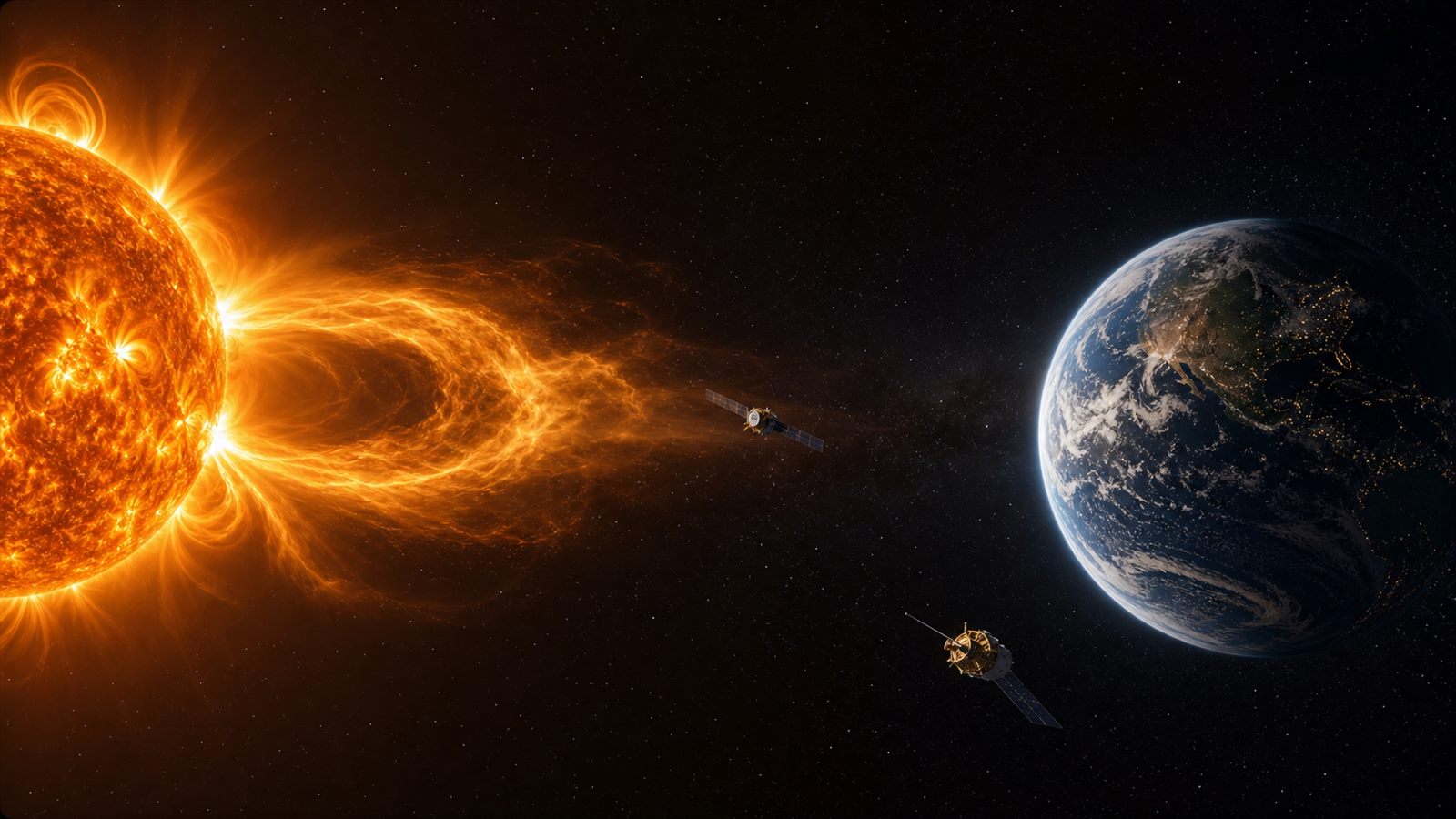
Space weather sounds remote until a solar outburst interferes with a satellite, radio link, navigation signal, or power network. The phrase covers changing conditions between the Sun and Earth, including bursts of radiation, clouds of magnetized plasma, and streams of energetic particles. Modern infrastructure depends heavily on systems that can be affected by those events, so forecasting the space environment is becoming an operational service rather than a specialist scientific exercise.
The goal is not to predict every effect with the certainty of a timetable. It is to combine observations, models, alerts, and operator procedures so that people responsible for spacecraft and critical infrastructure have useful time to respond. That requires measurements from the ground, near Earth, and deep space, plus a clear understanding of what remains uncertain.
Several Different Hazards Share One Name
A solar flare is a burst of electromagnetic radiation. Its X-rays and extreme ultraviolet light travel at the speed of light, so effects on Earth’s sunlit ionosphere can begin only minutes after an eruption is observed. High-frequency radio communication and some navigation services may be degraded before an operator has much time to act.
A coronal mass ejection, or CME, is a large release of plasma and magnetic field from the solar corona. It usually takes much longer to reach Earth, creating a larger warning window. If its magnetic field couples strongly with Earth’s field, it can drive a geomagnetic storm. Solar energetic particles are another hazard, particularly for astronauts, spacecraft electronics, and high-altitude or polar operations.
These are related phenomena, but they do not arrive on the same schedule or produce identical effects. A useful forecast therefore identifies the hazard, expected timing, confidence, and likely affected systems instead of reducing everything to a single dramatic label.
Forecasting Begins With a Network of Observations
Solar telescopes watch active regions and detect eruptions. Coronagraphs block the bright solar disk so analysts can estimate the speed, width, and direction of an outward-moving CME. Ground instruments monitor the ionosphere and Earth’s magnetic field. Spacecraft sample particles and magnetic fields that cannot be measured through the atmosphere.
NASA’s Deep Space Climate Observatory, DSCOVR, orbits around the Sun-Earth L1 region roughly a million miles upstream from Earth. Its real-time solar-wind measurements provide a final warning that disturbed plasma is approaching. That warning is valuable, but it is relatively short. The spacecraft does not tell forecasters everything about a CME days in advance.
The observing network is an infrastructure system of its own. Instruments need continuity, calibration, reliable communications, and backup coverage. A failed sensor during a major event can reduce forecast confidence exactly when users need it most.
The Magnetic Field Is a Hard Forecasting Problem
Forecasters can often estimate whether a CME is directed toward Earth and when it may arrive. The strength of the resulting geomagnetic storm depends heavily on the magnetic field embedded in the cloud, especially its orientation relative to Earth’s field. NOAA explains that this key property generally cannot be measured directly until the CME passes a monitoring spacecraft near Earth.
That creates a practical limit. An operator may receive days of notice that an event is possible, followed by a much more confident assessment only shortly before impact. Forecast products need to communicate that change in certainty. A wide time window is not a failure if the underlying physics and available observations do not support a more precise claim.
An L5 View Could Add Earlier Context
ESA is developing the Vigil mission for the fifth Sun-Earth Lagrange region, or L5, which provides a side view of the Sun-Earth line. From there, Vigil is intended to observe active areas before solar rotation brings them into full view from Earth and to improve measurements of CMEs moving toward our planet.
ESA currently plans a 2031 launch and describes Vigil as an operational mission feeding its Space Weather Service Network. The agency says the geometry could provide up to four or five days of notice for certain effects. That does not mean every storm will become predictable five days ahead; it means forecasters gain another angle and earlier evidence for some events.
Combining L5 observations with measurements from L1, Earth orbit, and the ground is more useful than treating any one spacecraft as a complete answer. Models improve when they can compare the same event from several positions.
Satellites Face More Than Direct Radiation
Energetic particles can upset electronics, damage components over time, and increase radiation exposure. Geomagnetic activity can heat and expand the upper atmosphere, increasing drag on spacecraft in low Earth orbit. Operators may see orbit predictions become less accurate just when crowded orbital regions require careful conjunction screening.
This connects space weather with orbital safety and debris management. A change in atmospheric density affects how quickly objects slow down, while uncertainty in drag affects predicted close approaches. Small spacecraft also have limited power, shielding, and operational staff, making the issue relevant to the growing small-satellite Earth observation sector.
Satellite operators can place systems in safer modes, postpone sensitive operations, adjust attitude, manage battery charging, or change mission schedules. The correct response depends on spacecraft design and the specific warning; shutting down every satellite whenever solar activity rises would create its own risks.
Navigation, Radio, and Aviation Depend on the Ionosphere
Satellite-navigation receivers calculate position from precisely timed radio signals. Those signals pass through the ionosphere, whose electron density changes during solar and geomagnetic activity. The result can be reduced accuracy, loss of signal lock, or greater difficulty for applications that depend on high precision.
High-frequency radio used on some polar aviation routes can also be disrupted. Operators may change routes, altitudes, or communication plans when conditions warrant it. The expanding satellite-to-phone ecosystem adds more users who will indirectly depend on space-weather-aware network planning.
Power Grids Need Actionable Alerts
A geomagnetic storm can induce electric fields in the ground and long conductors. The resulting currents may enter transmission networks through transformer connections. Risk varies with latitude, geology, network topology, equipment, and operating conditions, so a global storm rating is only the beginning of a grid operator’s assessment.
Utilities can use regional measurements and network models to decide whether to adjust flows, increase reserves, postpone maintenance, or monitor vulnerable equipment more closely. The value of a warning comes from linking it to a tested operating procedure. An alert that is scientifically accurate but too vague for a control room has limited practical value.
Forecasts Reduce Risk but Do Not Remove It
Space weather models face incomplete observations and a complex chain from the Sun to a particular device on Earth. Local impacts can differ even during the same event. Forecast performance should therefore be measured by lead time, reliability, false alarms, missed events, and usefulness to each sector.
Engineering remains essential. Radiation-tolerant electronics, redundant communications, robust timing, sensible satellite modes, transformer monitoring, and recovery plans limit damage when forecasts are late or an event behaves unexpectedly. Forecasting and resilient design are complementary layers.
What to Watch Next
Watch the development of ESA Vigil, continuity of L1 solar-wind monitoring, improved CME magnetic-field models, and services tailored to satellite, aviation, navigation, and electricity users. Better forecasting will look less like a spectacular image of the Sun and more like a dependable chain from observation to decision.
For ordinary technology users, the most useful lesson is modest: a navigation or communications disturbance during a solar event does not mean every system is failing, and an aurora alert is not automatically a severe infrastructure warning. Different hazards require different interpretations, which is exactly why professional space weather services matter.
Leave a Reply