
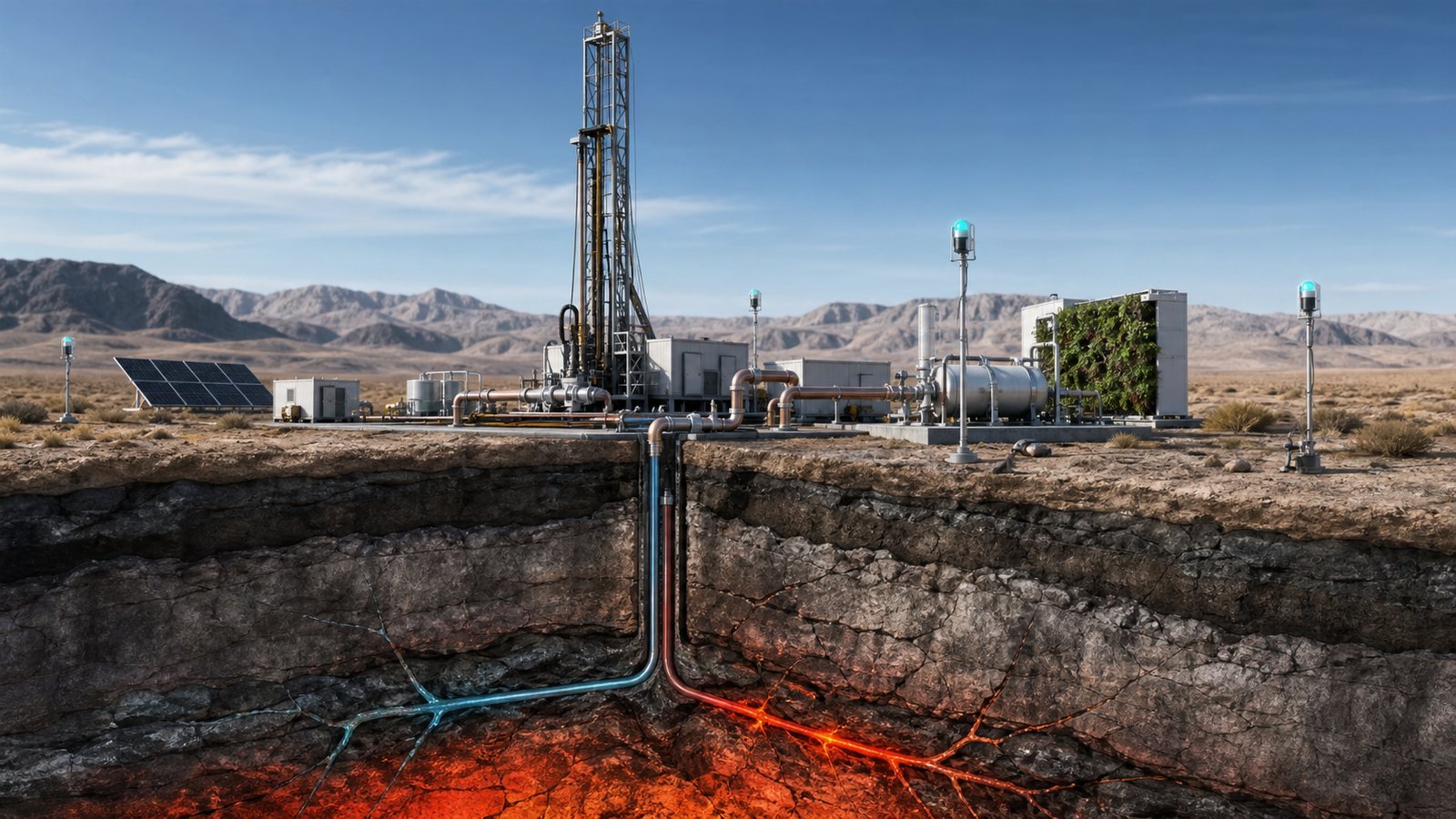
Geothermal energy has a strong appeal: clean heat from the Earth, available day and night, with a smaller land footprint than many other energy sources. The limitation is geography. Traditional geothermal power works best where hot water or steam is naturally accessible. Enhanced geothermal systems, or EGS, aim to expand that map.
EGS does not wait for a perfect natural reservoir. It uses drilling, stimulation, and reservoir engineering to create or improve pathways through hot rock so fluid can circulate, collect heat, and return to the surface. If it can scale safely and economically, geothermal could become a more flexible clean-energy resource.
Why Geothermal Is Attractive
Unlike solar and wind, geothermal power can operate steadily when the resource and plant are available. That makes it useful for firm clean electricity and industrial heat. A grid with more variable generation still needs dependable sources that can run through calm nights and winter peaks.
The US Department of Energy describes enhanced geothermal systems as a way to access heat in places without naturally productive hydrothermal resources. The technology borrows from oil and gas drilling, reservoir modeling, and power-plant engineering while pursuing a low-carbon purpose.
This complements our coverage of long-duration energy storage. Storage can shift electricity across time, while geothermal can supply clean power continuously if the resource is developed well.
That firm-power role is why geothermal keeps returning to policy discussions even when solar, wind, and batteries dominate new project headlines. A system with high renewable penetration needs resources that help through long periods of low wind, low sunlight, or grid stress.
The Main Engineering Challenge Is the Reservoir
An EGS project needs hot rock, a way to circulate fluid, and a reservoir that remains productive. Engineers may inject fluid under pressure to open or connect fractures. The goal is enough permeability for heat exchange without losing control of the system.
That is difficult. If fluid moves too quickly, it may not pick up enough heat. If it flows through too few channels, the reservoir may cool unevenly. If fractures behave unpredictably, performance and safety risks increase.
Reservoir monitoring therefore matters as much as drilling. Operators need seismic sensors, pressure data, flow measurements, temperature models, and careful operating limits. EGS is not just digging a deep hole; it is managing a subsurface heat exchanger.
FORGE Is a Major Test Platform
DOE’s Frontier Observatory for Research in Geothermal Energy, known as Utah FORGE, is a dedicated field laboratory for EGS research. It gives researchers a place to test drilling, stimulation, monitoring, and reservoir-management techniques under real subsurface conditions.
Field test platforms are important because lab results and simulations cannot capture every feature of hot rock, stress fields, water-rock interactions, and long-term circulation. A technology that looks promising on paper must survive drilling cost, reservoir uncertainty, equipment wear, and operational complexity.
This is similar to the interconnection reality we covered in clean-energy grid bottlenecks. The energy transition depends on less glamorous engineering infrastructure as much as headline generation technologies.
Induced Seismicity Must Be Managed
Any technology that injects fluid underground needs careful seismic risk management. EGS can create small earthquakes as fractures respond to pressure changes. Most may be too small to feel, but public trust depends on transparent monitoring, conservative operations, and clear rules for slowing or stopping activity.
Risk depends on geology, faults, injection strategy, pressure, volume, and local vulnerability. It cannot be dismissed with generic assurances. Communities need to know what is being measured, what thresholds trigger action, and who is accountable.
Seismic management does not make EGS impossible. It makes governance and site selection central to deployment. A technically promising resource is not enough if local risk is poorly understood.
Cost Is Still the Scaling Question
Drilling deep wells is expensive. EGS projects must improve drilling speed, well durability, reservoir productivity, and plant performance to compete with other clean-energy options. The economics improve if methods can be repeated across many sites rather than custom-engineered each time.
DOE’s Enhanced Geothermal Shot aims to reduce the cost of EGS substantially. Cost targets are not deployment guarantees, but they clarify the scale of improvement needed.
Geothermal also has system value that simple energy prices may not fully capture. Firm clean power, heat supply, small land footprint, and use of existing drilling expertise can matter, especially in regions with limited transmission or difficult seasonal demand.
Oil and Gas Skills Could Help
EGS can reuse some oil and gas capabilities: drilling, well completion, reservoir characterization, downhole tools, and field operations. That does not mean geothermal is simply oil and gas with a different label. Heat extraction, water management, induced seismicity, and long project lifetimes create different priorities.
Still, transferable expertise could reduce cost and speed learning. Companies that understand subsurface engineering may be able to improve geothermal drilling and monitoring. The strongest projects will adapt those skills to clean-energy requirements rather than copy fossil-fuel workflows blindly.
What to Watch Next
Watch field results from FORGE and commercial pilots, especially flow rates, temperature decline, drilling costs, seismic response, and uptime. Also watch whether projects can move from one successful site to repeatable development across different geology.
Enhanced geothermal systems are not a universal replacement for solar, wind, batteries, or transmission. They are a possible addition to the clean-energy toolkit. If the reservoir engineering matures, geothermal could provide firm clean energy in more places than traditional geothermal maps suggest.
For ordinary energy watchers, the useful question is not whether EGS sounds futuristic. It is whether developers can show repeatable wells, stable reservoirs, transparent seismic management, and costs that keep improving across projects rather than resetting with every site.
Leave a Reply