
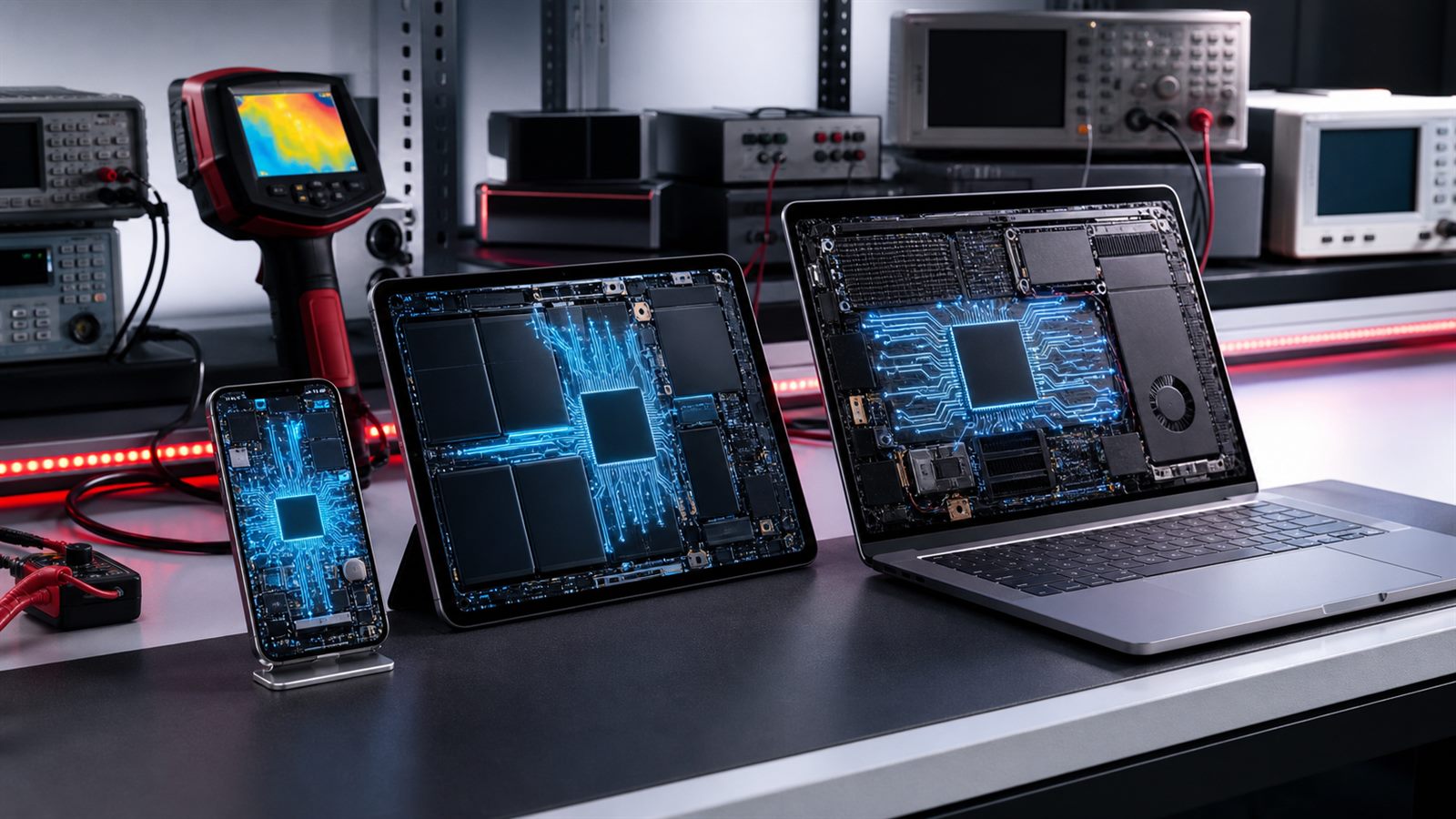
Phone and laptop makers increasingly advertise artificial-intelligence performance with a single large number: trillions of operations per second, usually shortened to TOPS. The figure can describe the peak arithmetic capability of a neural-processing unit, but it cannot tell a buyer whether an AI feature will answer quickly, preserve useful model quality, fit in memory, or keep working after the device warms up.
That gap matters as generative models move from cloud servers onto personal devices. Local inference can reduce network dependence and keep more data on the device, but it also forces a model to share limited memory, power, and cooling with every other application. A credible benchmark must therefore test the complete experience, not just one component’s theoretical ceiling.
TOPS measures only part of the system
TOPS is a rate: how many arithmetic operations a processor may execute under specified conditions. It can help engineers compare hardware blocks when the operation type and numerical precision are the same. Marketing comparisons often omit those conditions. An accelerator may quote a higher figure by using lower-precision arithmetic, while another may run a particular model more efficiently through better software, memory access, or operator support.
Generative AI is a pipeline. The device must load model weights, process the prompt, move data through memory, schedule work across the CPU, GPU, and neural accelerator, and produce tokens. The slowest stage can dominate. Peak compute that waits for memory or falls back to a less efficient processor will not deliver its headline rate to the user.
Time to first token and generation speed answer different questions
A useful language-model test separates responsiveness from throughput. Time to first token measures how long the user waits before an answer begins. Token generation speed measures how quickly the rest arrives. A device can perform well on one and poorly on the other, particularly when model loading, prompt length, or caching changes.
Benchmarks should publish prompt length, output length, model version, quantization, and runtime configuration. Otherwise, a short warm-cache demonstration can be compared with a longer cold-start task as if they were equivalent. The same discipline applies to multimodal features, where image preprocessing or audio capture may add delays outside the neural accelerator.
Accuracy belongs beside speed
A faster answer is not better when model compression removes too much capability. Quantization can reduce model size and energy use by representing weights with fewer bits, but the acceptable trade-off depends on the task and model. Apple, for example, documents optimization techniques that balance model quality, size, and speed rather than treating performance as a single number.
MLCommons added generative-AI tests to MLPerf Mobile v6.0 in 2026, pairing performance measurements with TinyMMLU and IFEval evaluations. That is an important direction: measure whether a model remains useful while measuring how quickly it runs. It also echoes the broader need for real-world AI evaluation beyond polished demos.
Memory can be the hard limit
Model weights are only part of the memory requirement. Inference also needs working buffers and a key-value cache that grows with the conversation context. The operating system, graphics stack, and open applications compete for the same physical memory on many consumer devices. A model that fits during a controlled benchmark may trigger app closures or fail under ordinary multitasking.
Good reports should list peak memory use, model storage size, supported context length, and whether memory pressure changes performance. They should also distinguish a model permanently bundled with an app from one downloaded later. Storage consumption and update size are real costs even when inference is local.
Heat and battery reveal sustained performance
Short benchmark bursts favor peak clocks. Real tasks such as summarizing a long recording, generating many images, or maintaining a voice assistant can run for minutes. As temperature rises, a thin device may reduce power to protect the battery and components. Performance after ten minutes can therefore matter more than the first result.
A fair test should report device temperature, ambient conditions, power draw, battery energy per completed task, and performance over repeated runs. Apple’s own profiling guidance emphasizes tracing the entire model pipeline and comparing work across the CPU, GPU, and Neural Engine. Those measurements are more informative than assuming every operation lands on the advertised accelerator.
Local processing offers benefits, but privacy is not automatic
Running a model entirely on a device can remove the need to send prompts or media to a remote server. It can also support features when connectivity is slow or unavailable. Apple’s Core ML documentation explicitly links strict on-device execution with network independence, responsiveness, and keeping personal data local.
However, an app may still transmit analytics, sync conversation history, call cloud tools, or fall back to a server for difficult prompts. A benchmark can verify offline operation by disabling the network, but a privacy claim also requires a clear data-flow policy. Local inference describes where computation occurs; it does not describe every destination for the user’s data.
Model and software updates complicate comparisons
Two devices with identical chips may perform differently after runtime, operating-system, or model updates. A vendor can improve operator fusion or memory allocation without changing hardware. It can also replace a model with a smaller one that runs faster but behaves differently. Reproducible results need exact software builds and model identifiers.
This is one reason benchmark governance matters. A shared test suite allows results to be compared under disclosed rules, while independent task-level testing can expose features the suite does not cover. The problem resembles the interoperability challenge discussed in AI agent protocols: a common interface helps comparison, but it does not create trust on its own.
A practical scorecard for buyers
Consumers do not need to become chip architects. They need results tied to the feature they intend to use. For an offline assistant, look for time to first token, sustained generation speed, supported languages, accuracy, and whether the task really works in airplane mode. For image tools, look for generation time, output quality, resolution, energy use, and repeated-run performance. For transcription, check real-time factor, speaker conditions, and error rate.
Reviewers should also state the device memory configuration and battery condition. Synthetic training data and compact models can be valuable, but quality must be monitored; the risks of poorly controlled data loops are explained in our guide to synthetic data and model collapse.
Limitations
No benchmark represents every prompt, language, accessibility need, or application. Standard models may not match the proprietary model shipped with a phone. Energy readings can vary with screen brightness, radios, and background services. Quality evaluations also simplify human preferences and may not fully capture hallucinations or safety failures.
The answer is not one universal score. It is a transparent group of measurements run under repeatable conditions, with quality and efficiency reported together.
What to watch next
Watch for mobile benchmark suites to add longer contexts, multimodal workloads, energy per task, cold-start measurements, and sustained thermal runs. Vendors should disclose model identity and precision alongside hardware figures. Independent reviewers can then test the feature as shipped, not merely the processor in isolation.
Peak TOPS will remain a useful engineering specification. It should be the beginning of an on-device AI comparison, not the conclusion.
Sources: MLCommons: MLPerf Mobile v6.0; MLCommons Mobile Working Group; Apple Core ML documentation; Apple: Analyzing model runtime performance.
Leave a Reply