
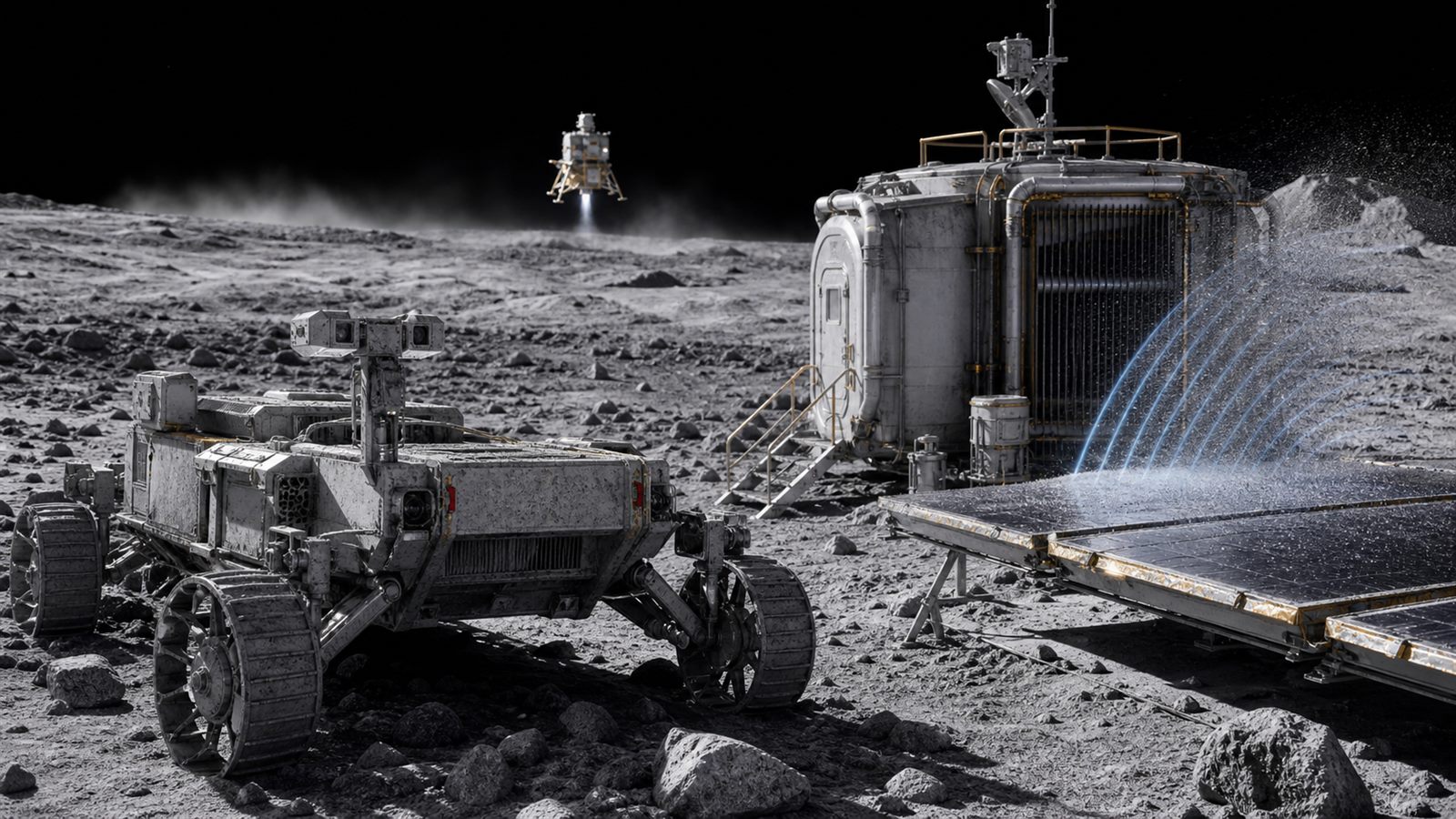
Lunar dust looks like a housekeeping problem until it reaches a seal, bearing, radiator, camera, spacesuit joint, or human lung. The Moon’s surface material, called regolith, is created by repeated impacts rather than Earth-like weathering. Its finest particles can be sharp, abrasive, electrically charged, and easy to loft in low gravity.
Short Apollo visits exposed the problem. Longer surface missions will multiply the number of landings, drives, equipment cycles, airlock entries, and maintenance tasks that move dust around. The practical response is not one miracle coating or cleaning tool. Dust has to be treated as a system requirement connecting vehicles, habitats, spacesuits, landing zones, power systems, operations, and health monitoring.
Lunar regolith is not ordinary household dust
Wind and water gradually round many particles on Earth. The Moon has neither process, so impact-fractured grains can remain angular. Regolith also contains material produced or altered by intense impacts. Fine grains can work into small gaps, scratch surfaces, and increase friction when two components move against each other.
Sunlight and the solar environment can charge exposed surface material. Charged grains may cling to equipment and fabrics instead of falling away. Particle behavior also varies with size, composition, location, illumination, and how it was disturbed. A test using one terrestrial simulant cannot reproduce every lunar condition.
Apollo showed how quickly contamination spreads
Astronaut activity carried dust onto suits and into the lunar modules. NASA’s reviews describe clogged mechanisms, affected instruments, radiator problems, worn suit materials, and eye, nose, or throat irritation. These observations came from brief missions with limited surface infrastructure.
A crew returning repeatedly to a habitat could create a contamination loop: dust adheres outside, enters through an airlock or suit interface, becomes airborne inside, settles in equipment, and is disturbed again during cleaning. Robotic missions avoid cabin exposure but still face abrasive joints, obscured optics, contaminated connectors, and reduced thermal performance.
Mechanisms and seals face repeated abrasion
Rover wheel assemblies, hinges, latches, sample containers, cable connectors, docking interfaces, and suit joints all rely on controlled clearances. A hard grain trapped between moving surfaces can score a seal or increase torque. Repetition matters: hardware that operates once in a test may behave differently after hundreds of dusty cycles.
Designers can reduce exposed gaps, add barriers, use dust-tolerant geometries, select wear-resistant materials, and provide inspection access. Yet protection should not make maintenance impossible. A failed dust barrier that cannot be reached may merely move the failure deeper into the machine.
Thermal control and power surfaces can lose performance
Space hardware must reject heat through radiators because there is no air for convection. Dust on a radiator can change how it absorbs and emits energy. Accumulation on solar arrays can reduce incoming light, while contamination on optical sensors can degrade navigation or science data.
These effects connect cleanliness to energy budgeting. A dusty array may require more area or cleaning time. A less effective radiator can force electronics to operate at lower power. Engineers therefore need performance limits that specify how much contamination a system can tolerate, not just a visual definition of clean.
Landing plumes create a different dust hazard
Routine movement lofts fine material locally, but a rocket plume can accelerate dust, gravel, and larger particles across the surface. That ejecta can sandblast nearby hardware, strike sensors, coat solar equipment, and disturb scientifically important terrain. Larger landers can change the scale of the hazard.
Mitigation may include landing-zone separation, prepared surfaces, barriers, plume-aware vehicle design, and sensors that measure actual ejecta. The issue also affects site planning: the most convenient place to land may not be the safest place for an established habitat or power station.
Spacesuits are both protection and a transport path
A spacesuit must remain mobile while resisting abrasion and keeping dust away from pressure seals, bearings, life-support connections, and the crew. Stiffness or wear in a joint can increase physical workload. Dust embedded in outer fabrics may also be difficult to remove before entering a vehicle.
Possible controls include resistant textiles, external cleaning, carefully designed airlocks, replaceable covers, and interfaces that keep much of the suit outside the cabin. Each choice creates tradeoffs in mass, mobility, repair, and emergency access. Dust performance has to be tested alongside pressure, temperature, radiation, and mobility requirements.
Cabin filtration needs monitoring as well as filters
Once particles enter a pressurized volume, ventilation can move them through the cabin. Filters must capture relevant particle sizes without consuming excessive power or creating too much pressure drop. Crews also need ways to clean surfaces without simply returning particles to the air.
NASA identifies compact filtration, particle separation, and monitoring instruments as development needs. A sensor that distinguishes lunar material from ordinary cabin debris would help operators understand exposure and decide when maintenance is required. Health effects from longer or repeated lunar exposure remain uncertain, making measurement especially important.
Active dust shields can move particles without brushes
An electrodynamic dust shield uses patterned electrodes to create a changing electric field across a surface. The field can move charged particles away from protected areas such as solar panels, windows, radiators, seals, or instruments. NASA reports tests in low Earth orbit and on the lunar surface.
The technology is promising, but integration determines usefulness. Electrodes need power, control electronics, durable insulation, and a geometry suited to the protected component. A system must also show where displaced dust goes and whether performance persists after radiation, thermal cycling, abrasion, and partial damage.
Passive and operational controls still matter
Low-adhesion surfaces, protective covers, brushes, gas cleaning, surface stabilization, designated dirty zones, and inspection procedures can complement active methods. No technique works equally well for fabrics, optics, seals, radiators, and large solar arrays. Layered controls are more credible than a universal treatment.
Operations can prevent contamination before cleaning becomes necessary. Route planning can keep rovers away from sensitive equipment. Crews can sequence tasks from cleaner to dirtier zones. Landing schedules can protect nearby assets. These decisions belong beside the communications and navigation services needed on the Moon because both shape safe surface operations.
Interfaces need shared contamination requirements
A habitat, rover, suit, charger, logistics container, and science instrument may come from different suppliers. If each defines dust tolerance differently, contamination can cross a supposedly protected interface. Shared test methods should specify particle distributions, charging conditions, exposure cycles, cleaning procedures, and acceptable performance loss.
This resembles the challenge facing standard interfaces for satellite servicing: mechanical compatibility is only the beginning. Surface partners need common expectations for cleanliness, inspection, connectors, maintenance, and fault reporting.
Earth tests need lunar evidence
Vacuum chambers, thermal cycling, electrostatic testing, abrasive simulants, and plume experiments can expose failure modes before launch. However, terrestrial gravity, atmosphere, humidity, and simulant chemistry influence results. Hardware should be tested as an assembled system, not only as isolated material coupons.
Small lunar payloads can measure particle motion, charging, adhesion, filter behavior, and cleaning performance under real conditions. Those measurements should feed models and qualification standards. As with orbital-debris mitigation, evidence is most useful when it changes design requirements before deployment.
Limitations
Apollo data remains valuable, but it represents particular sites, equipment, activities, and short exposure periods. Future polar missions may encounter different illumination, temperature, terrain, and operational rhythms. Long-term human health effects are not fully established, and published technology-readiness levels do not guarantee performance on every surface or material.
Dust control also carries costs in power, mass, time, spare parts, and complexity. An aggressive cleaning system can damage a delicate surface, while excessive sealing can trap heat or complicate repairs. The best architecture will allocate different controls to different hazards.
What to watch next
Watch for lunar measurements from dust sensors and electrodynamic shields, repeat-cycle testing of suit and rover joints, better cabin particle monitoring, plume-ejecta data from landers, and shared contamination standards across commercial systems. Reports should describe remaining performance after exposure, not only whether a cleaning demonstration looked successful.
Sustained Moon operations will depend on many technologies that rarely appear in mission artwork. Keeping sharp, charged grains out of the wrong places is one of them, and it may determine how often equipment can be reused and crews can work safely.
Sources: NASA Science overview of lunar regolith hazards; NASA Space Logistics Technology Catalog: Dust Mitigation; NASA, Dust: An Out-of-This World Problem; NASA on lunar landing ejecta and dust measurement.
Leave a Reply