
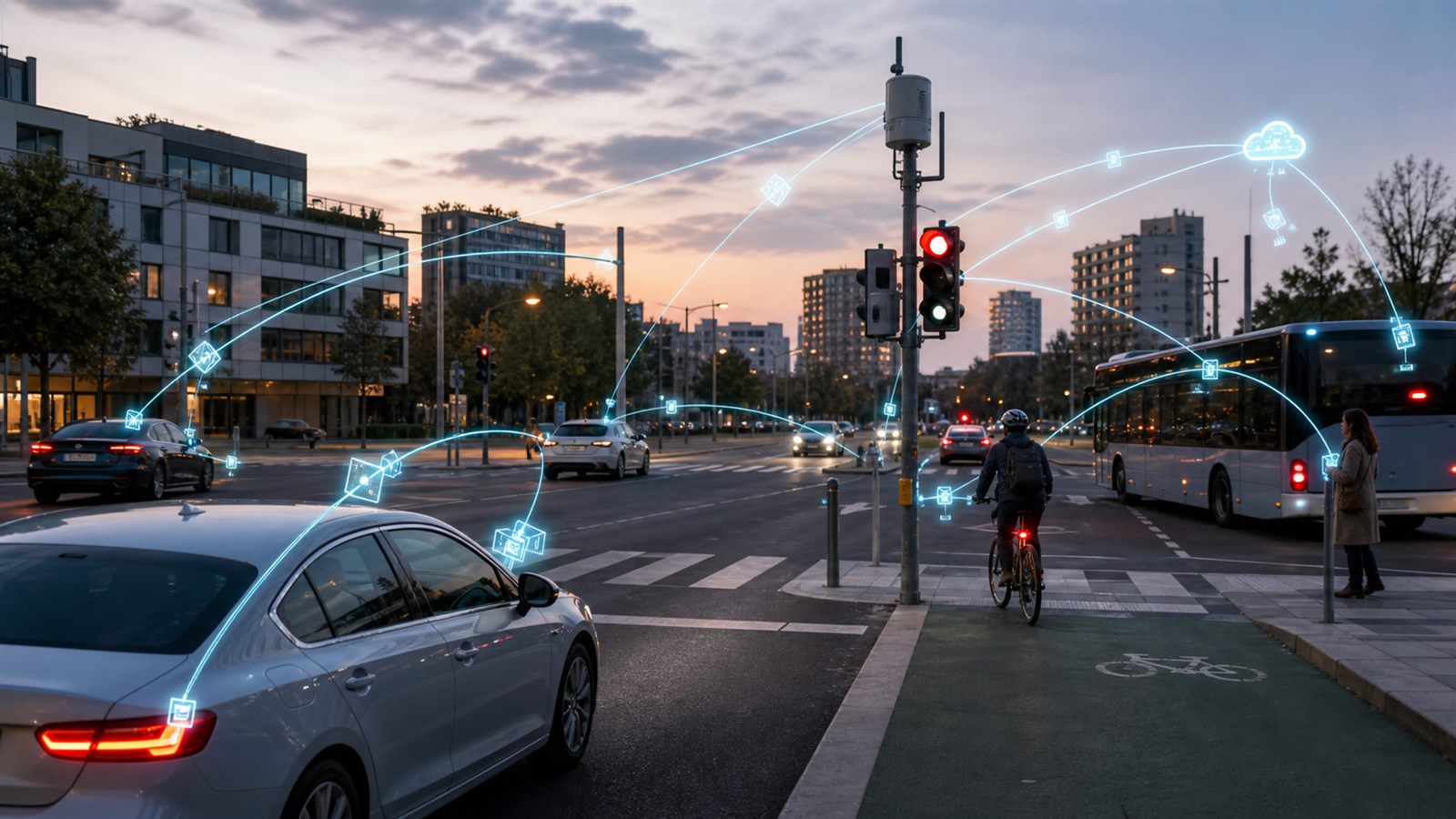
A connected car can detect hazards beyond the reach of its cameras and radar if nearby vehicles and road infrastructure share timely information. That idea is vehicle-to-everything communication, or V2X. It includes direct messages between vehicles, roadside units, traffic signals, and vulnerable road users, plus network connections to broader services.
The radio link is only one layer. A useful safety system also needs common message meanings, accurate position and time, trusted credentials, privacy protections, misbehavior handling, roadside maintenance, and a deployment large enough for participants to hear one another. V2X is therefore a shared trust network, not simply another wireless feature in a car.
V2X covers several communication paths
Vehicle-to-vehicle messages can warn about sudden braking, loss of traction, or an approaching vehicle hidden at an intersection. Vehicle-to-infrastructure communication can exchange signal timing, work-zone status, or roadway conditions. Vehicle-to-pedestrian communication aims to improve awareness of cyclists and people carrying compatible devices.
Cellular V2X, or C-V2X, can communicate directly in designated spectrum without sending every safety message through a mobile network. It can also use conventional network connections for services that tolerate a different path and delay. The distinction matters because a local collision warning should not depend on a distant cloud service being reachable.
Cooperative awareness fills gaps in onboard sensing
Cameras, radar, lidar, and ultrasonic sensors observe a vehicle’s immediate environment. Buildings, trucks, curves, weather, and distance can block or weaken that view. A message from another road user or roadside sensor can provide information from beyond the physical line of sight.
V2X does not make onboard perception unnecessary. A receiver still needs to compare a message with its own sensors, maps, motion, and confidence estimates. The most robust design treats connectivity as another evidence source rather than an instruction that must always be obeyed.
Shared message semantics are as important as radio compatibility
Two devices can exchange bits and still misunderstand each other. They must agree on data fields, coordinate systems, timestamps, units, event definitions, confidence, and how frequently information is sent. A roadworks warning also needs a consistent geographic scope and expiration rule.
ETSI’s Cooperative ITS work covers services such as cooperative awareness, decentralized environmental notifications, cooperative perception, and maneuver coordination. Conformance testing matters because implementations from different vehicle makers and road authorities must behave consistently across borders and software versions.
Spectrum rules shape the US deployment path
The US Federal Communications Commission retained the upper 30 megahertz of the 5.9 GHz band for intelligent transportation systems using C-V2X, while allocating the lower 45 megahertz to unlicensed uses. Its final technical rules address channel use, power, emissions, roadside units, and the transition away from the older DSRC approach.
That history explains why deployment has taken longer than installing radios. Vehicles remain in service for many years, road infrastructure changes through public procurement cycles, and devices must avoid harmful interference. A stable regulatory and standards baseline gives manufacturers and transport agencies a clearer target.
A safety message needs an authenticated source
A receiver should not act on an unverified claim that a traffic light is red or a vehicle is stopped ahead. The US Intelligent Transportation Systems Joint Program Office describes a Security Credential Management System, or SCMS, as the infrastructure that issues and manages certificates for V2X participants.
Devices digitally sign messages, and receivers verify those signatures. This can show that a message came from a recognized participant and was not altered in transit. It does not prove that every data value is accurate. A valid device can be faulty, compromised, poorly calibrated, or confused about its position.
Privacy requires rotating credentials and restrained data
Road-safety messages may include location, direction, speed, and time. Broadcasting a permanent identifier with those fields would create an obvious tracking risk. V2X trust systems use privacy-preserving credential designs so receivers can validate messages without receiving a driver’s name or a permanent public identity.
Certificate changes alone do not eliminate every correlation path. Motion patterns, radio characteristics, application logs, and network services can still expose information. Deployments need data minimization, limited retention, access controls, and clear rules for when investigation can link activity to an accountable device.
Misbehavior detection is harder than signature checking
A false message with an invalid signature is easy to reject. A properly signed but physically impossible message requires more reasoning. Systems can compare reports from multiple participants, check motion constraints, identify repeated contradictions, and submit evidence for review.
Revocation must be careful. Removing a genuinely malicious device protects the network, but mistakenly excluding a valid vehicle can reduce safety. Attackers may also try to frame other participants. Technical detection, policy, appeals, audit records, and cross-operator coordination all belong in the trust architecture.
Roadside infrastructure turns pilots into public systems
Roadside units need power, backhaul, secure configuration, software updates, certificates, accurate maps, and links to traffic controllers. They must survive weather and remain synchronized. A radio installed at an intersection is not useful if its signal-phase data is stale or its certificate has expired.
This operational burden resembles the lesson from EV charging reliability: uptime for one component does not prove that a user completes the intended task. V2X performance should be measured as successful, timely, trustworthy message delivery across the full path.
Vulnerable road users are the hardest participants to include
A car can carry a powered, calibrated radio and antenna. A pedestrian may have a phone in a bag, an old device, a disabled radio, or no device at all. Cyclists and road workers have different movement patterns, and a phone’s position estimate may not reliably identify which side of a barrier a person occupies.
Warnings must avoid overwhelming drivers with uncertain alerts. Infrastructure sensing and vehicle sensors will remain necessary for people who are not broadcasting. V2X should improve inclusion without making safety conditional on owning compatible personal electronics.
Network effects make deployment sequencing difficult
A V2X-equipped vehicle gains more cooperative information as compatible vehicles and intersections appear. Early deployments therefore need corridors and use cases that provide value before universal coverage. Work zones, school areas, emergency response routes, freight corridors, and signalized intersections can offer concentrated opportunities.
The US Department of Transportation’s national plan sets staged deployment and interoperability goals rather than assuming an instant nationwide switch. Europe uses cross-site testing and common security policies to support travel across jurisdictions. Both approaches recognize that a vehicle cannot stop being interoperable at a state or national border.
V2X complements automation but does not certify it
Connected warnings can support human drivers, advanced driver-assistance systems, and automated vehicles. They do not establish that an automated-driving system is safe in every condition. A vehicle must handle missing, delayed, contradictory, or malicious messages and continue operating within its defined limits.
That resilience should be examined in automated-driving testbeds. The vehicle’s software lifecycle also matters: as with over-the-air vehicle updates, a change that improves one function can alter compatibility or safety behavior elsewhere.
Limitations
V2X benefits depend on penetration, message quality, radio conditions, infrastructure coverage, and application design. Published demonstrations may use favorable routes and carefully maintained equipment. A warning delivered in a pilot does not automatically establish a population-level crash reduction.
Regional technologies and policies also differ. C-V2X, European C-ITS profiles, spectrum allocations, certificate systems, and deployment schedules should not be treated as one global configuration. Cross-border interoperability requires testing of actual products and operations, not merely references to the same family of standards.
What to watch next
Watch for multivendor interoperability events, operational SCMS providers that can trust one another, real maintenance data from roadside networks, privacy audits, reliable certificate renewal, and safety evaluations based on completed warnings rather than radio range alone. The newest ETSI Release 2 work and US 5.9 GHz deployments should show how standards move into sustained service.
The connected road will succeed when a vehicle can receive a useful message from an unfamiliar participant, verify it quickly, interpret it consistently, protect privacy, and remain safe when the message is absent or wrong. That is a trust and operations challenge as much as a wireless one.
Sources: US Department of Transportation National V2X Deployment Plan; FCC 24-123, final C-V2X rules for the 5.9 GHz band; USDOT ITS Joint Program Office on interoperable connectivity and SCMS; ETSI Technical Committee on Intelligent Transport Systems; European Commission on cooperative, connected and automated mobility.
Leave a Reply