
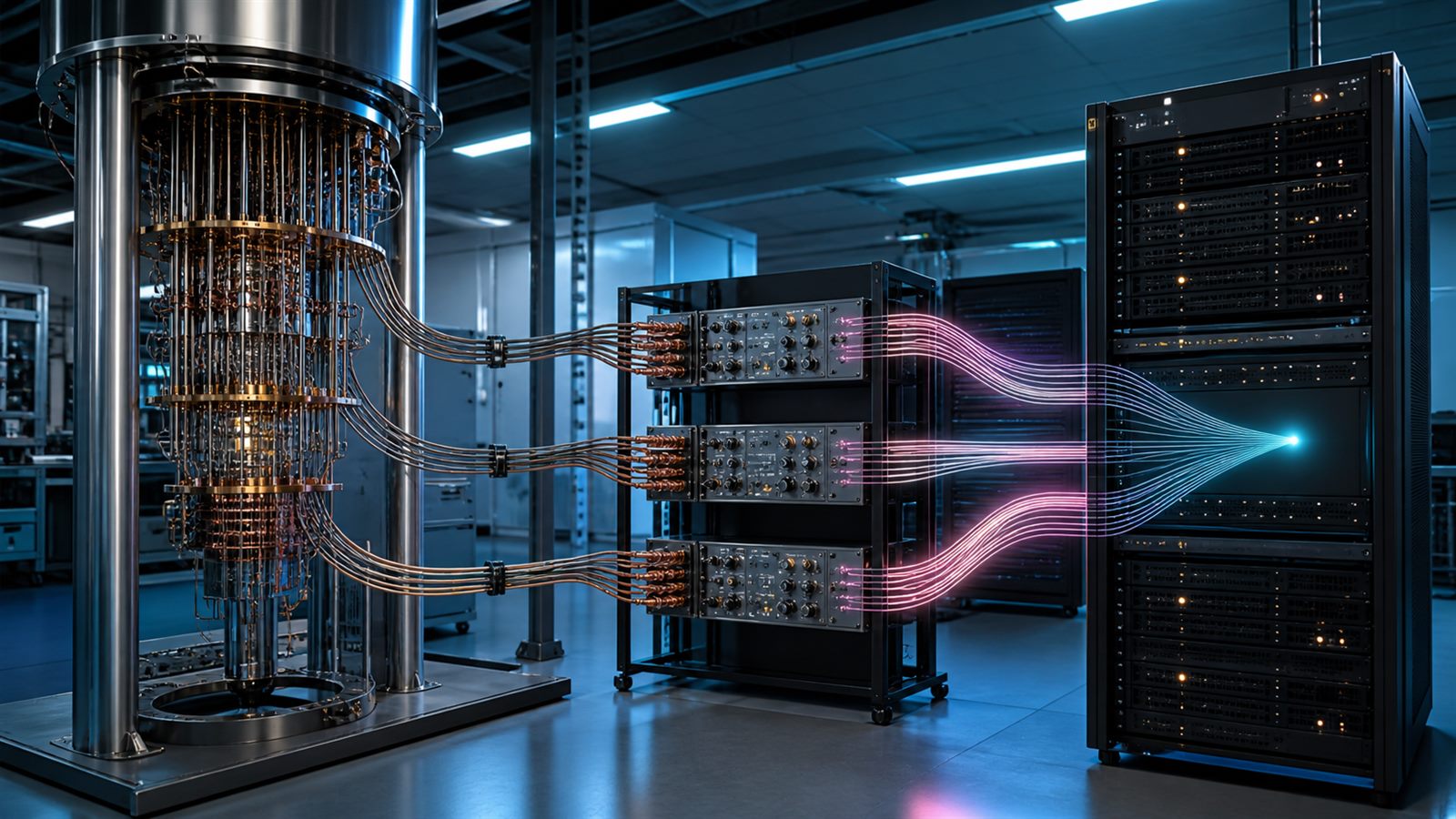
Quantum processors are noisy: gates are imperfect, qubits lose coherence, measurements make mistakes, and calibration drifts. Full quantum error correction aims to protect logical information by detecting and correcting faults during a calculation. Quantum error mitigation takes a different route. It runs noisy circuits, often many times and in several modified forms, then uses classical analysis to estimate what a less noisy result would have been.
That can improve selected measurements on today’s hardware without encoding every logical qubit across a large error-correcting system. It does not repair the quantum state inside the processor, extend a circuit indefinitely, or guarantee a correct answer. Understanding that boundary is essential when a demonstration claims useful computation before fault tolerance.
Mitigation improves an estimate after the experiment
A quantum algorithm usually ends with repeated measurements. Each run produces a bit string, while many runs provide statistics. Researchers often want an expectation value: the average value of a measurable quantity such as energy, magnetization, or another observable. Error mitigation changes how those statistics are collected or interpreted.
The distinction from correction is physical. Error correction encodes information across multiple qubits, repeatedly measures error syndromes, and applies or tracks corrections while preserving the logical state. Mitigation normally leaves the noisy physical computation in place. It estimates a cleaner output from additional executions, noise knowledge, symmetries, or classically tractable reference circuits.
The broad Review of Modern Physics survey of quantum error mitigation describes a family of methods rather than one universal filter. Each method has assumptions about the noise, target quantity, circuit, and classical resources. Those assumptions determine whether an improved number is credible.
Readout mitigation addresses measurement mistakes
A processor may prepare the right final state but report some zeros as ones or ones as zeros. A calibration experiment can estimate a response matrix for the measurement system. Software then uses that model to infer a distribution closer to the one that existed before readout error.
This is useful, but the calibration matrix grows with the system if correlations between qubits matter. A simplified model may treat readout errors as independent when they are not. The device can also drift between calibration and the real experiment. Readout mitigation corrects only the final measurement channel; it does not undo errors accumulated during the circuit.
Symmetry checks can reject impossible outcomes
Some problems have known constraints. A physical model may conserve particle number, parity, or another symmetry. If a measured outcome violates that rule, the experiment can discard it or use the violation rate as evidence of noise. This technique can improve results without a complete hardware noise model.
Postselection has a cost because rejected shots carry no final estimate. It can also hide problems if the analysis reports only retained data without showing the acceptance rate. Symmetry verification catches errors that leave the allowed subspace, but errors within that subspace can remain invisible.
Zero-noise extrapolation deliberately makes noise stronger
Zero-noise extrapolation, or ZNE, runs related versions of a circuit at several effective noise strengths. If researchers can amplify noise in a controlled way without changing the ideal computation, they can fit the measured values and extrapolate back toward a hypothetical zero-noise point.
IBM’s technical tutorial demonstrates this workflow using probabilistic error amplification. Other approaches can stretch control pulses or fold extra gate pairs into a circuit. The method does not create a truly noiseless run; it estimates an intercept from noisy points.
The quality of that estimate depends on the chosen noise factors, fitting model, number of shots, and whether amplification preserves the relevant noise structure. Extrapolation can magnify statistical fluctuations. If the device drifts or different error mechanisms scale differently, a smooth fit may look convincing while remaining biased.
Probabilistic cancellation trades noise for sampling cost
Probabilistic error cancellation characterizes noisy operations and represents an ideal operation as a weighted combination of operations the hardware can perform. The processor samples from those implementable circuits, and classical post-processing combines their results with positive and negative weights.
Under an accurate noise model, the resulting expectation-value estimator can be unbiased. The difficulty is variance. Cancellation weights can make the estimator noisy, requiring many more circuit executions to reach a useful confidence interval. As circuits grow deeper or noisier, that sampling overhead can become prohibitive.
A 2023 Nature Physics experiment on scalable mitigation reported competitive expectation values on larger noisy circuits and analyzed the associated overhead. It is evidence that mitigation can work in carefully characterized regimes, not proof that any large circuit can be cleaned cheaply.
More circuit executions are the hidden resource
Error correction is famous for needing many physical qubits per logical qubit. Mitigation avoids much of that spatial overhead but consumes other resources: circuit shots, calibration experiments, device access time, classical processing, and uncertainty analysis. A mitigated result should therefore include the total number of executions and not only the final error bar.
Noise can erase information that post-processing cannot recover efficiently. A 2024 Nature Physics analysis of mitigation limits showed strong worst-case sampling barriers for broad classes of methods. The result does not say every practical circuit is hopeless. It says there is no general promise that mitigation will scale efficiently as systems and circuit depth increase.
This is why a full quantum resource estimate should identify shots, calibration, classical reconstruction, and validation alongside qubits and gates. A short circuit with a favorable observable may be practical even when a deeper general computation is not.
Evidence of utility still needs a trusted reference
In 2023, researchers reported evidence for utility before fault tolerance using a noisy 127-qubit processor and error mitigation. They checked the method with exactly verifiable circuit instances and compared results with leading classical approximations. The study helped define a serious experimental path, while also illustrating how much validation is required.
A quantum result is not established simply because one classical method struggles. Researchers need multiple classical baselines, instances with known answers, withheld tests, uncertainty intervals, sensitivity to analysis choices, and enough information for independent reproduction. Classical algorithms also improve, so a claimed boundary can move after publication.
Our guide to independent quantum benchmarks explains why vendor-controlled tests are insufficient. Error mitigation adds another layer that evaluators must audit: the raw noisy data, noise model, discarded shots, amplification schedule, estimator, and total computational cost.
Mitigation and correction can work together
The choice is not permanently either mitigation or correction. Error suppression can improve hardware and control before a circuit runs. Small error-detecting or error-correcting codes can protect part of a computation. Mitigation can then reduce residual bias in logical measurements. The most useful stack may combine all three at different layers.
Only error correction offers a path to arbitrarily long reliable computation when physical error rates, code behavior, decoding, and system operation satisfy the required conditions. Our article on quantum error correction as an engineering benchmark focuses on that scaling test. Mitigation is valuable precisely because the field has not yet completed it.
What readers should demand from a mitigated result
A credible report should identify the observable being estimated, baseline hardware error, mitigation method, assumptions, calibration timing, number of raw and retained shots, uncertainty interval, and unmitigated result. It should show performance across more than a single favorable instance and explain how answers were verified.
Readers should be cautious when a paper reports improvement without total execution cost, uses the same circuits to tune and validate the estimator, omits failed instances, or compares against a weak classical baseline. A smaller error bar does not rule out systematic bias from an inaccurate noise model.
What to watch next
Progress will come from lower-noise hardware, faster execution, better drift tracking, compact noise models, transparent uncertainty accounting, and benchmarks that compare mitigation methods under the same conditions. Logical-qubit experiments will also test whether mitigation remains useful after partial error correction.
Quantum error mitigation is best understood as scientific inference under difficult noise, not a software repair button. It can extract a better estimate from a limited experiment, sometimes impressively. The result earns trust only when the extra sampling, assumptions, verification, and remaining uncertainty are visible.
Leave a Reply