
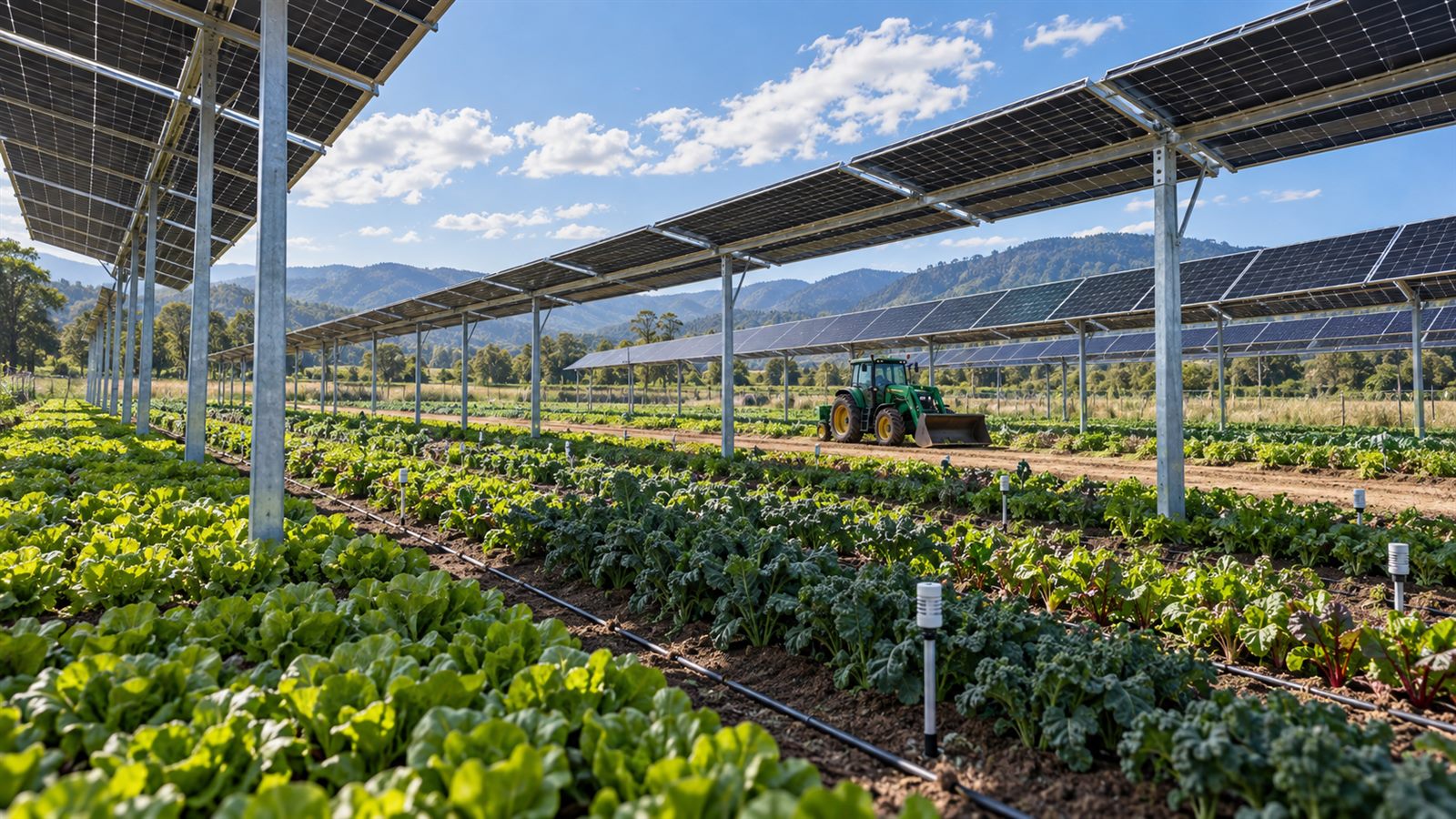
A conventional solar farm is designed to turn available sunlight into electricity. An agrivoltaic farm has a second job: leave enough light, space, and access for agriculture to remain productive. The same panels that generate power change the field beneath them, altering shade, moisture, and the routes available to machinery. Success therefore depends on designing an agricultural system and an energy system together.
That makes agrivoltaics an interesting clean-energy technology, but not a universal solution to competition for land. It can make some sites more useful, while a poorly matched crop and panel layout can undermine the farming activity it was meant to preserve. The question is not whether plants can grow beneath panels. It is whether a particular combination produces worthwhile food and electricity over many seasons.
Agrivoltaics describes several different arrangements
The US Department of Energy’s overview describes agrivoltaics, or dual-use solar, as agriculture beneath or between photovoltaic panels, including crops, livestock grazing, and pollinator habitat. Those uses have different design requirements. A sheep-grazing site is not the same agricultural proposition as a vegetable farm or an apple orchard.
Crop-based systems may raise modules overhead, leave wide spaces between rows, or arrange panels so agricultural equipment can operate between them. A useful project description should identify the actual activity, how much usable area remains, and who performs the agricultural work. A photograph of greenery alone cannot establish that commercial farming continues.
Shade can help a crop and still reduce its harvest
Panels intercept light that would otherwise reach plants. Partial shade can reduce heat and water stress, but plants also need light to produce the material that becomes a harvest. The balance depends on crop, climate, season, panel density, and irrigation. A cooler field is not automatically a more productive one.
A 2025 field study of zucchini in a hot, semi-arid climate makes that distinction concrete. Under a high-density agrivoltaic array, researchers observed improved moisture conditions and some measures of plant physiological performance, but fruit yield was consistently lower than in the full-sun control. The findings concern that crop and experimental setup; they are neither proof that agrivoltaics always reduces yield nor a reason to assume water savings guarantee more produce.
For a fruit-producing crop, a healthy-looking canopy is not enough. Researchers need to measure marketable output, quality, and the timing of harvest, alongside water use and electricity generation. The best shade pattern may change during a crop’s growth cycle, which makes crop-specific design more informative than a single annual average for sunlight.
Panel height and spacing are engineering decisions
Raising panels can make room for workers and machinery, but it changes the supporting structure. The DOE Farmer’s Guide to Going Solar notes that taller installations can need more steel and deeper supports because of wind loading. Wider panel and row spacing gives crops more light and equipment more access, while reducing the electricity that can be generated on the same land area.
A workable layout must also account for turning space, irrigation lines, drainage, maintenance access, and electrical equipment. Construction that compacts soil or blocks a familiar field route can create agricultural costs after the solar array is already operating. These are design questions to settle with farmers early, rather than inconveniences to solve after installation.
Module efficiency is still important, but improving the cell does not decide the field layout. The durability challenges discussed in our guide to tandem solar-cell reliability remain separate from whether a farm can grow and harvest crops efficiently around a long-lived array.
Orchards offer a different design opportunity
Some farms already install structures to protect crops from weather. That creates a different starting point from an open field. Fraunhofer ISE’s APV-Obstbau apple-orchard project investigates whether photovoltaic canopies can replace conventional protective structures while producing electricity and maintaining reliable, high-quality fruit production.
The project compares agricultural protection and panel-design variants rather than treating all overhead coverage as equivalent. Its documented practical lessons include soil compaction during construction and the location of rainwater dripping from module edges. These details show why rainfall distribution and vehicle lanes belong in the solar design. The project is an example of a crop-specific research approach, not a guarantee that a photovoltaic roof will suit every orchard.
Count both outputs without hiding the trade-offs
An agrivoltaic site can be evaluated against two reference systems: comparable farming without panels and a solar installation without the agricultural constraints. A combined land-use measure can be helpful, but the underlying food and electricity figures should remain visible. Otherwise, a strong combined headline can obscure a meaningful loss in either output.
A fair comparison also needs matching weather, crop varieties, irrigation practices, and measurement periods. One hot season may favor shade differently from a cool, cloudy season. Record marketable crop output, water use, labor, electricity delivered, and usable land area separately. These are evaluation questions, not performance results from a farm we have tested.
Farm economics and the electricity grid still matter
Sharing land does not automatically align the interests of a landowner, tenant farmer, and solar operator. Someone must maintain the crop activity, pay for additional structures, coordinate harvest and electrical maintenance, and manage the site over the project’s lifetime. Revenue from electricity does not reveal whether farming itself remains viable. A useful assessment makes those responsibilities explicit.
The National Laboratory of the Rockies’ agrivoltaics program emphasizes collaboration among farmers, developers, and communities, alongside field research and analysis. That is important because a technically workable panel layout may still be a poor fit for local agricultural practices or community priorities.
Grid access is another independent constraint. A dual-use field still needs somewhere to send electricity, or a suitable on-site load. Our explanation of clean-energy interconnection queues covers why a promising generation site can face connection delays. If a proposal includes irrigation or refrigeration as flexible loads, coordination with generation is a separate control problem, related to the principles behind virtual power plants.
The evidence is growing, but it remains uneven
A 2025 review of agrivoltaics research found substantial attention to crops, microclimates, and photovoltaic performance, with gaps in areas such as wildlife, policy, human health, and standardized methods. It also identified uneven geographic and topical coverage. Results from one research plot should therefore be transferred cautiously to another climate or farming system.
We have not visited or tested the projects discussed here. The sources support the design trade-offs and reported research findings, not a prediction about a specific farm’s profitability. Local crop trials, operational evidence, and planning requirements remain important before treating a design as commercially proven.
What to watch next
Watch for multi-season trials that report crop quality, machinery access, water use, and delivered electricity together. Comparable control plots and transparent panel layouts would make results more useful than a headline about one unusually successful harvest. Practical reports should also show maintenance work, agricultural labor, and how responsibilities are divided.
The most convincing agrivoltaic projects will make farming requirements visible in the engineering, from the choice of crop to the position of each support and drainage edge. Sharing a field can be valuable, but the value comes from a well-matched working system, not simply from putting solar panels above something green.
Primary and authoritative sources
- US DOE: Agrivoltaics, Solar and Agriculture Co-Location
- US DOE: Farmer’s Guide to Going Solar
- Rouini and colleagues: High-shade dryland agrivoltaic conditions and zucchini, 2025
- Fraunhofer ISE: APV-Obstbau orchard research project
- National Laboratory of the Rockies: Agrivoltaics research
- Lepley and colleagues: Comprehensive evaluation of agrivoltaics research, 2025
Featured image is an AI-generated editorial illustration, not a photograph of a particular farm or research installation.
Leave a Reply