
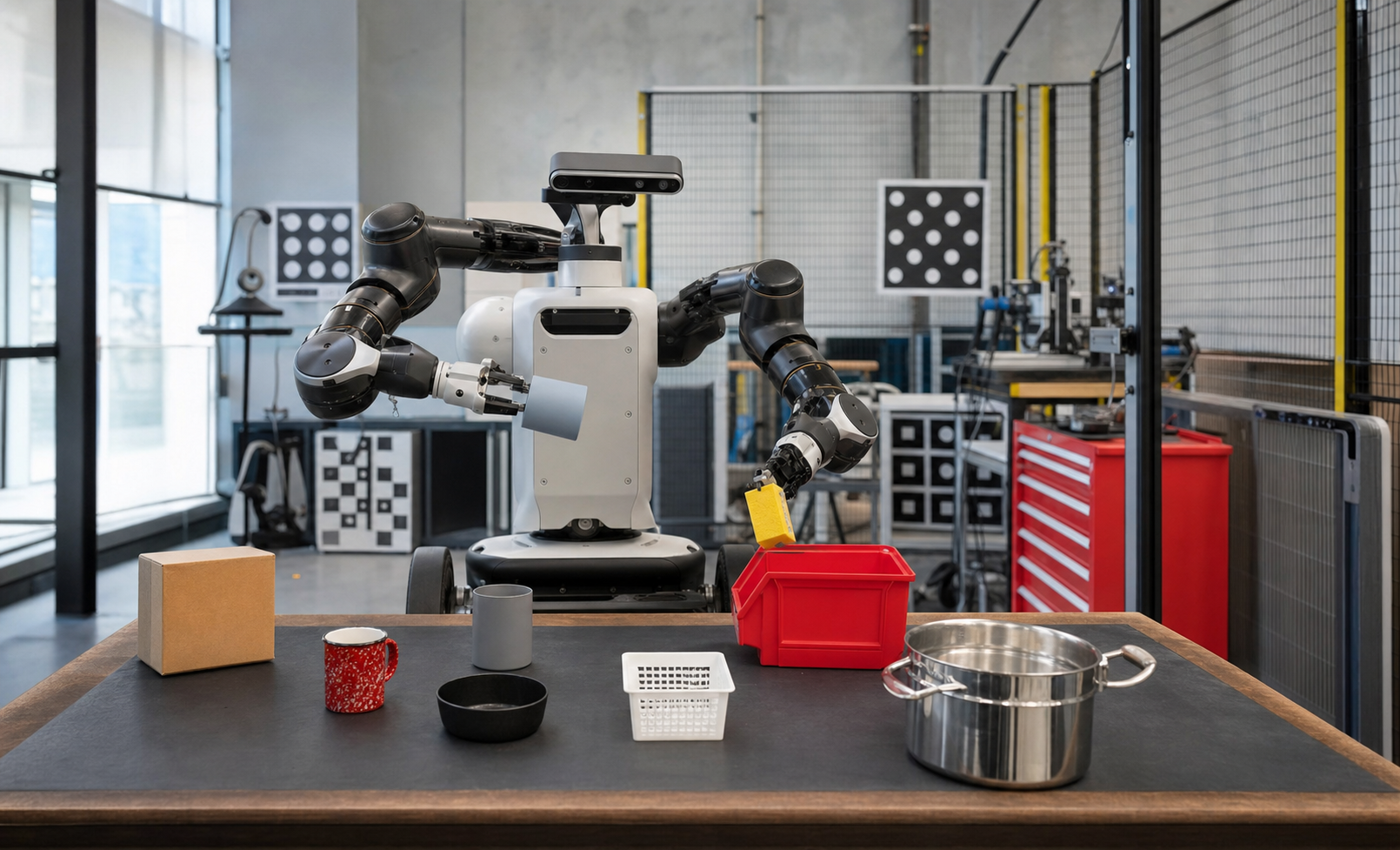
Robots have traditionally been built around narrow skills. A machine might weld one joint, move one kind of package, or follow a carefully mapped route. Changing the task often means changing the software, collecting new data, and tuning the entire system. Robot foundation models aim to make that process more flexible by giving machines a broader way to connect language, vision, spatial reasoning, and physical action.
The important change is not that every robot will look human. It is that one model may help different machines interpret instructions, understand unfamiliar objects, plan multiple steps, and adapt when a scene changes. In 2026, that remains a research and early-deployment capability rather than a guarantee of general-purpose autonomy.
From Vision and Language to Physical Action
Large language models predict and generate text. Multimodal models can also interpret images, audio, and video. A robotics model has an additional responsibility: its output must eventually become a safe physical action. Researchers often describe systems that connect visual and language inputs to actions as vision-language-action, or VLA, models.
A VLA model might receive camera images, a natural-language request, and information about a robot’s current position. It then produces a sequence that a controller can translate into motion. Other systems separate high-level reasoning from low-level control. A reasoning model may identify the correct object, choose a grasp point, and plan the order of operations while conventional motion software handles joint trajectories and collision limits.
This division is useful because fluent reasoning does not automatically create precise motion. The established control stack, safety systems, sensors, and mechanical design still matter. Our overview of robots moving from demos into real workflows explains why reliable repetition is often more valuable than a spectacular one-time performance.
Why Generalization Is the Main Goal
A traditional robot can perform extremely well inside a predictable cell. It struggles when an object moves, packaging changes, lighting shifts, or a person gives an instruction the programmer did not anticipate. Foundation models try to learn patterns across many tasks and environments so a robot can transfer prior knowledge to a new situation.
That does not mean the machine understands the world exactly as a person does. Generalization is measured on defined tasks and test sets. A model that handles a new cup or a paraphrased instruction may still fail on transparent objects, clutter, unusual tools, poor lighting, or an action requiring very fine force control.
Google DeepMind’s Gemini Robotics work emphasizes generality, interactivity, dexterity, and adaptation across more than one robot form. Its Robotics-ER line focuses on embodied reasoning, including spatial understanding, pointing, multi-view perception, and interpreting instruments. In April 2026, DeepMind introduced Gemini Robotics-ER 1.6 and reported improvements on its own evaluations.
NVIDIA’s GR00T N1.6 takes another route: an open foundation model intended for generalist humanoid and bimanual robots, with a vision-language component and an action-generation component. NVIDIA reports results in simulation and on several real robot platforms. These company evaluations are useful signals, but they are not direct head-to-head tests because the systems, datasets, tasks, and access models differ.
Data Is Still the Expensive Ingredient
Text models can learn from enormous collections of documents. High-quality robot data is harder to obtain. Physical demonstrations require machines, operators, safe workspaces, calibration, and time. The data must capture camera views, robot states, forces, actions, instructions, and outcomes. Failures are valuable for learning, but they can damage equipment.
Developers therefore combine several sources: human demonstrations, teleoperation, scripted behavior, simulation, synthetic scenes, and data generated by existing policies. Simulation can provide scale, while real-world fine-tuning helps address the gap between a virtual model and physical friction, lighting, flex, wear, and sensor noise.
The result is likely to be a layered development process rather than one universal download. A general model supplies broad perception and action knowledge. A company then adapts it to a specific robot, worksite, tool set, and safety policy. The last part may determine whether a system is commercially useful.
On-Device Models Change the Reliability Equation
Some robotics intelligence can run in a data center, but physical control introduces strict latency and availability requirements. A robot should not become unsafe because a network connection stalls. On-device models can reduce delay, keep some sensor data local, and continue operating in facilities with intermittent connectivity.
Local inference also creates hardware constraints. Models must fit available memory, power, and cooling while leaving room for perception and control workloads. This connects robotics progress to edge AI and to the memory and power limits described in our AI chips explainer.
Safety Is More Than Refusing a Bad Instruction
Software safety filters are only one layer. A physical system also needs speed and force limits, collision detection, workspace rules, emergency stops, human-aware planning, secure updates, and a clear fallback state. Developers must test what happens when a camera is blocked, an object slips, a person enters the area, or the model becomes uncertain.
Transparency matters too. Operators need to know which conditions were validated and when human approval is required. A robot that can explain a plan may be easier to supervise, but an explanation is not proof that the planned motion is safe.
Why the Robot’s Shape Is Secondary
Humanoid robots receive attention because workplaces are designed around human reach, stairs, doors, and tools. Yet a wheeled base with two arms may be more stable, cheaper, and more efficient for many jobs. Foundation models can be important even when the machine does not resemble a person.
The strongest sign of progress will be useful transfer across robot forms and tasks without sacrificing reliability. That is one reason the scaling questions in our humanoid robotics guide remain unresolved.
What to Watch Next
Look for independent evaluations, longer-duration trials, failure reporting, and evidence that a model can be adapted with less real-world data. Also watch whether developers publish safety limits, support more hardware, and demonstrate recovery from interruptions rather than only successful clips.
Robot foundation models are moving the field from programming every motion toward teaching broader capabilities. The opportunity is substantial, but the winning systems will combine adaptable models with excellent hardware, controls, data, safety engineering, and workflow design.
Leave a Reply