
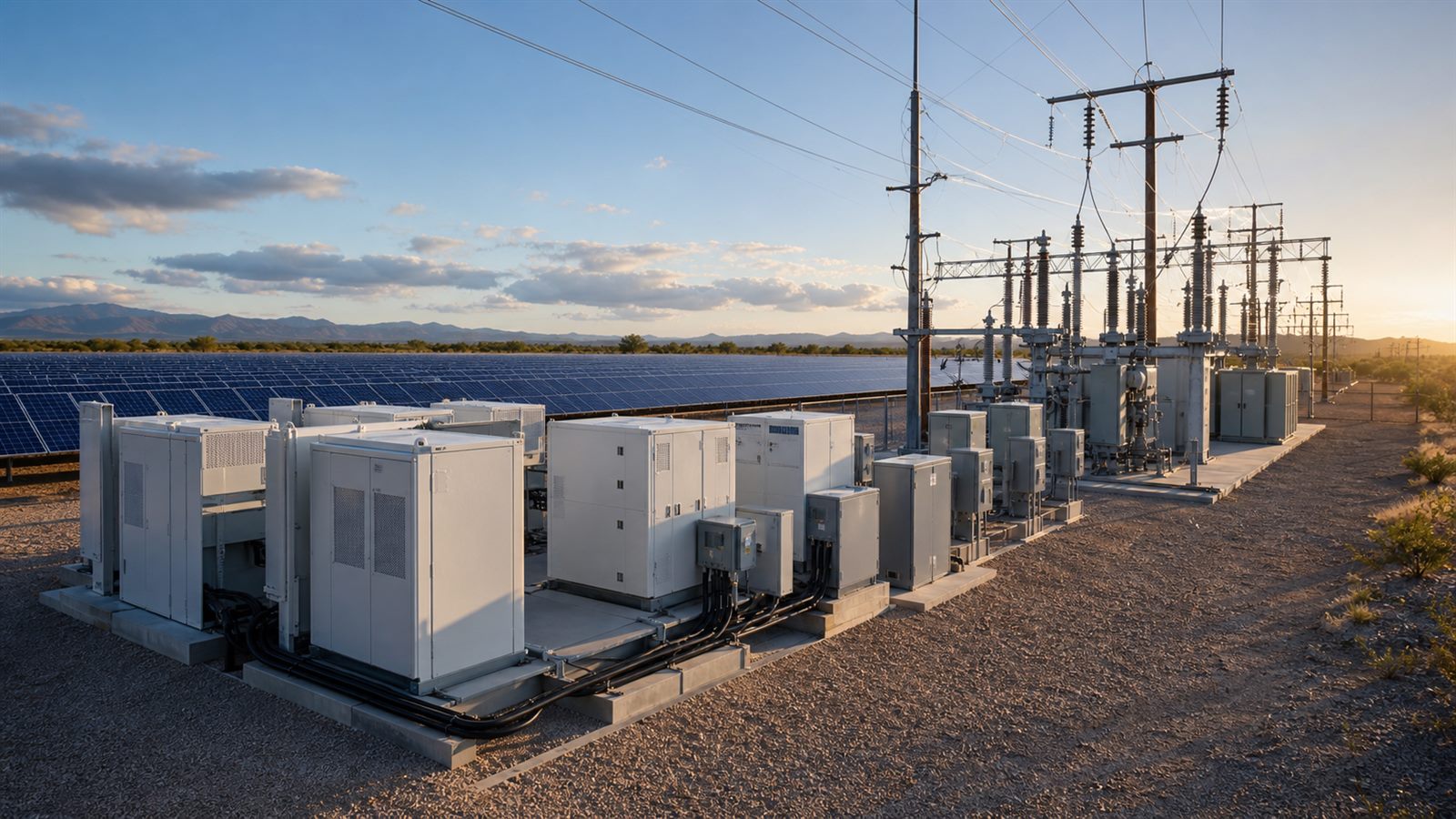
Solar panels, wind turbines, and batteries produce or store useful energy, but most connect to the power system through electronic inverters. Those inverters decide how electricity is synchronized and delivered. As inverter-based resources supply a larger share of power, a once-obscure control question becomes central: which devices establish the voltage and frequency that everyone else follows?
Most deployed inverters are grid-following. They measure an existing electrical waveform and inject current in step with it. Grid-forming inverters are designed to establish and regulate that waveform themselves. They could help renewable-heavy grids maintain stability and restart after an outage, but the technology still needs common specifications, realistic models, and evidence from larger field deployments.
Traditional Generators Provide a Physical Reference
Large power stations commonly use synchronous generators: spinning machines whose electrical behavior is directly tied to grid frequency. Their rotating mass stores kinetic energy. When supply and demand suddenly become unbalanced, that inertia slows the initial change in frequency and gives controls time to respond.
A power-electronic inverter has no heavy rotor coupled to the grid. It can respond very quickly, but its behavior comes from sensors, control software, semiconductor switches, and the energy source behind it. That flexibility is powerful. It also means the grid cannot assume every connected resource will naturally behave like a conventional machine.
The transition is broader than generation. Batteries, electric vehicles, and many industrial systems also use inverters. The software layer of the power grid increasingly determines how physical energy assets respond in milliseconds.
Grid-Following Control Needs Something to Follow
A grid-following inverter observes voltage and frequency, synchronizes with them, and delivers commanded current. This works well when enough conventional generators or other strong sources establish a stable reference. During a severe disturbance, the inverter may reduce output or disconnect to protect equipment and avoid making the event worse.
Problems can emerge when a local system contains many grid-following devices and too few sources able to establish the waveform. Each controller is looking for a reference that has become weak or unstable. Interactions among control loops can create oscillations or other behavior that planning tools built around conventional generators do not represent accurately.
This does not mean a particular renewable percentage automatically makes a grid unstable. The outcome depends on location, network strength, control settings, protection, transmission, operating conditions, and the mix of resources. Grid operators need detailed studies rather than a simple threshold.
Grid-Forming Inverters Establish Voltage and Frequency
A grid-forming controller acts as a controllable voltage source. It can set a local waveform and adjust its output as load changes. Multiple grid-forming devices can share power without waiting for a conventional generator to provide every reference function.
Different control methods exist. Some reproduce aspects of a synchronous machine in software, while others use droop control or more advanced strategies. The label grid-forming therefore describes a family of capabilities rather than one identical algorithm. Specifications must define the required response under disturbances, faults, and changing network conditions.
The energy behind the inverter still matters. A battery can rapidly inject or absorb real power within its charge and power limits. A solar plant can provide some upward response only if it is operating below available output or paired with storage. Control software cannot create energy that the connected resource does not have.
Black Start Is a Valuable Capability
After a widespread blackout, sections of the power system need a source that can start without relying on an already energized grid. Conventional black-start plans often use hydroelectric units, diesel generators, or other plants able to establish local voltage before reconnecting larger resources.
The U.S. Department of Energy says grid-forming inverters can allow inverter-based resources to help restart a downed grid. A battery-backed system is particularly useful because it can establish a waveform immediately, energize selected equipment, and support other generation as the network is rebuilt.
That capability must be planned and tested. Energizing transformers and transmission lines creates inrush current and voltage challenges. Operators need communications, sequencing, reserve energy, protection settings, and a path for synchronizing separate islands. A laboratory feature does not become a regional restoration plan simply by enabling a setting.
Protection Must Work With Different Fault Behavior
Traditional protection schemes often detect large fault currents from synchronous machines. Inverters are limited by semiconductor ratings and may provide a smaller, tightly controlled current during a fault. Relays that expect an old fault signature can respond too slowly or incorrectly.
Grid-forming controls must also remain stable while voltage collapses and recovers. Requirements for fault ride-through, current limiting, and transition between operating modes need to fit the network. The National Laboratory of the Rockies identifies protection, voltage control, frequency control, fault ride-through, and modeling as linked research areas.
This is a system problem. A control that performs well alone may interact poorly with another manufacturer’s inverter, a conventional plant, or a series-compensated transmission line. Hardware-in-the-loop tests and staged field demonstrations can expose those interactions before deployment at scale.
Standards and Models Need to Catch Up
Planning models simplify equipment behavior so utilities can study thousands of possible disturbances. Grid-forming projects need models that are accurate enough to reproduce fast control interactions without revealing every proprietary implementation detail. They also need parameters that can be validated against real devices.
The DOE-backed Universal Interoperability for Grid-Forming Inverters Consortium, or UNIFI, brings laboratories, universities, utilities, system operators, and manufacturers together around common guidelines. Its work includes modeling, controls, hardware prototypes, validation, standards, and a planned 20-megawatt demonstration.
Interoperability is important because a future grid will not contain one type of inverter. It will mix grid-following and grid-forming resources from many suppliers with synchronous generators and flexible loads. Operators need predictable behavior at the points where those systems meet.
Batteries Are Natural Early Hosts
Battery plants are well suited to early grid-forming projects because they can change power quickly and operate when solar or wind output is unavailable. They may provide frequency response, voltage support, reserves, or black-start service while also shifting energy across time.
Those services compete for battery capacity and inverter headroom. A plant scheduled to discharge at its maximum has less room to increase output. A nearly empty battery cannot sustain a long restoration event. The economic schedule must reserve enough capability for the reliability service being promised.
This trade-off connects to long-duration energy storage. Grid-forming control addresses how power behaves from moment to moment, while storage duration determines how long the energy source can maintain support. The two capabilities are related but not interchangeable.
Limits and Open Questions
Grid-forming inverters are not a universal replacement for transmission, reserves, protection upgrades, or sound operating practice. A weak grid may need several changes at once. Poorly coordinated grid-forming controls can create new interactions, and requirements suitable for an island microgrid may not transfer directly to a continental interconnection.
Costs also depend on whether capability is designed into new equipment or added to an existing plant. Owners need a market or contract that values the service, while system operators need tests that verify it remains available after firmware and parameter changes.
What to Watch Next
Watch the UNIFI demonstration, utility interconnection requirements, validated public models, and evidence from systems operating with high instantaneous shares of inverter-based generation. Strong reports will describe fault response, black-start sequences, mixed-vendor behavior, and the conditions under which controls were stable.
Also watch coordination with flexible resources such as bidirectional electric vehicles. Millions of small inverters may eventually support the grid, but only if communication, aggregation, customer needs, and protection are engineered as carefully as the control inside each device.
Leave a Reply