
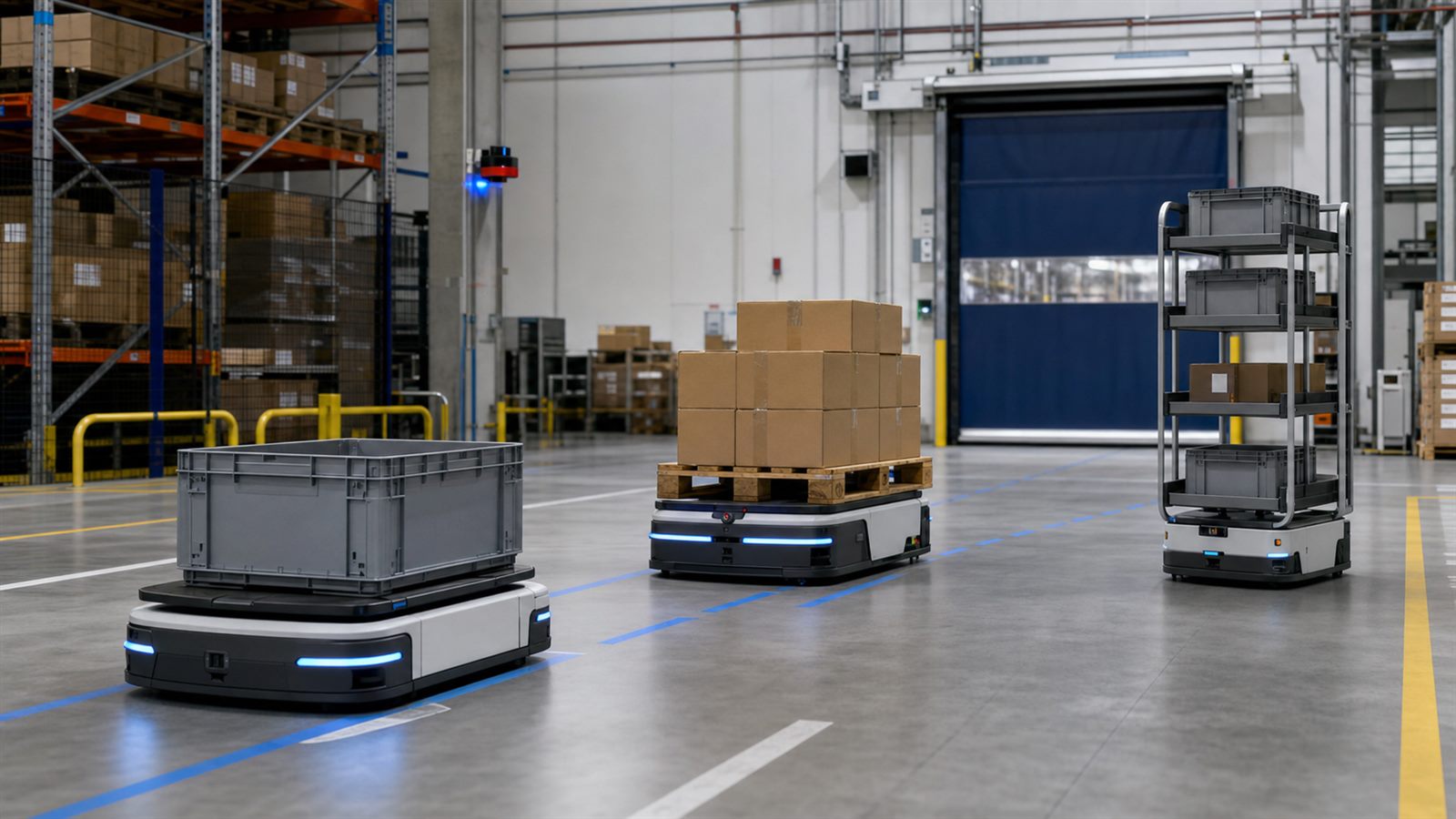
A warehouse may begin automation with one type of mobile robot, then add faster vehicles, pallet movers, or specialized carriers from another supplier. Each machine can navigate well on its own, yet the site still needs to assign jobs, prevent traffic deadlocks, coordinate elevators, and manage charging across the entire fleet. Without a common interface, every new robot can become a custom integration project.
VDA 5050 is an open communication specification intended to let a central fleet-control system exchange orders and status data with mobile robots from different manufacturers. Version 3.0, released in 2026 by Germany’s VDA and VDMA industry associations, expands the model for freely navigating robots. It is an important step toward mixed fleets, but it does not make different robots identical or solve safety, navigation, and physical compatibility by itself.
Why One Vendor Is Rarely the Final Answer
Automated guided vehicles once followed fixed lines or markers and performed tightly defined routes. Modern autonomous mobile robots can build maps, avoid obstacles, and choose paths more flexibly. A large facility may use both kinds, along with machines designed for different load sizes, floor conditions, and material-handling equipment.
A single-vendor fleet can simplify commissioning, but it may limit future choices. The best vehicle for moving small totes may not be the best pallet carrier. Acquisitions, site expansions, and changing workflows can also leave operators with several generations of equipment. A common communication layer gives the site a better chance of coordinating those assets without replacing working machines.
This is part of the larger transition described in our overview of robots moving into real operational workflows. The difficult work is often not making one robot move. It is fitting many machines into production, maintenance, traffic, and information systems that already exist.
What VDA 5050 Standardizes
The specification defines messages between a mobile robot and fleet control. The central system can send an order represented by nodes and edges, while the robot continuously reports its position, operating state, battery status, errors, and progress. Communication uses structured topics transported through MQTT, a widely used messaging protocol.
Fleet control remains responsible for functions such as job assignment, traffic management, energy planning, deadlock handling, and coordination with doors, gates, elevators, and other equipment. The robot remains responsible for localization, motion execution, actions, and continuous status reporting. This division gives both sides a common contract without requiring every manufacturer to reveal or replace its internal navigation software.
The standard also includes a factsheet that describes a robot’s physical properties and supported capabilities. Fleet software needs those differences. A route suitable for a compact empty vehicle may be impossible for a longer machine carrying a wide pallet, even when both speak the same protocol.
Version 3.0 Adds Zones and Path Sharing
Earlier versions worked well with predefined routes, trajectories, and corridors. Version 3.0 adds a zone concept for robots that plan more of their own movement. A zone can block access, impose a speed limit, require permission, encourage or discourage a route, enforce a direction, or restrict autonomous replanning.
This creates a middle ground between central control and local autonomy. Fleet software can establish site-wide traffic rules, while a capable robot selects its detailed path between waypoints. The robot can then share planned and intermediate paths so the central system retains enough visibility to coordinate other traffic.
Map distribution is another addition. Fleet control can tell a robot to download, enable, disable, or delete a specific map version. That is useful when a site layout changes, but the specification deliberately separates map transfer from the robot’s own mapping and localization method. A shared file does not guarantee that every robot interprets obstacles, clearances, or positioning accuracy in the same way.
Interoperability Is Not the Same as Safety
A communication protocol cannot certify that two vehicles can pass each other safely or that a robot will stop before reaching a person. Those decisions depend on the machines, payloads, floor, sensors, braking behavior, safety-rated controls, and application risk assessment.
Our guide to robot safety in shared workspaces explains why the complete application must be assessed. VDA 5050 can report status and coordinate traffic, but it is not a replacement for protective functions or the ISO 10218 integration process. A normal network message is not automatically a safety-rated command.
Sites also need a defined response to communication loss. A robot may stop, finish a safe segment, or enter another state depending on the application. Fleet software must recognize stale data and avoid assuming that a silent vehicle has disappeared from the physical aisle.
Different Standards Cover Different Layers
The MassRobotics AMR Interoperability Standard takes a lighter approach focused on sharing basic information such as location, direction, speed, and operational state. This can help robots and infrastructure maintain situational awareness. MassRobotics describes its standard as complementary to VDA 5050 rather than a competing fleet-management protocol.
Neither approach standardizes every physical interface. Charging connectors, load-transfer mechanisms, elevators, wireless coverage, and maintenance tools can remain vendor-specific. A warehouse can therefore achieve message compatibility while still needing adapters and operating rules for the equipment that robots touch.
Commissioning Still Requires Detailed Engineering
Before deployment, the operator has to define maps, routes, stations, restricted areas, charging locations, priorities, and the characteristics of each robot. The integrator must map vendor-specific actions to a common workflow and test how mixed vehicles behave around narrow aisles, queues, failed missions, and manual traffic.
Version compatibility matters as well. A robot that implements an older profile may not understand the new zone or map features. Optional capabilities should be discovered through the factsheet and tested rather than assumed. Operators need a change-control process so updates to fleet software, robot firmware, or map data do not quietly alter production behavior.
Cybersecurity belongs in the design because the protocol carries operational commands and detailed facility data. Network segmentation, authenticated endpoints, certificate management, logging, and controlled update procedures are needed around the messaging layer. Open documentation improves review, but openness alone does not secure a deployment.
What Operators Can Measure
A useful mixed-fleet trial should report more than whether robots completed a demonstration route. Measure job completion, traffic waiting time, blocked aisles, recovery after a lost connection, charger utilization, map-update success, and the amount of manual intervention. Include peak traffic and unusual payloads, not only a quiet test period.
Operators should also measure integration effort. A standard is delivering value if a new compliant robot can be added with less custom code, faster validation, and clearer ownership. If every action still requires a vendor-specific extension, the site may have interoperability in name but not in practice.
Limits and Trade-Offs
A central fleet controller can improve coordination, but it can also become a critical dependency. The architecture needs redundancy, monitored message delivery, and a safe degraded mode. Giving local robots more path-planning authority can reduce central complexity, yet it makes path prediction and traffic negotiation more important.
Standards can also lag the newest hardware capabilities. Vendor extensions are sometimes necessary, but too many extensions recreate lock-in. Buyers should distinguish required common functions from genuinely specialized behavior and document how the system would operate if one component were replaced.
What to Watch Next
Watch real deployments of VDA 5050 version 3.0, especially its zones, path sharing, and map lifecycle. Useful evidence will show mixed brands operating under load, safe recovery from failures, and the cost of adding a new vehicle type. Alignment with other map, facility, and robot standards will matter as warehouses connect mobile platforms to robotic arms and automated storage systems.
More capable robot foundation models may eventually make individual machines more adaptable. A shared operational language will still be needed so that intelligence on one vehicle does not become confusion across the rest of the floor.
Leave a Reply