
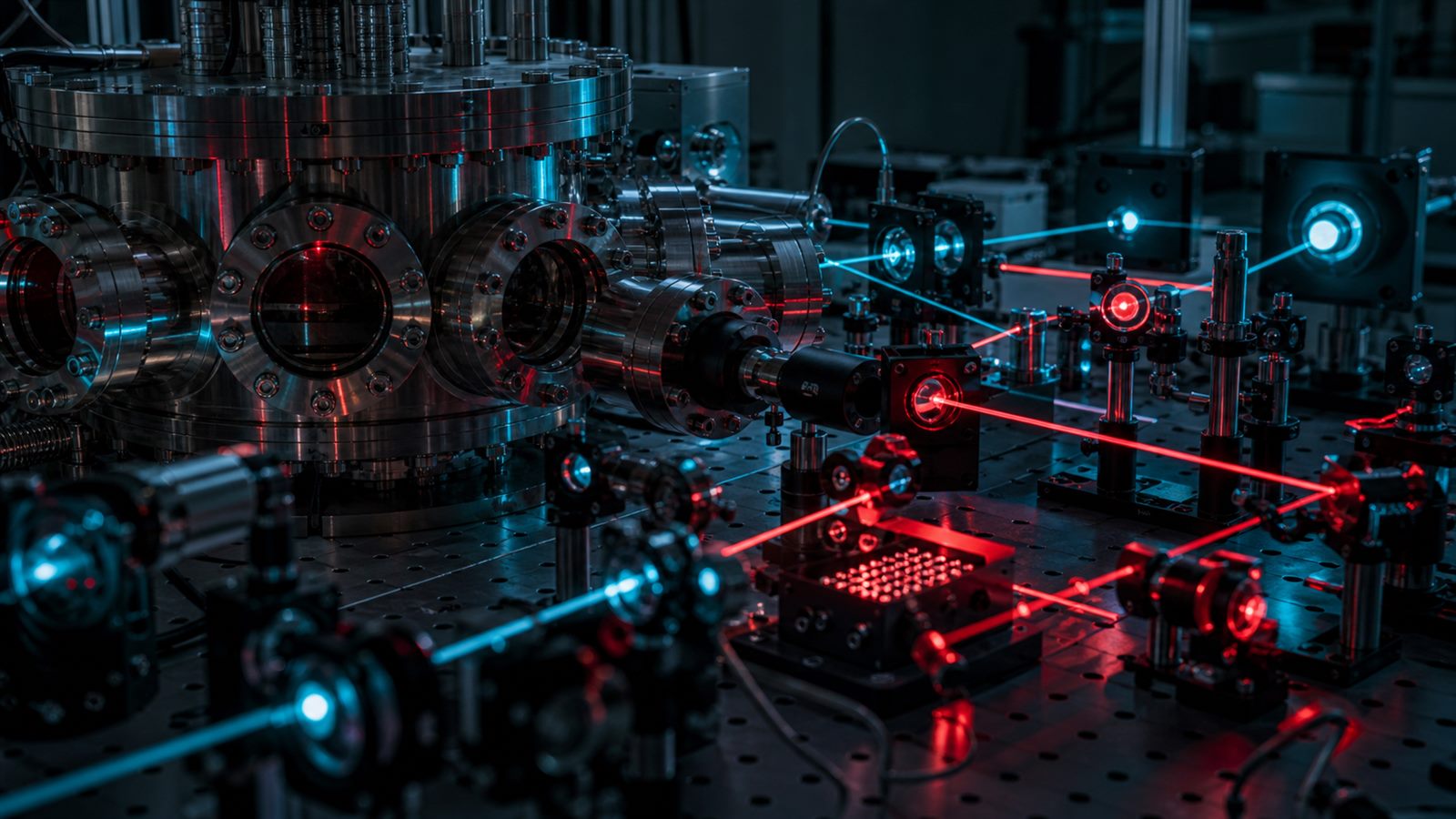
A neutral-atom quantum computer begins with something surprisingly tangible: individual atoms held in place by tightly focused beams of light. These optical tweezers can arrange atoms into programmable patterns, move them to fill empty sites, and bring selected neighbors into the right geometry for quantum operations. The approach has recently produced experimental systems containing thousands of trapped atoms, giving neutral atoms one of the most visually intuitive paths toward larger quantum processors.
Scale, however, is only the first requirement. A useful machine must initialize qubits, perform accurate gates, measure results, replace lost atoms, and eventually run error correction without the control system becoming unmanageable. Neutral-atom platforms are interesting because the same physics offers answers to several of those problems, while leaving difficult engineering work between today’s demonstrations and fault-tolerant computing.
How an Atom Becomes a Qubit
Neutral-atom machines commonly use stable internal energy states of an atom to represent the logical values zero and one. Lasers prepare, control, and read those states. Because atoms of the same isotope are naturally identical, manufacturers do not have to fabricate thousands of nominally matching qubit devices one by one. The challenge shifts to trapping and controlling those atoms with highly stable optical, vacuum, and electronic systems.
An optical tweezer forms where a focused laser creates an energy landscape that can confine a cold atom. An array of many focused spots creates many potential qubit locations. Loading is probabilistic, so the first pattern usually contains vacancies. Cameras identify occupied sites, and movable tweezers rearrange the atoms into a denser, ordered register.
This ability to change geometry is more than a setup convenience. It can place qubits into layouts suited to a particular algorithm, move selected atoms toward interaction zones, or remove atoms used for one role from those used for another. It is a physical version of reconfigurable connectivity.
Rydberg States Switch Interactions On
Atoms held apart in the array interact only weakly in their ordinary states. To create an entangling gate, laser pulses can briefly excite selected atoms into high-energy Rydberg states. Rydberg atoms have strong, long-range interactions. If one nearby atom is already excited, that interaction can shift the energy levels and prevent another excitation, an effect called Rydberg blockade.
Carefully designed pulse sequences use this blockade to make the state of one qubit affect another. After the operation, the atoms return to the computational states. The interaction is therefore controllable: qubits can remain relatively isolated for storage and become strongly coupled for a gate.
The same mechanism is demanding. Laser frequency, intensity, timing, atom temperature, position, and environmental fields all influence fidelity. A large array is valuable only if these controls remain sufficiently uniform and if gates can be performed in parallel without unacceptable cross-talk.
Why Moving Qubits Changes the Architecture
Some quantum processors rely on a fixed map of neighboring connections. Neutral atoms can instead use transport to alter which qubits meet. That flexibility could reduce the number of extra swap operations needed to bring distant logical information together. It also supports architectures with separate storage, processing, and measurement regions.
Moving an atom is not instantaneous or error-free. The transport must avoid heating the atom, disturbing its quantum state, colliding with another path, or allowing too much decoherence while the computation waits. An architecture therefore has to balance movement against direct gates and schedule many operations efficiently.
This is one reason independent performance evaluation matters. As our guide to quantum-computing benchmarks explains, qubit count cannot describe gate accuracy, connectivity, speed, measurement quality, or the overhead of running a complete circuit.
Recent Experiments Show Larger, Refillable Arrays
A 2025 Nature paper reported a coherent array of more than 6,100 neutral-atom qubits assembled with optical tweezers. The result focused on the technologies needed to load, image, and maintain a very large atomic register. It demonstrated that neutral-atom control can extend well beyond the hundreds of sites common in earlier experiments.
A separate 2025 Nature study reported continuous operation of a coherent system with more than 3,000 qubits. It used an additional reservoir and repeated reloading to replenish atoms without rebuilding the entire array from the beginning. That capability addresses a distinctive failure mode: atoms can be lost from traps during operation or measurement.
Neither result means a 3,000- or 6,100-qubit fault-tolerant computer already exists. Preparing a large coherent register and executing deep, high-fidelity logical circuits are different milestones. These experiments are best understood as evidence that loading, rearrangement, and maintenance can scale, not as a direct comparison with a smaller processor running another qubit technology.
Atom Loss Is Both a Problem and a Detectable Error
A neutral atom may leave its trap after a collision, an imperfect pulse, or measurement. That removes the physical qubit entirely. Loss is disruptive, but it can sometimes be easier to identify than an unknown change of state because imaging reveals that a site is empty. Quantum error-correction schemes can use that location information if detection and replacement happen reliably.
Reloading from a reservoir could let a processor replace lost physical qubits during a long computation. The hard part is doing so without damaging nearby data and while preserving the timing and structure of the error-correcting code. Fast, selective measurement and reset are therefore as important as the number of storage sites.
This connects directly to why quantum error correction matters. A logical qubit is encoded across many physical qubits so that errors can be detected and corrected. If physical operations remain too noisy, adding more atoms can increase the amount of error-management work rather than producing a more useful computer.
From Physical Arrays to Logical Operations
Another 2025 Nature experiment demonstrated elements of a fault-tolerant neutral-atom architecture using up to 448 atoms. The work combined optical-tweezer transport, Rydberg gates, mid-circuit operations, and error-correction techniques. It is an important systems result because fault tolerance depends on many components working together, not on a record qubit count in isolation.
The long-term target is a logical error rate that falls as the code grows, while the machine continues to perform gates and measurements quickly enough to complete useful work. Achieving that requires high-fidelity two-qubit operations, reliable readout, stable qubit memory, low loss, parallel control, and decoders that interpret error data in real time.
Where Neutral Atoms May Fit
Programmable atom arrays are already useful as analog quantum simulators, where the natural interactions reproduce a many-body model of interest. Digital quantum computing imposes a different requirement: a universal set of calibrated gates assembled into circuits. A platform may support both modes, but results from one should not automatically be read as performance in the other.
Neutral atoms also have potential links to quantum networking because atoms can store quantum states and interact with light. Building a practical network requires efficient photon interfaces, memories, repeaters, and low-loss transmission, topics covered in our introduction to quantum networks and entanglement distribution. That opportunity remains separate from proving a scalable local processor.
Limits Behind the Impressive Images
The beautiful grid of bright dots in an experimental image can make a neutral-atom computer look finished. In reality, the supporting apparatus includes ultra-high-vacuum hardware, multiple stabilized lasers, imaging systems, optical modulators, magnetic-field control, and substantial classical electronics. Calibration and uptime will matter as much as the atomic physics when these systems move from research laboratories toward dependable computing services.
Comparisons across platforms also need care. Superconducting circuits, trapped ions, photonics, silicon spins, and neutral atoms have different gate times, connectivity, loss mechanisms, and definitions of a qubit that is available for computation. The relevant question is which system can deliver verified logical performance for a useful workload at an acceptable cost and reliability.
What to Watch Next
Watch for repeated logical operations rather than one-time physical-array records. Useful evidence will include two-qubit gate fidelity across a large fraction of the register, parallel operation, loss and reload rates, mid-circuit measurement, logical error suppression, circuit depth, and end-to-end application benchmarks. Researchers also need to show that control complexity and calibration time do not grow faster than the machine’s useful capacity.
Optical tweezers give neutral-atom computing a compelling physical toolkit: identical qubits, programmable geometry, switchable interactions, and the possibility of replacing lost atoms. The next stage is turning those tools into a processor whose logical reliability, not just its atom count, improves as it grows.
Leave a Reply