
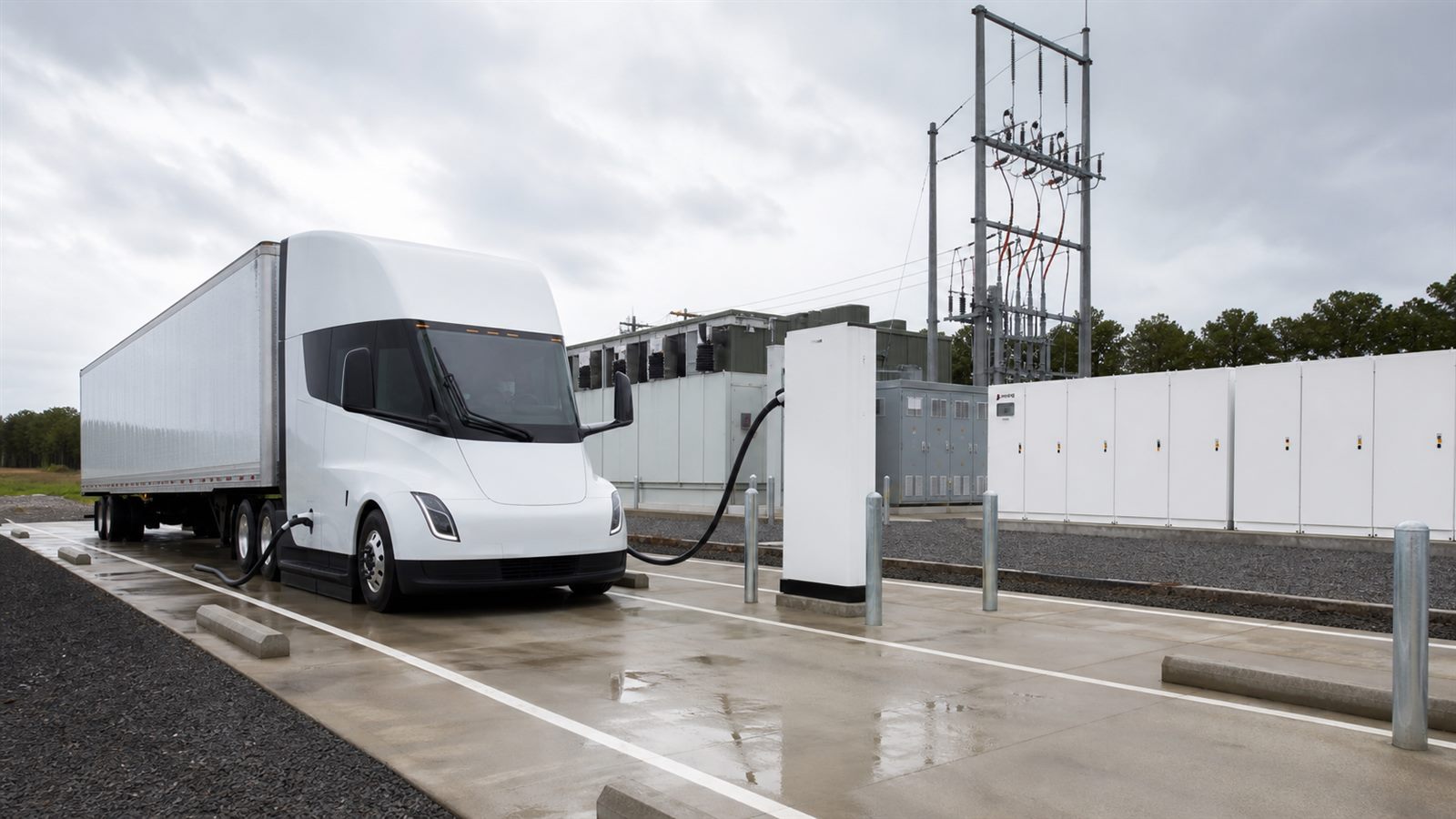
Charging an electric car is mostly a question of convenience. Charging a battery-electric truck is a question of logistics, electrical engineering, and fleet economics at the same time. A long-haul tractor may need to recover hundreds of kilowatt-hours during a driver break, while a depot may need to prepare many vehicles for the next shift. Conventional fast chargers can do the job slowly, but their power and connector designs were not created for that scale.
The Megawatt Charging System, or MCS, is being developed to close that gap. It is often described as a bigger plug, yet the connector is only the visible part. A useful megawatt site also needs high-capacity grid service, power conversion, cooling, communications, safe cable handling, traffic space, and software that schedules vehicles around both routes and available electricity.
Why Heavy Trucks Need a Different Charging System
A passenger vehicle typically carries a much smaller battery and spends long periods parked. Commercial trucks operate under tighter duty cycles. A fleet earns money when vehicles move goods, so a charge that takes several hours can require more trucks, more parking, or a different operating plan. Higher power can shorten that interruption and make electrification practical on routes that cannot be covered by overnight depot charging alone.
Power is only one side of the calculation. The energy delivered equals power multiplied by time, and the vehicle will not accept its peak rate throughout the session. Battery temperature, state of charge, cell chemistry, pack voltage, and the truck’s charging curve all affect the result. A nominal one-megawatt charger therefore does not promise one megawatt at every moment or guarantee a particular turnaround time.
The National Laboratory of the Rockies says the MCS design can support power up to 3.75 megawatts. That upper boundary creates room for future vehicles, but early installations and trucks may operate below it. As with the broader EV charging network, dependable availability and compatible equipment will matter more to fleets than a single headline number.
The Connector Must Carry High Current Safely
At megawatt levels, resistance that would be minor in a lower-power charger produces significant heat. The cable and contacts need careful thermal design, and liquid cooling may be used to keep the assembly manageable. The connector must also survive repeated use around rain, dust, road grime, vibration, and workers wearing gloves. Mechanical locking, electrical interlocks, insulation monitoring, and temperature sensing help prevent power from flowing under unsafe conditions.
SAE International’s J3271 standard addresses more than the physical coupler. Its scope includes communication, electrical and functional requirements, cooling, safety, interoperability, grid interaction, and bidirectional energy transfer. That breadth matters because a vehicle and charger must agree on voltage, current, limits, and session state before large amounts of power move.
A standard still has to be implemented and tested consistently. Fleets will need evidence that trucks from different manufacturers can charge at different network operators without unreliable handshakes, unexpected derating, or difficult payment and authorization steps. Connector durability and cable ergonomics will become daily operational concerns, not laboratory details.
A Truck Stop Can Become a Utility-Scale Load
One charger drawing a megawatt is substantial. A site serving many trucks can resemble an industrial facility. The national-laboratory analysis notes that medium and large stations could require 10 to 20 megawatts or more of grid capacity. Local distribution equipment may not be ready to provide that amount on short notice, especially near highway interchanges that were not built around large electrical loads.
Site developers may need a new utility feeder, substation equipment, switchgear, transformers, and years of coordination before opening. These upgrades can dominate the schedule even when chargers and vehicles are available. The challenge is not simply generating enough electricity over a year; it is delivering high power at the location and hour when a group of trucks arrives.
On-site batteries can reduce peaks by charging more slowly from the grid and discharging quickly into vehicles. Solar can contribute energy, but its output may not align with nighttime depot operations or every roadside stop. Neither resource makes the grid connection optional. Instead, storage, generation, and charging controls form a system that can lower demand charges, improve resilience, or defer some upgrades when the operating profile supports it.
Software Decides Which Truck Gets Power
A depot rarely needs every truck to charge at maximum power simultaneously. Vehicles have different departure times, routes, battery levels, and energy requirements. Smart scheduling can assign power to the vehicles with the most urgent operational need, then reduce or delay other sessions. This turns a row of chargers into a managed energy system.
The same principle appears in bidirectional vehicle-to-grid charging, although commercial fleets bring stricter availability requirements. A truck that must leave at 5 a.m. cannot be treated as a flexible grid battery without a firm energy reserve. Operators will need clear rules that protect the route plan before pursuing energy-market revenue.
Accurate forecasts are valuable: expected arrival, dwell time, required departure charge, electricity price, and site power limit. But the system must also handle late vehicles, damaged chargers, cold batteries, and emergency dispatches. A schedule that works only when every assumption is correct is not operationally robust.
Layout Is Part of Charging Performance
Truck geometry changes the station. Large vehicles need wide turning paths, trailer clearance, and preferably pull-through bays that avoid reversing or disconnecting a trailer. The charging inlet location must be reachable without stretching a heavy cable across a traffic lane. Bollards and curbs can protect equipment, but poor placement can make a connector difficult to use.
Queueing also matters. A theoretically fast charger creates little value if trucks wait behind other vehicles or find a blocked bay. Designers need to model arrival patterns, session duration, charger outages, and seasonal peaks. Restrooms, lighting, security, and driver access are practical parts of the experience, particularly when charging overlaps with regulated breaks.
Public Funding Is Testing More Than Hardware
The U.S. Department of Energy has funded heavy-duty charging projects that examine high-power depots and corridor hubs, including demonstrations in the multi-megawatt range. DOE’s Electric Vehicles at Scale Consortium also studies the combined effects on vehicles, infrastructure, controls, cybersecurity, and the grid. These programs are useful because the unanswered questions sit between industries that have traditionally planned separately.
Utilities need credible load forecasts. Fleets need predictable interconnection dates and tariffs. Truck makers need charging curves and thermal systems that match route needs. Charging operators need utilization high enough to support expensive sites. Coordinated pilots can reveal which assumptions survive real scheduling and weather, without pretending that one demonstration proves a universal business case.
Limits and Trade-Offs
Higher charging power is not free. It can require costlier equipment, larger grid connections, more cooling, and battery designs able to accept rapid energy without excessive degradation. The best solution for a return-to-base delivery fleet may remain lower-power overnight charging. Megawatt charging is most valuable where time is genuinely constrained, such as long-haul corridors, intensive multi-shift operations, or vehicles with very large batteries.
Infrastructure also has to arrive ahead of demand without sitting mostly unused for too long. A phased site can install conduits, foundations, and electrical room capacity early, then add dispensers as vehicle volume grows. Open standards reduce the risk of locking that long-lived investment to one vehicle brand or charging provider.
What to Watch Next
Watch for interoperable production trucks and chargers, published reliability data, utility interconnection timelines, and transparent prices for fleet charging. The strongest projects will report energy delivered, station uptime, queue time, peak grid demand, and how often vehicles actually reach high power, rather than highlighting only a charger’s rated maximum.
Megawatt charging shows why the transition to electric transport depends on the software and control layer of the power grid as much as on better batteries. The plug may be the part a driver touches, but successful electric trucking will be built around the entire system behind it.
Leave a Reply