
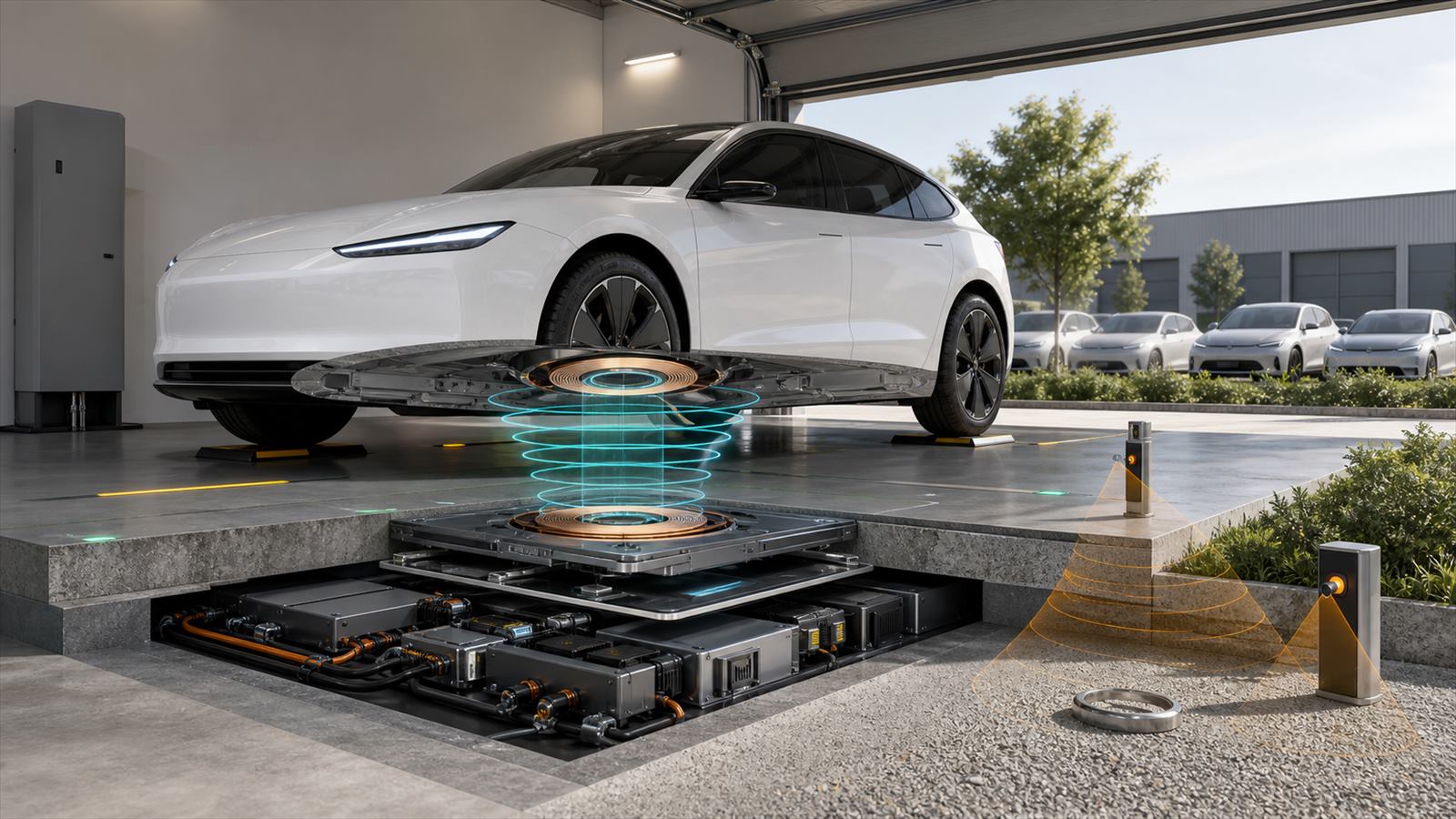
Wireless charging promises an appealing electric-vehicle routine: park, walk away, and let the car charge without handling a cable. The energy transfer is only one part of that experience. A dependable system also has to align two magnetic assemblies, identify compatible equipment, establish communications, detect unsafe conditions, and stop correctly when something changes.
That makes wireless EV charging an infrastructure and interoperability problem, not merely a larger version of a phone charger. Standards are defining a common baseline, but buyers and cities still need to examine installation, efficiency, vehicle support, safety certification, and the difference between stationary pads and experimental charging roads.
Inductive charging connects through a magnetic field
A stationary magnetic-field wireless power system has a ground assembly connected to power electronics and a vehicle assembly mounted underneath the EV. Alternating current in the ground coil creates a changing magnetic field. A coupled coil on the vehicle receives energy, and onboard electronics convert it into the form the battery requires.
The assemblies do not need exposed electrical contacts, but they do need to work as a coordinated pair. Coil geometry, operating frequency, air gap, shielding, power class, and control behavior affect performance. The vehicle and pad must also exchange information before transferring full power.
Wireless does not mean connection-free. The system still has a grid connection, protection equipment, a communications link, a charger, and thermal limits. It simply moves the user-facing connection below the vehicle.
Alignment is part of the charging protocol
Coupling becomes weaker when the vehicle coil is too far from the center of the ground assembly or when ground clearance falls outside the intended range. Poor alignment can reduce power transfer and increase losses or heating. Drivers therefore need positioning guidance, while automated vehicles need a machine-readable alignment method.
The current SAE J2954 revision defines criteria for stationary wireless transfer to light-duty plug-in vehicles, including interoperability, electromagnetic compatibility, electromagnetic fields, minimum performance, safety, and testing. It specifies three charging levels up to 11 kVA and anticipates higher power in future work.
Alignment can use magnetic positioning, radio ranging, cameras, parking sensors, or combinations of these techniques. The important outcome is not the brand of sensor but whether a certified vehicle can find and use compatible infrastructure consistently.
Interoperability needs reference behavior on both sides
A pad that energizes only one manufacturer’s coil design would fragment public charging. J2954 uses performance-based testing and reference devices so ground and vehicle assemblies from different suppliers can be evaluated against a common target. The 2024 revision covers stationary, surface-mounted light-duty installations; heavy-duty and dynamic applications are handled by related projects.
Communications are equally important. SAE J2847/6 specifies messages for recognizing proper alignment, initializing subsystems, ramping to full power, maintaining transfer, and terminating the session. A charger should not apply full energy merely because metal is present above the pad.
The standard also expects wirelessly chargeable vehicles to retain conductive charging capability in the near term. That matters because a driver will encounter many more plugs than pads during a transition. Wireless charging is an additional interface, not an immediate replacement for established connectors.
Safety extends beyond electric shock
A practical pad must recognize foreign objects that could heat in the magnetic field, such as certain metal items. It should also respond appropriately when a living object enters a hazardous area, when the vehicle moves, when communications fail, or when temperatures exceed limits. Detection zones and responses need validation across realistic parking conditions.
Electromagnetic-field exposure and electromagnetic compatibility are separate concerns. The system must remain within applicable limits while avoiding unacceptable interference with the vehicle and nearby equipment. Shielding, coil design, power control, grounding, and installation all contribute.
Cybersecurity matters because charging involves identification, control messages, billing, and potentially grid coordination. A wireless energy link does not remove the digital attack surface discussed in our review of EV charging reliability. Operators still need authenticated software, monitored networks, update procedures, and recovery plans.
Efficiency should be measured from the wall to the battery
A headline efficiency measured between two well-aligned coils does not describe the entire installation. Conversion losses occur in grid-side electronics, the magnetic link, vehicle electronics, cooling, communications, and standby operation. Misalignment and an excessive air gap can change the result.
Useful reporting should state input energy, battery energy received, power level, alignment tolerance, ground clearance, ambient temperature, and standby consumption. Charging time also depends on the vehicle’s onboard limits and battery-management decisions. A high nominal pad rating cannot force a cold or nearly full battery to accept maximum power.
This whole-system view mirrors the lesson from megawatt truck charging: the coupler is only one element of a site that includes electrical capacity, cooling, controls, operations, and maintenance.
Installation decides where wireless charging makes sense
Home users may value automatic overnight charging, especially where handling a cable is difficult. Fleets can gain predictable behavior when vehicles return to assigned spaces, and automated vehicles can recharge without a person connecting them. Taxis, shuttles, and accessible parking are other plausible cases.
The trade-offs include pad and vehicle hardware, civil work, drainage, snow or debris management, protection from impact, electrical upgrades, and maintenance access. A surface-mounted pad may affect clearance and parking geometry. A flush installation requires more construction and needs dependable sealing and water management.
For many private drivers, a conventional wall connector remains simpler and less expensive. Wireless charging earns its cost where automation, accessibility, frequent short stops, or controlled fleet operations provide a clear operational benefit.
Stationary pads and charging roads are different systems
Dynamic wireless power transfer places energized segments along a roadway so vehicles can receive energy while moving. It faces additional demands: high-speed alignment, segmented activation, road durability, traffic-scale billing, maintenance, and large infrastructure investment.
The IEC PAS 61980-5:2024 addresses off-board interoperability, electrical safety, and electromagnetic compatibility for magnetic-field dynamic systems. That work should not be confused with a claim that charging roads are ready for broad deployment. Demonstrations still need to prove lifecycle cost, reliability, energy delivery, and cross-vehicle compatibility under public-road conditions.
Questions to ask before buying or deploying a system
Consumers should verify that both vehicle and pad support the same finalized standard and power class, that installation is certified for the location, and that conductive charging remains available. They should ask about alignment tolerance, wall-to-battery efficiency, standby power, warranty, software support, repair responsibility, and behavior during an outage.
Fleet operators need additional evidence: successful-session rate, automatic retry behavior, queue management, maintenance time, foreign-object events, winter performance, and integration with energy-management systems. Bidirectional power should be treated as a separate capability. The 2024 J2954 revision explicitly standardizes forward grid-to-vehicle transfer, while future revisions are expected to address bidirectional testing and communications. Our guide to vehicle-to-grid charging explains the wider grid requirements.
What to watch next
The next milestones are certified interoperable products, field data across different vehicle heights and climates, clearer support for flush-mounted systems, heavy-duty standards, and validated bidirectional operation. Independent tests should compare whole-system efficiency and session reliability against conductive charging, not only demonstrate that power moved across an air gap.
Wireless EV charging can make electrification more automatic and accessible. Its success will be measured by an uneventful routine: the right vehicle parks over the right pad, authenticates, transfers energy efficiently, detects hazards, and completes the session every time.
Leave a Reply