
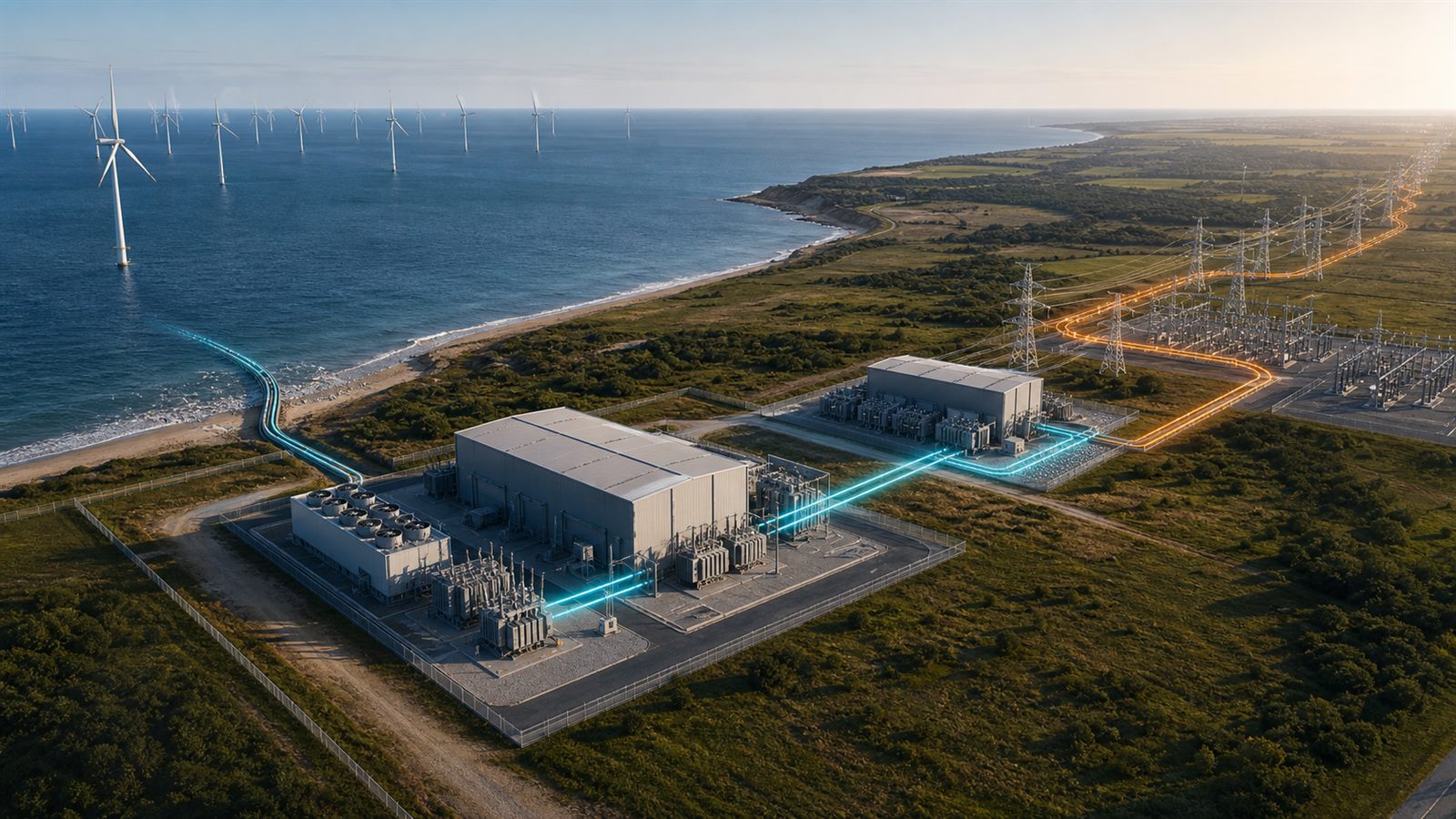
Electricity grids use alternating current because it is easy to transform between voltages and works well across interconnected networks. Yet some of the largest new transmission projects deliberately convert that electricity to direct current, move it hundreds of kilometers, then convert it back. High-voltage direct current, or HVDC, is becoming a strategic tool for connecting remote generation, submarine cables, and power systems that do not operate in synchronism.
HVDC is not automatically better than high-voltage alternating current. Converter stations are large, costly, and complex. The technology earns its place when controllable power flow, long distance, cable physics, or asynchronous grids outweigh those terminal costs.
An HVDC link begins and ends with conversion
A point-to-point link has a converter station at each end. The sending station takes three-phase AC from a regional grid, transforms it to the required voltage, and uses power-electronic valves to create DC. Conductors carry the direct current to the receiving station, which reconstructs AC synchronized with the destination network.
Older line-commutated converters use thyristor valves and depend strongly on the connected AC system. Modern voltage-source converters use controllable semiconductor switches that can regulate active and reactive power more independently. VSC systems are attractive for offshore wind, weak grids, underground cables, and future multi-terminal networks, although equipment losses, cost, control, and protection remain significant.
The US Department of Energy’s Advanced Transmission Technologies report describes HVDC as a direct-current power-flow-control technology used for bulk transfer over long distances and between asynchronous AC systems. That controllability is central: operators can order a link to move a defined amount of power rather than let flow follow AC network impedance alone.
Direct current has an advantage in long cables
AC cables continuously charge and discharge their capacitance as voltage reverses. That reactive current consumes cable capacity even when it delivers no net energy to the far end. The effect becomes especially restrictive in long submarine and underground cables. DC avoids this alternating charging current after the line reaches operating voltage.
HVDC can therefore transmit more useful power through a long cable and control its direction precisely. This is why many offshore wind connections and international submarine interconnectors use DC. It can also use fewer conductors for a given transfer design and may have lower losses over a sufficiently long route.
The break-even distance is project-specific. Converter stations add costs and losses that an AC line may avoid. Route type, voltage, power rating, cable or overhead construction, permits, land, reliability criteria, and financing all influence the choice. DOE’s overview, Connecting the Country with HVDC, presents indicative distance comparisons while emphasizing the value of long-range efficiency and asynchronous connection.
HVDC can connect grids that run independently
Two AC systems can operate at the same nominal frequency without their electrical phase being locked together. Directly tying them with an AC line would require synchronized operation and coordinated stability controls. An HVDC link separates the AC waveforms: one converter takes power from the source, the DC line transfers energy, and the other creates an AC waveform suitable for the destination.
This allows energy exchange between asynchronous regions and gives operators a controllable interface during disturbances. In the United States, DC links can bridge major interconnections. In Europe, submarine interconnectors move power among countries and support trade, reserves, and renewable balancing.
Controllability does not make capacity unlimited. Each converter, cable, and connected AC network has thermal, voltage, stability, and contingency limits. Market rules must determine who schedules the link, how congestion is priced, and which system receives support during an emergency.
Power electronics can support the surrounding AC grid
A voltage-source converter can rapidly adjust active power and exchange reactive power to help control voltage. Depending on design and grid conditions, it can contribute to frequency response, oscillation damping, restoration, and support for a weak offshore or remote network.
Those services depend on control software, measurements, communication, and agreed operating modes. A converter cannot replace every function of synchronous generation automatically. Grid-forming behavior, fault response, protection coordination, and restoration capability need to be specified and tested for the connected system.
Europe’s Network Code on HVDC Connections establishes requirements for long-distance DC links and DC-connected power-park modules. Such rules matter because the converter becomes an active participant in system stability, not merely an electrical adapter.
DC faults are fast and difficult to interrupt
AC current naturally crosses zero every cycle, giving conventional breakers an opportunity to extinguish an arc. DC has no periodic zero crossing. A fault can draw energy from the line, converter capacitors, and connected systems while current rises rapidly.
Point-to-point links can sometimes block converters and isolate the entire line, but a multi-terminal DC grid needs to separate a faulty branch while healthy paths continue operating. That requires fast detection, selective protection, and specialized DC circuit breakers or alternative architectures. DOE has funded work to reduce the cost of high-voltage DC circuit breakers, reflecting how protection remains a deployment constraint.
Protection also has a cybersecurity dimension. Converter controls depend on precise measurements and automation. Secure communications, tested fallback behavior, configuration management, and incident recovery are part of reliability even when the power hardware itself is healthy.
Interoperability becomes harder in multi-vendor networks
A traditional point-to-point project can be engineered as one integrated system. A larger offshore or continental DC network may connect converters from different suppliers at different times. Their controls must share voltage regulation, power balancing, fault response, and restoration without unstable interaction.
Common models, interfaces, test procedures, and responsibility boundaries are therefore essential. DOE notes that DC systems do not yet have the same level of component standardization and interoperability as mature AC networks. Without progress, owners risk supplier lock-in or expensive custom integration whenever a network expands.
Supply chains and planning can dominate the schedule
Converter transformers, valve modules, power semiconductors, bushings, cable, switchgear, cooling equipment, and control systems are specialized products. Large projects compete for engineering capacity and manufacturing slots. The International Energy Agency’s transmission-grid report describes broader supply-chain pressure, long procurement cycles, and the need for coordinated planning.
HVDC projects also cross jurisdictions, shorelines, communities, markets, and utility territories. Route approval, environmental review, cost allocation, connection studies, and contracts can take longer than hardware installation. The same planning bottleneck appears in our coverage of interconnection queues: useful equipment cannot deliver value before institutions decide where and how it connects.
HVDC complements rather than replaces the AC grid
Most generation, distribution, and customer equipment will remain connected through AC networks. HVDC acts as a controlled corridor or interface within that system. Strong AC substations, transformers, protection, and local transmission are still needed to collect power at one end and distribute it at the other.
This is why the manufacturing constraints discussed in our article on grid transformers remain relevant. Converter transformers are specialized, and receiving regions may need conventional upgrades before they can absorb a large new injection.
Grid-enhancing technologies can increase use of existing lines more quickly, but they solve another layer of the problem. Dynamic line ratings can reveal additional safe AC capacity under favorable conditions; they do not create a new long-distance corridor across an ocean or between asynchronous systems.
What a credible project should disclose
Important facts include power rating, voltage, route length, cable versus overhead construction, converter technology, expected losses, availability target, connected-grid strength, contingency design, reactive-power capability, and restoration plan. Cost comparisons should include both terminals and the network upgrades around them.
Developers should explain protection strategy, spare equipment, vendor interoperability, cyber controls, environmental impacts, community benefits, and who pays when the link is unavailable. A projected renewable-energy transfer is not the same as measured annual delivery after curtailment, outages, and market constraints.
What to watch next
Watch for lower-cost voltage-source converters, proven DC breakers, multi-vendor interoperability tests, expandable offshore grids, and coordinated planning across national and regional boundaries. Public operating data from completed links will help compare availability, losses, support services, and maintenance.
HVDC is valuable because it gives planners a controllable way to move large amounts of electricity across physical and electrical boundaries. Its success depends less on a single cable record than on converter reliability, protection, standards, supply chains, permits, and the strength of the AC grids at both ends.
Leave a Reply