
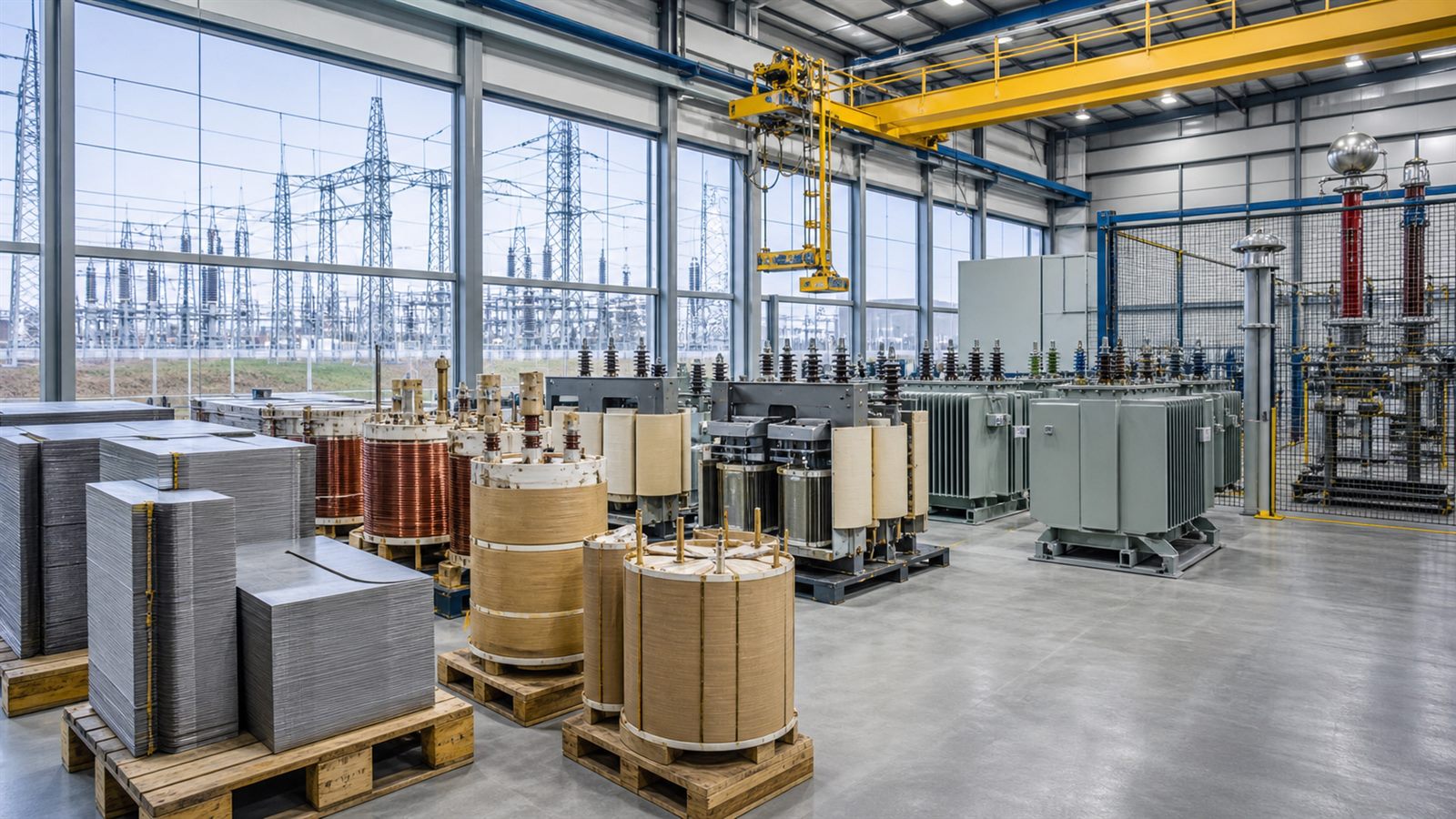
Electrification is often described as a race to build batteries, renewable generators, transmission lines, and data centers. A less glamorous component can still decide when those projects connect: the transformer. Transformers change voltage so electricity can move efficiently across the grid and then reach homes, factories, chargers, and computing facilities at usable levels.
Utilities report long waits for many transformer classes, but the problem is not simply a shortage of metal boxes. Transformers combine specialized electrical steel, conductors, insulation, precision assembly, testing, utility-specific requirements, and difficult logistics. Expanding output requires coordinated changes across a manufacturing system.
Transformers make a multi-voltage grid possible
Power plants and renewable projects generate electricity at one voltage, long-distance networks transmit it at much higher voltages, and local equipment uses lower voltages. A transformer transfers energy between circuits through a magnetic core and windings. It has no continuously moving mechanical parts, but small design choices influence efficiency, temperature, sound, insulation life, and fault tolerance.
A distribution transformer typically makes the final voltage conversion near customers. Larger power transformers connect major substations and transmission systems. They are not interchangeable products; their engineering, transport, testing, and replacement strategies differ substantially.
Electrification increases demand from several directions
New housing, industrial expansion, electric heating, vehicle charging, renewable generation, storage, and data centers all create connection work. Aging equipment also needs replacement. A utility may therefore be ordering for normal maintenance, storm recovery, new loads, grid modernization, and resilience at the same time.
The US Department of Energy has been studying transformer demand, age profiles, manufacturing capacity, and material constraints with support from the National Renewable Energy Laboratory. That matters because a national headline about electricity growth does not translate directly into a count of transformer models. Location, voltage, phase, capacity, mounting style, protection, and utility practice determine the actual order.
A highly customized market is hard to scale
DOE’s supply-chain analysis identified more than 80,000 distribution-transformer varieties and noted that inconsistent utility specifications contribute to longer production times. Many differences have valid technical origins, including local network design, climate, safety rules, loading assumptions, and installation equipment. Others can persist because utilities developed procurement standards independently over decades.
Customization fragments demand into smaller batches. Manufacturers must change tooling, materials, drawings, test plans, and documentation. Utilities may also have to qualify a design or supplier before placing a large order.
Electrical steel is a strategic input
The magnetic core is made from thin laminations of electrical steel engineered to reduce energy losses. Grain-oriented electrical steel is especially important in many transformer designs. Its production requires specialized metallurgical processing and equipment, so capacity cannot be expanded as quickly as ordinary sheet steel.
Core geometry and material grade affect efficiency, dimensions, weight, sound, and cost. Manufacturers also need reliable supplies of conductor metal, insulating paper, fluids, bushings, tanks, controls, and other components. A shortage or qualification delay in one item can hold an otherwise complete unit at the factory.
Efficiency rules interact with manufacturing capacity
More efficient transformers reduce losses over decades of operation, saving energy across millions of units. However, a revised efficiency requirement can also change core materials, dimensions, tooling, and qualification work. The timing of a standard therefore matters to both energy savings and the industry’s ability to deliver equipment.
In 2024, DOE finalized amended US efficiency standards for distribution transformers that take effect in 2029. In 2026, the department sought further information about manufacturing capacity, materials, and supply-chain resilience. The policy question is not whether efficiency or availability matters more. It is how to plan a transition that improves lifetime performance while suppliers expand the necessary production capability.
Manufacturing is precision work, not simple enclosure assembly
Steel laminations must be formed and stacked into a low-loss magnetic path. Conductors are wound into coils, dried, insulated, assembled around the core, connected, enclosed, and filled or otherwise prepared for thermal management. Moisture, contamination, mechanical alignment, and insulation defects can shorten life or cause a failure under high electrical stress.
Finished units undergo electrical and mechanical tests appropriate to their class. Large power transformers are often engineered for a particular substation and can take a long time to design, build, test, ship, and commission. Adding buildings is not enough; manufacturers also need skilled workers, winding and core equipment, test bays, quality systems, and dependable upstream suppliers.
Transport can become part of the engineering
A pole-mounted distribution transformer can move through familiar freight networks. A large power transformer may require special railcars, heavy-haul trailers, bridge studies, road closures, lifting plans, and site preparation. Some accessories travel separately and are installed after the main tank arrives.
This makes replacement planning different from ordering ordinary industrial hardware. A spare is useful only if it matches the required electrical role and can physically reach the site. Regional sharing programs, transport-ready designs, and preplanned routes can improve resilience, but they cannot eliminate every compatibility constraint.
Standardization could enlarge production runs
Utilities do not need to erase every local difference to gain scale. They can identify which specifications are essential and which can be harmonized across multiple buyers. Common ratings, interfaces, accessories, test documentation, and procurement language could support larger production batches and more supplier competition.
Standardization requires engineering work and governance. A common model must still tolerate expected loads, weather, faults, and maintenance practices. It may also require changes to utility inventories and field equipment. The payoff is a market in which capacity investments have clearer demand and replacement units can serve more locations.
Better forecasting can reduce boom-and-bust investment risk
Manufacturers hesitate to finance long-lived capacity when orders are uncertain. Utilities, regulators, developers, and governments can improve visibility by sharing credible multiyear demand ranges and project schedules. Aggregated procurement can support investment.
Forecasts must account for cancellations and delays. The presence of a project in an interconnection queue does not guarantee construction. Scenarios are more useful than one precise number because data-center growth, electrification policy, housing, interest rates, and local permitting can all change actual demand.
Utilities can manage risk before equipment arrives
Asset-health monitoring can identify transformers that need attention before failure. Loading studies can show whether an existing unit has usable capacity, while maintenance can extend service life where safe. Strategic spares can reduce outage exposure.
Grid-enhancing technologies also help utilities use existing infrastructure more effectively. Dynamic line ratings can reveal additional transmission capacity under favorable conditions. These measures do not remove the need for transformers, but they can improve sequencing and keep scarce equipment focused on the projects that truly require it.
Transformer availability shapes the clean-energy timeline
A solar farm, battery site, factory, or charging depot may be technically complete yet unable to energize until substation equipment is ready. The resulting delay raises financing costs and can hide behind broader labels such as permitting or interconnection. Tracking critical equipment separately makes project schedules more realistic.
Transformers also work with power-electronic equipment. As renewable penetration grows, grid-forming inverters may support voltage and frequency, but they still connect into a physical network with voltage-conversion, protection, and thermal limits. Digital controls cannot manufacture missing hardware.
Limitations
Lead times vary widely by transformer class, specification, supplier, buyer, and market conditions. DOE reported that US distribution-transformer lead times rose from roughly three to six months in 2019 to about 12 to 30 months in 2023, but those figures should not be treated as a permanent quote for every order in 2026. Commercial terms and factory schedules continue to change.
Standardization is also not a universal cure. Overly rigid designs can perform poorly in unusual climates or network configurations. Domestic production can improve resilience without making global supply relationships irrelevant. A durable strategy needs material diversity, qualified suppliers, workforce development, demand visibility, and emergency planning.
What to watch next
Watch for expansion of electrical-steel and transformer plants, utility specification harmonization, multiyear procurement agreements, workforce and test-bay investment, and evidence that announced capacity is producing qualified equipment. DOE’s distribution-transformer working group and standards process should reveal how efficiency, materials, and supply resilience are balanced.
The transformer shortage is best understood as an industrial coordination problem. Electrification will move faster when the grid’s most ordinary-looking equipment is treated as strategic manufacturing infrastructure.
Sources: US Department of Energy Supply Chain and Market Analysis; DOE research on distribution-transformer types and demand drivers; DOE 2026 request for information on distribution-transformer standards and supply chains; DOE Electric Grid Supply Chain Deep Dive Assessment.
Leave a Reply