
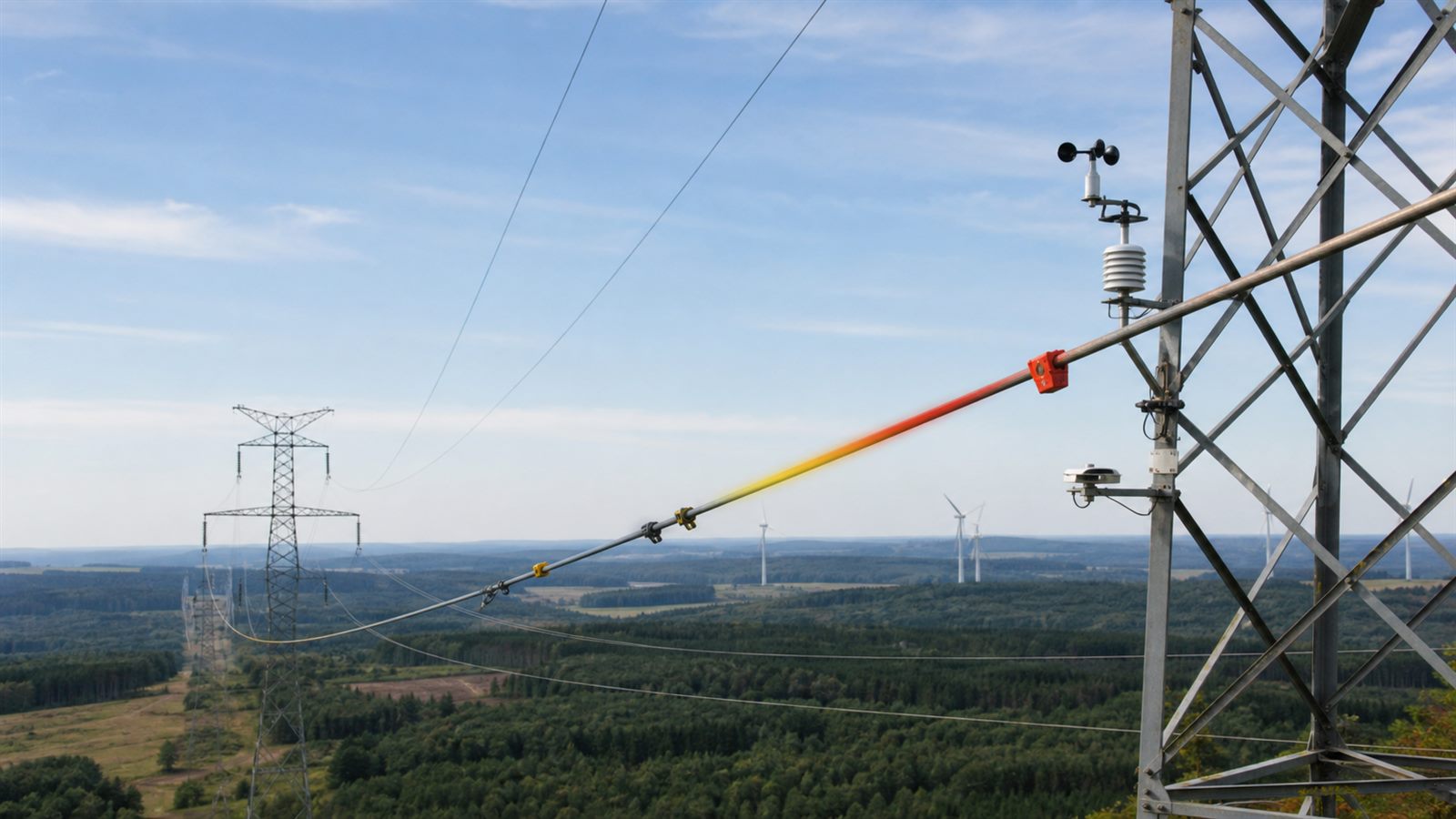
Electric transmission lines do not have one permanent carrying capacity. Their safe limit changes with conductor temperature, wind, sunlight, and the amount a wire sags toward the ground. Yet many power systems have historically operated lines using conservative static or seasonal ratings based on assumed conditions.
Dynamic line rating, or DLR, replaces part of that assumption with current measurements and forecasts. It can reveal additional capacity when cool air or wind removes heat from a conductor, and it can reduce the rating when conditions are hotter or calmer than expected. That makes DLR a valuable grid tool, but not a substitute for every new power line.
A transmission rating is a safety boundary
Current heats a conductor. As the wire warms, it expands and sags. Excess heat can also accelerate material aging and stress connected equipment. Operators set a line rating to keep conductor temperature, ground clearance, and equipment loading within safe limits while respecting voltage and stability constraints elsewhere on the network.
A static rating uses a conservative set of environmental assumptions. A seasonal rating changes a few times per year. These methods are simple and predictable, but they can understate capacity during cool, windy periods and can be less accurate during unusual conditions.
Ambient-adjusted and dynamic ratings are different
An ambient-adjusted rating updates the limit using forecast air temperature, often at hourly intervals. A dynamic rating can incorporate additional inputs such as wind speed and direction, solar heating, precipitation, conductor temperature, tension, or measured sag. FERC defines DLR as applying to a period no longer than one hour and reflecting up-to-date forecasts of relevant inputs.
The distinction matters in regulation. FERC Order 881 required ambient-adjusted ratings for many near-term transmission decisions and required regional operators to support at least hourly electronic rating updates. It did not broadly mandate that every transmission owner deploy full DLR. A later inquiry examined where deeper requirements could be justified.
Sensors and models work together
A DLR installation may use weather stations, conductor-temperature sensors, tension monitors, sag measurement, or remote observations. Software combines those inputs with conductor properties and an engineering thermal model to calculate a safe current limit. Forecasts extend the rating beyond the immediate measurement so operators can plan dispatch.
No single sensor represents an entire long corridor. Terrain, vegetation, tower geometry, and local wind can change along the route. Engineers need enough coverage to identify the limiting span, plus quality checks that detect a failed sensor or implausible value. Conservative fallback ratings remain essential when data are missing.
Where DLR creates the most value
DLR is most useful when conductor heating is the binding limit and weather frequently provides more cooling than the static assumption. Wind generation can create a helpful correlation: the same wind producing electricity may cool nearby lines, allowing more output to move. Congested corridors with large price differences may gain substantial operational value from a modest increase in capacity.
The Department of Energy has highlighted utility deployments that reported increased line capacity and avoided or deferred some upgrades. These are project-specific outcomes, not a universal percentage. Every corridor needs its own weather record, power-flow analysis, sensor design, and economic case.
More accurate can also mean lower
Dynamic does not always mean higher. On a hot, still, sunny day, the calculated capacity may fall below a seasonal assumption. That is a feature of accurate operation, not a failure. Operators must be prepared to redispatch generation or reduce flows when the rating changes.
Forecast uncertainty matters because power schedules are arranged before real-time conditions are known. A useful system should report confidence, apply margins, and prevent frequent rating swings from destabilizing operations. Grid control rooms also need procedures that explain when an automated rating may be overridden.
Telemetry becomes reliability infrastructure
Once a sensor changes an operational limit, its communications and software become part of a safety-critical system. Authentication, time synchronization, calibration, maintenance, audit logs, and cyber incident response all matter. A false high reading could create unsafe loading, while a false low reading could cause unnecessary congestion.
Utilities therefore need diverse data checks and a safe fallback rather than trusting one internet-connected device. This mirrors the broader lesson from grid-forming inverter controls: software can provide valuable grid behavior only when protection and validation are engineered around it.
DLR cannot remove every bottleneck
A corridor may be limited by transformers, breakers, voltage, transient stability, or another line rather than conductor temperature. Increasing one rating can simply move congestion to the next element. DLR also cannot create much extra capacity during extended hot, calm conditions, precisely when demand may be high.
Long-term load growth and new generation still require new lines, reconductoring, substations, storage, and other investments. The interconnection queue problem is too large to solve with one sensor technology. DLR is best treated as part of a portfolio that also includes power-flow control, topology optimization, advanced conductors, and transmission expansion.
Planning rules are beginning to recognize grid-enhancing technology
DOE describes dynamic ratings as one form of grid-enhancing technology, alongside tools that redirect power or optimize network configuration. FERC Order 1920 requires transmission providers to consider certain alternative transmission technologies, including DLR, in long-term regional planning processes. Consideration does not mean automatic selection; planners still compare costs, reliability, deployment time, and expected benefits.
This creates a useful discipline. A proposed new line should be compared with ways to use existing infrastructure better, while a software proposal should be tested against realistic future demand. Energy storage can complement both approaches, as explained in our guide to the long-duration storage technology portfolio.
Limitations
DLR performance is location-specific, and pilot results may not transfer to another climate or corridor. Installation and communications are faster than building a new line but still require engineering, outages, integration, training, and continuing maintenance. Public benefit estimates depend on market rules and which generator would otherwise be curtailed.
Weather data also have limits. Forecast errors, icing, wildfire conditions, sensor drift, and changing vegetation can require special treatment. Ratings should remain conservative where evidence is weak.
What to watch next
Watch for regional operators to publish more hourly rating data, planners to compare DLR with reconductoring and new construction, and utilities to report multi-year performance rather than only pilot peaks. Standards for telemetry, uncertainty, cybersecurity, and fallback operation will be as important as sensor accuracy.
Dynamic line ratings can make the grid more aware of its real physical capacity. Their value is greatest when that awareness is paired with new infrastructure, not used as an excuse to postpone it indefinitely.
Sources: FERC: Implementation of Dynamic Line Ratings; U.S. Department of Energy: Smart Transmission Tools; NREL: On the Road to Increased Transmission; U.S. Department of Energy: Grid-Enhancing Technologies.
Leave a Reply