
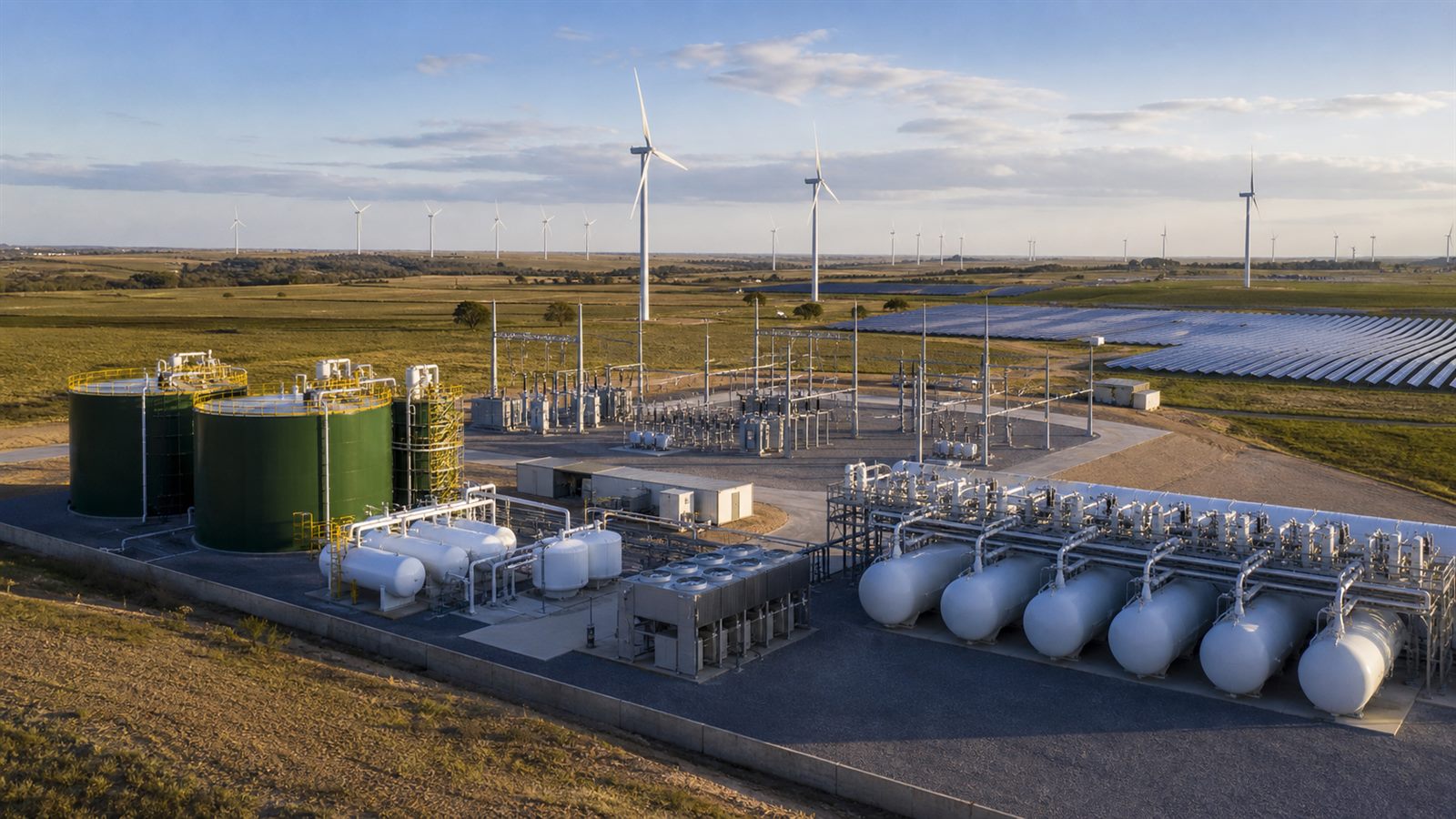
Battery storage is becoming a familiar part of modern electricity grids, but most grid batteries are designed to shift energy across a limited part of the day. A system that covers an evening peak is solving a different problem from one that must carry critical loads through a long shortage of wind or sunlight. That is where long-duration energy storage, usually shortened to LDES, enters the conversation.
The important idea is not simply a battery that runs longer. Long-duration storage is a portfolio of electrochemical, mechanical, thermal, and chemical approaches, each with different costs, efficiencies, locations, and operating limits. The right technology depends on the grid service being purchased, not on which storage chemistry has the most dramatic headline.
Long duration is a grid requirement, not one fixed number
The US Department of Energy commonly defines LDES as storage that can deliver electricity for 10 hours or more. That is a useful program boundary, but it is not a universal engineering answer. A National Renewable Energy Laboratory study found that the duration needed for firm capacity can vary from a few hours to multiple days depending on the power system and the job storage must perform.
This distinction prevents a common mistake. Duration is calculated by comparing the energy a system can store with its maximum power output. A plant may discharge at high power for a short period or at lower power for much longer. Neither configuration is automatically better. A utility first needs to identify the shortage, ramp, congestion, or resilience problem it is trying to solve.
Why four-hour batteries do not solve every problem
Lithium-ion batteries are effective for fast response, frequency control, and moving solar generation into the evening. But adding more hours can require proportionally more battery cells, which may make a different architecture more attractive. A storage system designed around inexpensive energy capacity can be useful when long discharge time matters more than a compact footprint.
The grid also changes as storage is added. Early batteries can target the highest-value short peaks. As more of those peaks are covered, the remaining periods of tight supply may become longer or occur less often. That is one reason NREL warns against treating “long duration” as a static label. Storage value depends on the future mix of generation, transmission, flexible demand, and other storage.
A portfolio is emerging
Flow batteries store energy in liquid electrolytes held in tanks. Their power hardware and energy tanks can be sized somewhat independently, which is attractive for longer discharge times. Other electrochemical systems use abundant materials such as zinc, iron, or lead in designs intended for stationary storage. Each approach still has to demonstrate lifetime, efficiency, manufacturing quality, and safe operation at scale.
Mechanical systems include pumped hydropower and compressed-air storage. They can move large amounts of energy, but geography, permitting, construction time, and site design are central constraints. Thermal systems store heat in materials such as molten salts, rocks, or carbon blocks and later use that heat directly or convert it back to electricity. Chemical storage, including hydrogen-based pathways, may support very long or seasonal time scales, although conversion losses and infrastructure requirements can be substantial.
This variety is a strength, not evidence that one winner has been missed. Different grids may need different combinations. A dense city, an isolated microgrid, a region with suitable underground formations, and an industrial site that can use heat directly do not face the same design problem.
The most important metric may not be efficiency
Round-trip efficiency measures how much electricity returns after charging and discharging losses. It matters, especially for storage that cycles frequently. But an efficient system with expensive energy capacity may not be the best choice for a rare multi-day event. A lower-efficiency technology could still be useful if it stores a large amount of energy cheaply, remains ready for long periods, and meets the required reliability.
Buyers also need to compare response time, cycle life, calendar life, standby losses, minimum operating level, maintenance, land use, water needs, fire behavior, supply-chain exposure, and the time required to build a project. Performance should be measured under realistic duty cycles rather than inferred from a laboratory cell or a short demonstration.
Storage cannot replace the rest of the grid
Long-duration storage is one flexibility option among several. Transmission can move electricity from a region with surplus generation to one with a shortage. Demand response can shift some consumption. Firm generation can provide power during extended low-renewable periods. Better forecasting and regional coordination can reduce the amount of backup capacity required.
This is why the transmission bottleneck described in Interconnection Queues Show Clean Energy’s Grid Bottleneck Is Still Real remains relevant. A storage project cannot help if it waits years for a grid connection. Distributed coordination also matters. Virtual Power Plants Turn Small Energy Devices Into Grid Capacity shows how many shorter-duration devices can sometimes provide services that would otherwise require a larger plant.
Commercial proof is harder than a prototype
DOE’s LDES portfolio includes pilot and demonstration programs because grid infrastructure needs evidence beyond a working prototype. Developers must prove that systems can be manufactured, permitted, financed, operated, maintained, and insured. Utilities need warranties and degradation data that match the planned use. Regulators need a way to compare a new storage plant with transmission, demand flexibility, generation, and other storage options.
Revenue is another challenge. A plant built for rare reliability events may provide enormous value during a shortage but earn little in ordinary energy trading. Market rules must recognize capacity, resilience, and other grid services without paying for equipment that cannot perform when needed. That is a policy and planning problem as much as a materials problem.
Limitations worth keeping in view
No LDES technology eliminates environmental tradeoffs. Large projects use land, materials, industrial equipment, and grid infrastructure. Mechanical projects may reshape sites. Chemical systems need careful leakage and safety management. Batteries require responsible sourcing and end-of-life plans. Claims about low cost should specify whether they include charging electricity, power conversion, construction, financing, replacement, and decommissioning.
Storage also does not generate energy. Extended shortages require enough generation and transmission to recharge the system. Complementary clean firm resources, including the geothermal expansion discussed in Enhanced Geothermal Systems Could Expand Clean Energy’s Underground Map, may reduce how much stored energy a region needs.
What to watch next
Watch for independently verified performance over several years, clearer safety standards, repeatable project costs, and contracts that pay for the grid service rather than a fashionable technology label. Also watch whether developers can separate the cost of power equipment from the cost of adding more stored energy. That is one of the design advantages long-duration systems often promise.
LDES is best understood as a planning category, not a single product. Its future will probably be a mix of technologies selected for specific locations and time scales. The strongest projects will be the ones that solve a measured grid problem and can prove their performance outside a presentation.
Sources: US Department of Energy: Long-Duration Energy Storage; DOE Office of Electricity: Energy Storage; NREL: The Challenge of Defining Long-Duration Energy Storage; DOE: Achieving the Promise of Low-Cost Long Duration Energy Storage.
Leave a Reply