
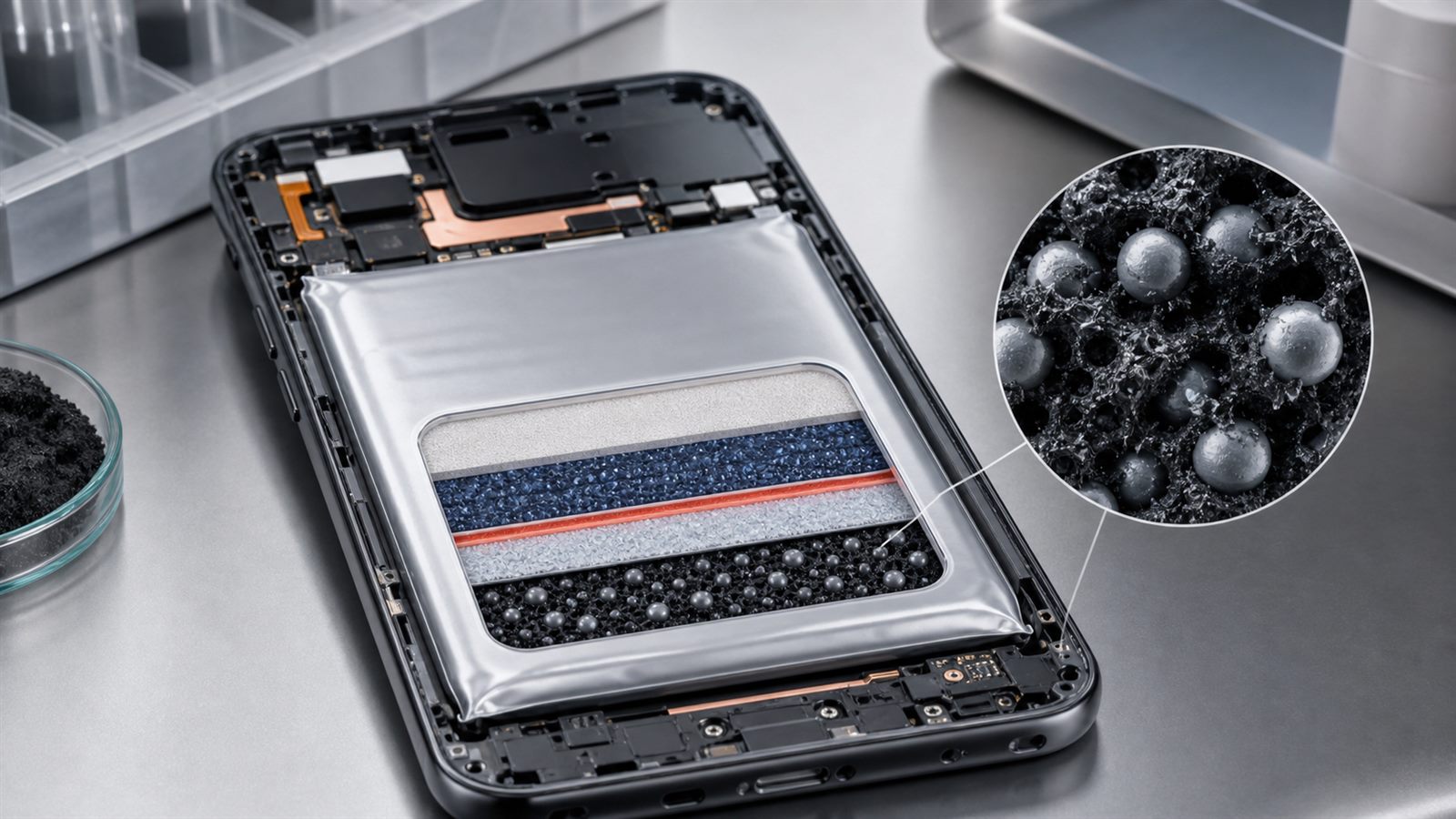
Smartphone makers are using silicon-carbon anodes to fit more battery capacity into thin devices. The result can be a larger milliamp-hour number without a proportionally larger phone, which is especially attractive for foldables and handsets running power-hungry displays, radios, cameras, and on-device AI.
The name can sound like an entirely new battery chemistry. In most phones, it is better understood as an evolution of lithium-ion engineering: silicon is added to or structured within a carbon-based negative electrode. The advantage comes with a difficult materials problem, because silicon changes size dramatically as lithium enters and leaves it.
Silicon-carbon is still part of a lithium-ion cell
A rechargeable phone battery contains a positive electrode, a negative electrode, electrolyte, separator, current collectors, packaging, and protective electronics. Lithium ions move between the electrodes during charging and discharging. In conventional cells, the negative electrode is dominated by graphite.
A silicon-carbon design changes that negative electrode. It may blend silicon particles with graphite and carbon, use silicon oxide, coat silicon with carbon, or build a more elaborate porous structure. Products that share the silicon-carbon label can therefore use quite different material percentages and manufacturing methods.
Silicon offers more capacity than graphite
Silicon can host much more lithium per unit mass than graphite. That makes it attractive when engineers want more stored energy without expanding the battery enclosure. Commercial phone pages now explicitly advertise silicon-carbon batteries, and some identify the silicon content of the negative electrode.
Material-level capacity is not the same as cell-level energy density. A phone battery must include the cathode, separator, electrolyte, tabs, protection, and pouch. Extra structures used to stabilize silicon also occupy mass and volume. The final gain is therefore smaller than a comparison of pure active materials might suggest.
Expansion is the central engineering problem
As silicon takes up lithium, it expands; as the battery discharges, it contracts. Repeated dimensional change can crack particles, break electrical contact, and disturb the solid-electrolyte interphase, or SEI, that forms on the anode surface.
When fresh silicon is exposed, more electrolyte can react to rebuild the SEI. That consumes lithium and electrolyte that can no longer contribute to useful capacity. Mechanical and chemical degradation therefore reinforce each other. This is a good example of why advanced materials quietly determine product performance.
Carbon provides structure, conductivity, and space
Carbon can create a conductive network around silicon and help maintain an electrical path as particles change shape. Porous structures, coatings, elastic binders, and carefully selected particle sizes can provide room for expansion or reduce stress concentration.
There is no free solution. More empty space may reduce the volumetric advantage. Nanostructures can improve mechanical behavior but complicate manufacturing and increase surface area for unwanted reactions. Higher silicon content may raise initial capacity while making lifetime control harder.
The milliamp-hour number is only one measurement
Battery capacity in milliamp-hours, or mAh, describes electric charge. Energy in watt-hours also depends on voltage. Two phones with the same advertised mAh can deliver different usable energy because of cell voltage, power-management limits, temperature, and the point at which software shuts the device down.
Runtime also depends on the phone. Display brightness, modem conditions, processor efficiency, background software, camera use, and local AI workloads can overwhelm a modest cell-level improvement. Capacity should be considered with standardized endurance tests and charging behavior, not treated as a complete battery-life result.
Cycle life and calendar life are different
Cycle aging measures degradation as a battery is charged and discharged. Calendar aging occurs while time passes, including while the device is stored or held at a particular state of charge. Temperature and extended time near full charge can influence both conventional and silicon-containing cells.
Research on silicon-graphite cells has found capacity loss during cycling and measurable degradation during calendar aging. Newer work continues to study how SEI cracking, dissolution, electrolytes, and silicon structure affect both mechanisms. A claim about retaining capacity after a set number of cycles does not by itself describe several years of ordinary use.
Fast charging adds a second optimization problem
High charging power creates heat and can produce uneven conditions inside a cell. The anode must accept lithium without harmful deposition, excessive side reactions, or local stress. A larger battery may reduce the effective charge rate for the same charger, but aggressive charging profiles can still trade speed against temperature and aging.
The cable and connector are only part of this system. As our guide to USB-C capabilities explains, a familiar port does not guarantee a particular power mode. Charger negotiation, cell design, thermal sensors, and battery-management software all determine what the phone can safely accept.
Battery-management software can hide or preserve capacity
A phone rarely exposes the full electrochemical range of its cell. The battery-management system sets voltage and current limits, estimates state of charge, balances performance with temperature, and may reserve capacity at the top or bottom of the range.
Adaptive charging can reduce time spent at a high state of charge by delaying the final portion until the user normally disconnects the phone. Manufacturers can also change charging curves through software updates. These controls may extend life, but they make comparisons difficult when testing methods and default settings differ.
Safety depends on the complete cell and manufacturing process
A silicon-containing anode does not automatically make a phone safer or less safe. Separator quality, cathode stability, electrolyte, contamination control, pouch construction, protection circuits, thermal design, and manufacturing consistency all matter.
Certification tests can address electrical abuse, mechanical stress, temperature, transport, and other defined conditions. They cannot guarantee that every cell will retain a particular capacity for years. Buyers should separate safety compliance, cycle-life claims, and real-world endurance because they answer different questions.
Repairability changes the meaning of a long-lived phone
A battery may still be the first major component to wear out in an otherwise capable device. Higher initial capacity can leave more useful capacity after degradation, but a difficult or expensive replacement can still shorten the practical life of the phone.
European rules now make more smartphone durability and repair information visible, as covered in our article on smartphone repairability and energy labels. Clear replacement pricing, parts availability, software support, and battery health reporting matter alongside anode chemistry.
How to read a silicon-carbon battery claim
Start with the rated capacity and device dimensions, then look for energy in watt-hours, charge power, claimed capacity retention, test temperature, number of cycles, and the threshold used to define end of life. Check whether the result covers a finished commercial cell or a small laboratory sample.
Independent runtime testing should use repeatable workloads and comparable settings. Long-term evidence is more difficult because products change quickly, but transparent battery-health data and replacement policies can reveal whether a manufacturer expects the phone to remain useful beyond the launch cycle.
Limitations
Commercial cell formulations are often proprietary. Research on one silicon percentage, particle structure, electrolyte, or cathode cannot predict another product’s lifetime. Laboratory studies may use temperatures, charge rates, cell sizes, and pressure conditions that differ from a smartphone.
This article is based on published specifications and research, not hands-on battery teardown or longevity testing. Individual product claims need product-specific verification.
What to watch next
Watch for manufacturers to publish watt-hours, silicon content, standardized cycle and calendar-aging results, charging curves, temperature behavior, and replacement commitments. Research should increasingly report practical full cells with realistic material loading rather than only favorable half-cell measurements.
Silicon-carbon anodes can make room for meaningfully larger phone batteries. The technology becomes more valuable when the industry proves that those extra milliamp-hours remain useful after years of heat, charging, storage, and daily cycling.
Sources: HONOR Magic V3 silicon-carbon battery specification; US Department of Energy report on silicon anode capacity and expansion; Argonne research on cycle and calendar aging of silicon-graphite cells; Nature Energy research on interphase-driven aging in silicon anodes.
Leave a Reply