
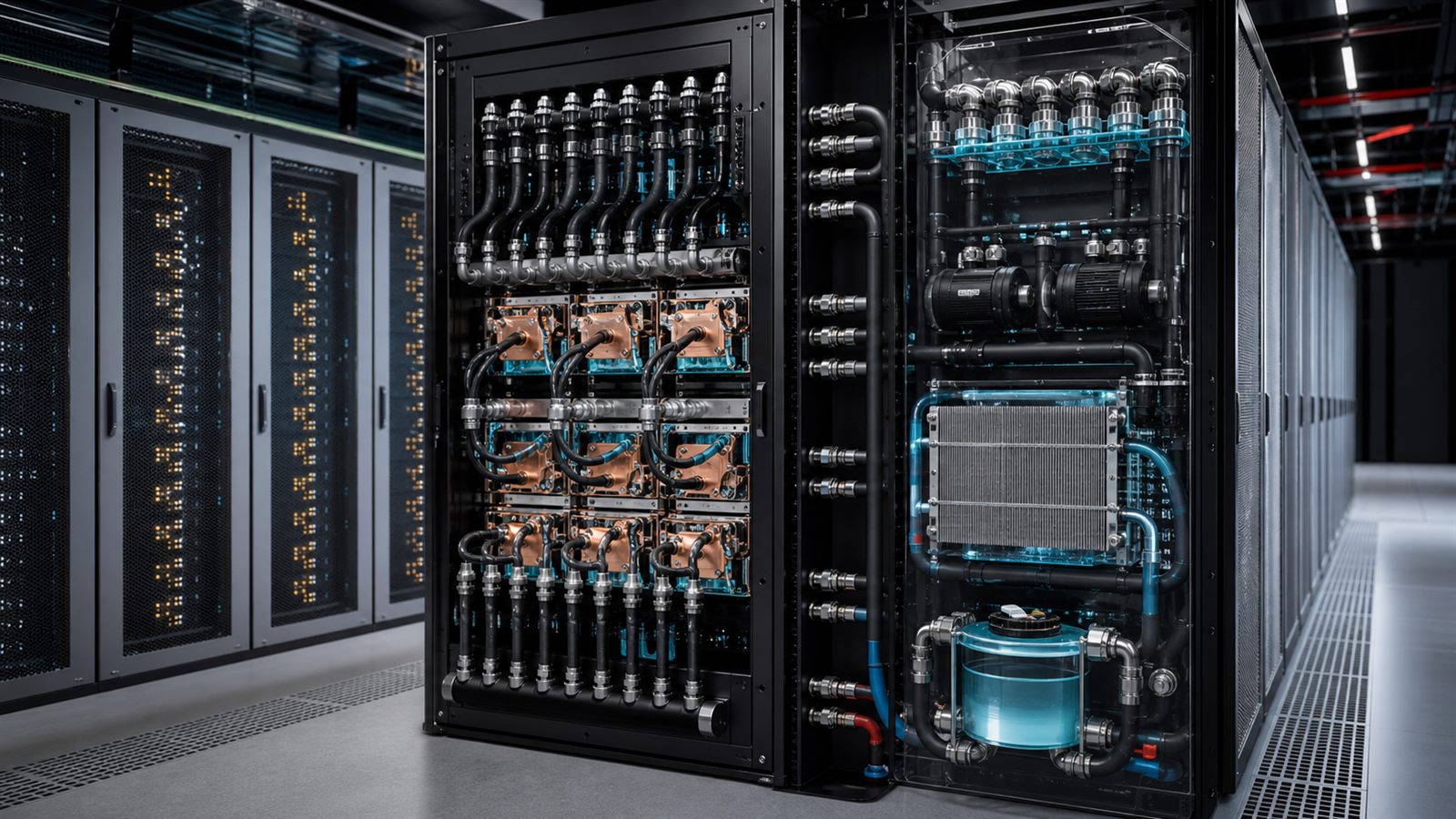
Artificial intelligence is changing data-center cooling from a facility utility into part of the computing architecture. Dense accelerator systems concentrate enormous electrical power in a small volume, and nearly all of that power eventually becomes heat. If the heat cannot leave the chip, package, server, rack, and building quickly enough, performance must be reduced or equipment can become unreliable.
Liquid cooling moves heat more effectively than air near a hot component. That does not make it a universal answer, and it does not remove fans, pumps, heat exchangers, or facility engineering. It creates a connected thermal system that has to be designed, monitored, maintained, and upgraded alongside the processors it supports.
Cooling starts at the chip package
An AI accelerator produces heat inside tiny regions of silicon and packaging. That heat passes through interface materials into a heat sink or cold plate. It then travels through air or coolant, into rack equipment, and finally to an outdoor heat-rejection system. Every boundary adds thermal resistance.
Improving one step does not guarantee a cool system. A highly capable cold plate can still underperform if coolant flow is uneven, a heat exchanger is undersized, or the facility water arrives too warm. Thermal design therefore connects semiconductor packaging to mechanical engineering and building operations.
Air cooling meets limits as rack density rises
Air is convenient, electrically nonconductive, and supported by decades of standard equipment. Servers use fans to push it across heat sinks, while computer-room systems remove the warm air. At higher power density, however, moving enough air requires larger heat sinks, stronger fans, careful aisle containment, and more space.
Fan energy and noise increase, and small airflow imbalances can create hot spots. The US Department of Energy’s data-center design guide notes that high-performance computing facilities adopted direct liquid cooling as rack densities climbed beyond levels that traditional room air systems handle comfortably.
Direct-to-chip cooling brings liquid close to the source
In direct-to-chip systems, a metal cold plate sits on a processor, accelerator, or other hot component. Coolant flows through fine channels in the plate and carries heat to a rack manifold. Flexible hoses and quick-disconnect fittings let technicians install or replace server trays.
The coolant normally remains inside a sealed loop, so liquid does not wash across the electronics. Some components may still rely on air, creating a hybrid design. Memory, network cards, power supplies, and voltage regulators all influence how much heat the liquid loop must capture.
Rear-door and immersion systems solve different layouts
A rear-door heat exchanger replaces or supplements a rack door with a liquid-fed coil that removes heat from the server exhaust. It can help a facility raise rack density without redesigning every server, but fans still move air through the electronics.
Immersion cooling submerges compatible equipment in a dielectric fluid. Single-phase systems circulate a liquid that remains liquid; two-phase systems use controlled boiling and condensation. Immersion can remove heat efficiently, but it changes service procedures, component compatibility, fluid management, and hardware form factors. No one method is automatically best for every site.
The coolant distribution unit is a thermal interface
A coolant distribution unit, or CDU, links the clean technology cooling loop serving IT equipment to the facility water loop. It controls flow, pressure, and temperature while a heat exchanger transfers energy between the two circuits. Keeping the loops separate helps protect narrow cold-plate channels from contamination and allows different water chemistry.
Pumps, filters, sensors, expansion capacity, valves, and redundant controls turn the CDU into critical infrastructure. A design must define what happens during power loss, pump failure, blocked flow, or a rapid change in computing load.
Retrofitting a building can be harder than cooling a server
A new data center can place pipes, CDUs, drainage, leak detection, and heat rejection around liquid-cooled racks from the beginning. An existing site may lack floor loading capacity, pipe routes, water connections, or enough room for distribution equipment. Shutting down a live hall to add them can be expensive.
Open Compute Project guidance emphasizes standardized connection practices between advanced cooling equipment and facility water. Stable interfaces matter because server generations change more often than buildings. A facility should be able to accept new racks without rebuilding the entire thermal plant.
Reliability depends on materials and maintenance
Liquid systems introduce risks that air-cooled operations may know less well. Mixed metals can corrode, seals can age, hoses can kink, and particles can obstruct microchannels. Coolant chemistry, cleanliness, pressure control, and material compatibility affect long-term performance.
Leak detection should find a problem early and identify its location. Quick disconnects need repeated-life testing, and service procedures must prevent contamination. Redundant pumps and bypass paths can keep equipment operating through maintenance, but they add cost and control complexity.
AI workloads make thermal control more dynamic
Training and inference do not create perfectly steady loads. A synchronized workload can make many accelerators rise or fall in power together. Cooling controls must respond without allowing chip temperatures to oscillate or wasting energy by running pumps and chillers at maximum output continuously.
Telemetry from processors, cold plates, racks, CDUs, and the facility can coordinate that response. This is another reason the physical infrastructure belongs in the frontier technology stack, not in a separate conversation that begins after the computers are purchased.
Efficiency needs more than one headline metric
Power usage effectiveness, or PUE, compares total facility electricity with electricity used by IT equipment. Liquid cooling can reduce fan and chiller work, especially when warmer coolant enables more hours of compressor-free heat rejection. Yet pumps, CDUs, water treatment, and outdoor equipment still consume energy.
A fair comparison should also include water consumption, useful computing delivered, equipment utilization, climate, and the energy embodied in replacement hardware. Faster accelerators can finish a job sooner while drawing more power at an instant. Our explanation of why memory and power matter in AI chips shows why system efficiency cannot be inferred from processor specifications alone.
Cooling does not solve the grid connection problem
Efficient cooling reduces overhead, but it cannot erase the electrical demand of the computing equipment. Large projects still need utility capacity, substations, backup systems, and a schedule for interconnection. Flexible operations may help some workloads respond to grid conditions, but latency-sensitive services cannot always pause.
Technologies such as dynamic line ratings can improve use of existing transmission, yet new data-center loads also require conventional grid planning. Cooling and power delivery must be modeled together.
Higher coolant temperatures can make heat reuse easier
Air leaving a server room is often too cool and diffuse for economical reuse. A liquid loop can capture heat at a higher, more stable temperature. Depending on local conditions, a heat pump may raise it for district heating, industrial processes, or nearby buildings.
Open interfaces will determine how quickly the market scales
Cold plates, manifolds, connectors, CDUs, coolant chemistry, facility loops, and control systems may come from different suppliers. Incompatible pressure ranges, materials, fittings, or telemetry can lock a site into one equipment family. Shared specifications make qualification and replacement more practical.
The Open Compute Project and ASHRAE are coordinating work across IT and facility boundaries. That type of collaboration is important because cooling systems are expected to outlive several generations of accelerator hardware.
Limitations
Published rack-density and efficiency figures usually describe specific hardware, climates, temperatures, and facility designs. They should not be transferred directly to another deployment. Some operational data is proprietary, and long-term reliability evidence for newer connectors and fluids remains uneven.
Liquid cooling also does not certify the sustainability of an AI service. Model design, utilization, electricity source, construction, water conditions, and hardware turnover remain part of the environmental result.
What to watch next
Watch for standardized facility-to-CDU connections, serviceable liquid-cooled server designs, validated material compatibility, workload-aware control systems, transparent water and energy reporting, and designs that can accept several hardware generations. Heat-reuse projects should report delivered heat, not only theoretical potential.
The future of AI computing will not be decided by chips alone. As power density rises, the path that carries heat away becomes part of performance, reliability, and the pace at which new systems can actually be deployed.
Sources: Open Compute Project Open Systems for AI white paper; US Department of Energy Best Practices Guide for Energy-Efficient Data Center Design; Open Compute Project connection guidance for advanced cooling systems; ARPA-E COOLERCHIPS program.
Leave a Reply