
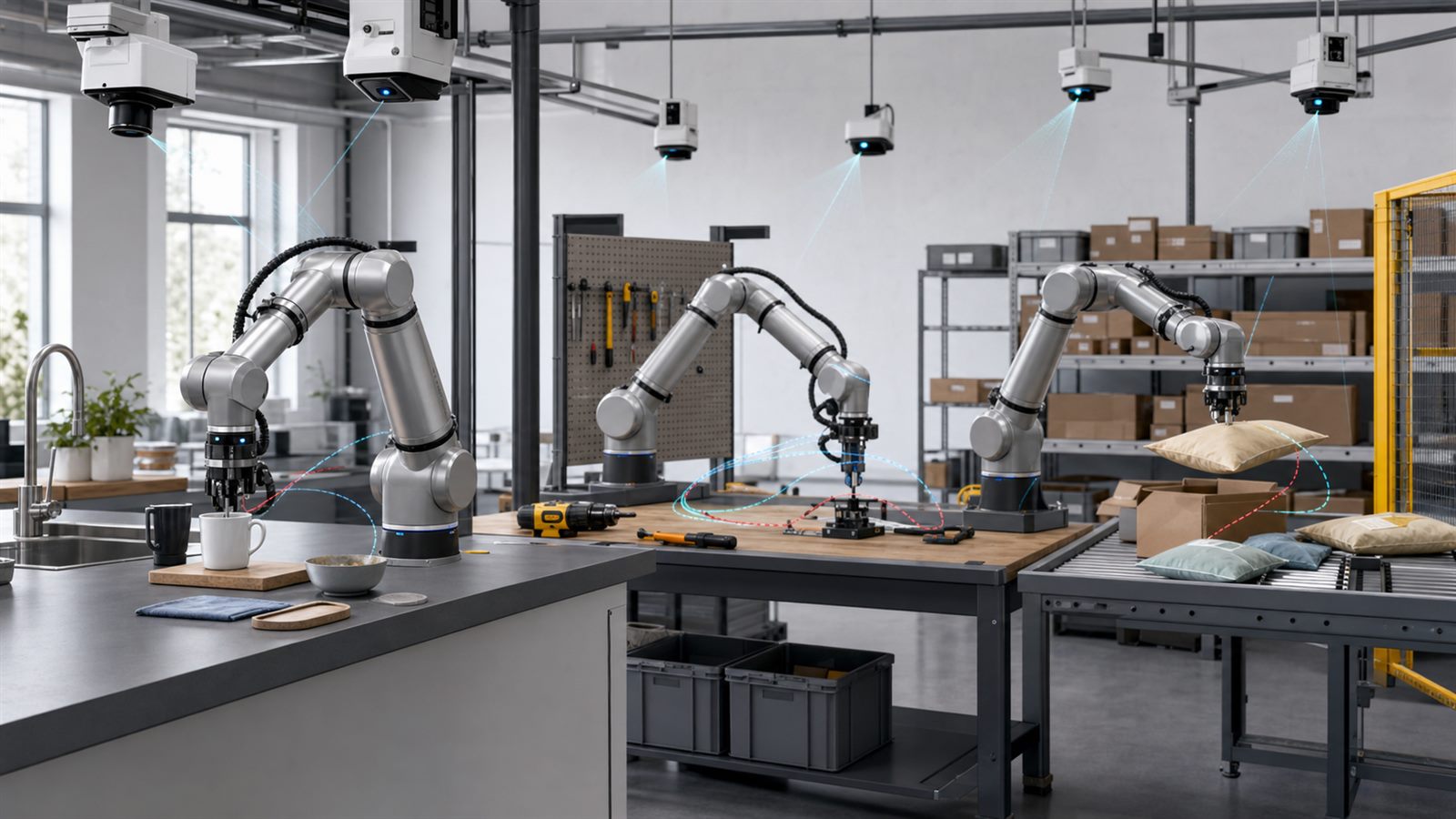
A robot cannot learn physical work from the open web in the same way a language model learns from pages of text. Useful manipulation data must connect camera images and sensor readings to precisely timed actions on real hardware. Someone has to operate the robot, arrange the scene, recover from mistakes, check the recording, and often repeat the task under different conditions.
That makes robot demonstrations expensive, but expense is only part of the challenge. A million nearly identical motions can teach a narrow habit. A smaller collection with varied objects, lighting, viewpoints, operators, failures, and environments may provide more useful evidence about how a policy will behave outside the laboratory.
A robot demonstration is a synchronized episode
A training episode typically contains a sequence of observations and actions. Observations may include fixed-camera images, wrist-camera images, depth, joint positions, gripper state, force, and tactile signals. Actions describe how the robot moved, while a language instruction or task label explains the intended goal.
These streams need accurate timing and calibration. If an action is paired with the wrong video frame, the model learns a distorted relationship between what it sees and what the robot did. Missing camera geometry, inconsistent units, or an undocumented controller can make data difficult to reuse on another system.
Repetition and diversity solve different problems
Repeated demonstrations help a model estimate a task reliably and capture natural variation in human control. Diversity determines whether that skill survives a change in cup shape, table height, clutter, lighting, camera position, or background. Both matter, but one cannot fully replace the other.
A dataset should describe its distribution rather than advertise only an episode count. Buyers and researchers need to know which tasks dominate, how many distinct scenes and objects are represented, how often attempts fail, and whether the evaluation environment resembles the training environments.
Open X-Embodiment showed the value of a common format
The Open X-Embodiment collaboration assembled datasets from 22 different robots across 21 institutions and represented them in a shared episode format. Its RT-X experiments provided evidence that training across robots can produce positive transfer, allowing experience from multiple platforms to improve policies on individual systems.
A common container is not the same as identical data. Different robots have different joints, cameras, grippers, action spaces, control rates, and task conventions. Standardization makes comparison and co-training possible, but models still need explicit mappings between embodiments and careful treatment of missing sensors.
DROID traded hardware variety for scene variety
The DROID project used a shared robot hardware setup across many institutions to collect about 76,000 demonstration trajectories, representing roughly 350 hours of interaction across hundreds of scenes. Keeping the arm, cameras, and control stack consistent reduced one source of variation while allowing collectors to move the system through laboratories, offices, and homes.
That design illustrates an important choice. A cross-robot dataset explores hardware diversity; a shared-platform dataset can concentrate on objects, tasks, operators, and environments. Neither is universally better. The right mixture depends on whether the target is one deployed robot family or a policy meant to adapt across many bodies.
Calibration and metadata are part of the training signal
Camera calibration connects pixels to physical geometry. Robot configuration identifies joint limits, gripper behavior, coordinate frames, and controller assumptions. Metadata about scene, operator, success, task, and collection software makes it possible to filter episodes and diagnose bias.
The DROID maintainers later published improved camera calibrations for tens of thousands of episodes and expanded language annotations for successful episodes. That is a reminder that datasets are maintained technical products. Versioning, correction records, licenses, and checksums matter alongside the raw recordings.
Successful demonstrations are not enough
If a dataset contains only smooth successes, a policy receives little evidence about how failure begins or how to recover. Real deployments include slipping objects, blocked paths, unexpected contact, ambiguous instructions, and partial task completion. Negative examples and recovery demonstrations can help distinguish a minor deviation from a state that requires stopping.
Failure data must be collected safely and labeled carefully. A robot should not be encouraged to explore dangerous contact around people or fragile equipment simply to increase variety. Safety limits, simulation, controlled perturbations, and human supervision define what can be recorded responsibly.
Language labels can hide disagreement
Vision-language-action models connect instructions such as placing an object in a container to continuous robot actions. Natural language makes a policy easier to command, but labels can be vague. Two annotators may describe the same motion differently, while the same phrase may refer to several acceptable outcomes.
Multiple descriptions, structured task metadata, and clear completion criteria can reduce that ambiguity. Language should complement sensor evidence rather than conceal a poorly specified task. This becomes especially important for robot foundation models that combine data from many sources.
Touch data is valuable and difficult to combine
Images reveal object appearance and approximate geometry, but they do not directly measure grip force, friction, softness, or whether an object has begun to slip. Tactile and force sensors can expose those hidden states, particularly for deformable items and close contact.
Sensor designs vary widely, making touch data harder to standardize than RGB images. Calibration drift and wear also affect measurements. The challenge supports the argument that robot hands need better touch and better benchmarks, not only larger vision datasets.
Target-domain demonstrations remain important
Large general datasets can provide a useful starting policy, but a new deployment has its own camera placement, objects, workflows, and failure costs. The DROID project documentation recommends adding a small amount of teleoperated data from the target domain when training for that setting.
This resembles adaptation in other machine-learning systems, but physical errors have immediate consequences. Local demonstrations should cover normal cases, edge cases, safe stops, and recovery states. They should also be separated carefully from evaluation data so a system is not tested on scenes it already saw during training.
Evaluation needs to reveal the dataset’s boundaries
A policy can score well when test tasks use familiar objects, backgrounds, or camera positions. Stronger evaluations change several factors independently and together. They measure task completion, unsafe contact, recovery, time, human intervention, and consistency across repeated trials.
Physical tests should state the hardware, controller, environment, and statistical uncertainty. That complements our discussion of repeatable robot agility testing: a polished demonstration is evidence that one run worked, not a distribution of performance.
Dataset governance will become deployment infrastructure
Organizations need provenance for who collected data, which consent and workplace rules applied, what licenses permit, and whether cameras captured personal or confidential information. Access controls and retention policies matter when data comes from homes, hospitals, or factories.
Documentation should also record dataset versions, known gaps, collection incentives, and filtering decisions. A robot policy may reproduce the habits and blind spots of its demonstrators, so collection teams and environments should be diverse enough to reveal systematic bias.
Limitations
Public robot datasets represent only part of the data used by commercial systems, so comparisons are incomplete. Results from one policy architecture may not transfer to another. Dataset size, task definitions, and success labels can also be counted differently, making headline numbers difficult to compare.
More diverse data does not remove the need for mechanical reliability, safety engineering, runtime monitoring, and testing on the deployed system. A learned policy is one component of a robot, not the entire safety case.
What to watch next
Watch for richer open dataset cards, common episode schemas that preserve calibration and licensing, practical methods for learning from failures, better integration of touch and force, and benchmarks that hold out entire environments rather than random episodes. Tools that reduce the labor of teleoperation without degrading labels will also matter.
Robot learning will benefit from more demonstrations, but scale is meaningful only when the recordings preserve the variety, context, and quality needed for machines to act reliably in a changing physical world.
Sources: Open X-Embodiment: Robotic Learning Datasets and RT-X Models; Open X-Embodiment dataset repository; DROID: A Large-Scale In-The-Wild Robot Manipulation Dataset; DROID policy-learning and dataset documentation.
Leave a Reply