
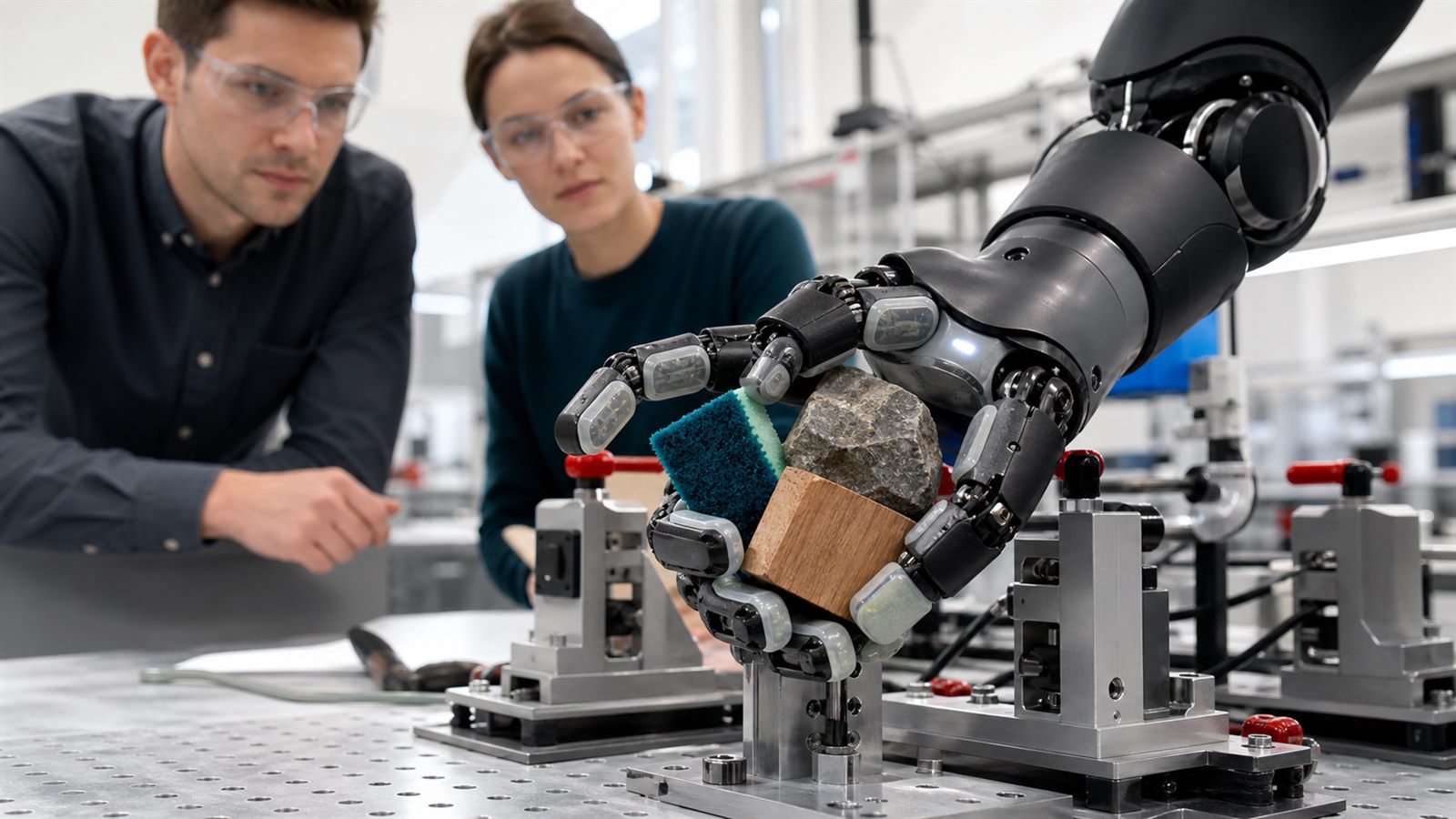
Robots can identify an object with a camera, estimate its pose, and plan a grasp before making contact. The difficult part often begins a fraction of a second later. A package shifts, a tool starts to slip, or a piece of fruit deforms under pressure. Vision can describe the scene, but it cannot directly measure what is happening at the contact surface.
That is why tactile sensing is becoming an important part of practical robotic manipulation. Researchers are spreading touch sensors across fingers and palms, combining them with compliant materials, and testing control systems that react to force and slip. The goal is not to reproduce every feature of a human hand. It is to give robots enough contact information to handle uncertain objects without crushing, dropping, or jamming them.
Vision Becomes Less Reliable at the Moment of Contact
A camera is excellent for locating visible edges and estimating the shape of an object. Once fingers wrap around that object, however, the most important contact points may be hidden. Small errors in position can also become large errors in force. A rigid gripper that closes a few millimeters too far may damage a delicate item, while one that stops too early may lose it.
Tactile sensors add measurements such as pressure, shear force, contact location, vibration, and deformation. Those signals can help a controller answer immediate questions: Has the object started to slip? Is one finger carrying too much load? Did the part reach the end of an insertion? The information complements vision rather than replacing it. Cameras provide the broad scene; touch provides local evidence after physical interaction begins.
This distinction matters as robot foundation models learn broader physical skills. A model may generate a plausible motion, but safe execution still depends on feedback that reveals whether the real object behaves as expected.
Full-Hand Touch Changes What a Robot Can Notice
A 2025 study in Nature Machine Intelligence described F-TAC Hand, a research hand with high-resolution tactile sensing across much of its surface. The system used vision-based tactile sensors: small cameras observed the deformation of compliant sensor material to estimate contact. The researchers reported 0.1-millimeter spatial resolution across 70 percent of the hand surface and evaluated the system in 600 real-world trials.
The significance is broader than the headline numbers. Tactile coverage on a fingertip can detect a pinch, but coverage across fingers and the palm can reveal how several objects interact during a grasp. That can support adjustments when items collide or shift. In the study, tactile-informed control performed better than alternatives that did not use the same contact information in complex manipulation tests.
This remains a laboratory system, not proof that a general-purpose hand is ready for factories or homes. The work assumed known object geometry for part of the evaluation, and the hardware required specialized sensing, calibration, and control. It nevertheless shows why dexterity is not only a question of adding joints. A highly articulated hand without useful feedback can still be clumsy.
Soft Grippers Turn Deformation Into Useful Data
Another route uses compliant fingers that naturally conform to objects. A 2026 open-access study in Microsystems & Nanoengineering integrated multimodal waveguide tactile sensors into a three-finger soft gripper. The research explored gentle grasping and the recognition of attributes such as shape and hardness.
Compliance can reduce damaging impacts because the finger bends instead of transferring every positioning error into the object. Sensors are still necessary, though. A soft material can mask how force is distributed, and its behavior may change with temperature, wear, or manufacturing variation. Useful systems therefore need both mechanical compliance and calibrated feedback. The controller must know what a given deformation means, not merely observe that deformation occurred.
Touch Data Needs Skills, Not Just More Sensors
Raw sensor output does not tell a robot what action to take. It must be translated into policies for grasping, insertion, sliding, bending, or detecting a failed operation. A separate 2025 Nature Machine Intelligence study proposed a process-centered taxonomy for tactile manipulation skills. The researchers organized contact-rich tasks around formal process descriptions and reusable control elements rather than treating every task as an unrelated end-to-end learning problem.
That approach highlights a practical choice for robotics teams. A large learned policy may offer flexibility, while a structured skill can make constraints and failure conditions easier to inspect. Real deployments will probably combine both: learned perception and adaptation inside a framework that defines allowed forces, expected contact events, and recovery behavior.
The same principle appears in robot safety standards for shared workspaces. A robot needs limits and measurable responses, not only an impressive demonstration under ideal conditions.
Benchmarking Is the Bridge From Demo to Deployment
Comparing robot hands is difficult because laboratories use different objects, tasks, sensor layouts, and definitions of success. A video of one successful grasp says little about repeatability, recovery, cycle time, maintenance, or the range of items a system can handle.
The US National Institute of Standards and Technology maintains an ongoing dexterous grasping program focused on performance metrics, test methods, and measurement tools. Its work treats picking up and placing objects as measurable capabilities. Useful evaluations include grasp strength, slip resistance, manipulation, touch sensitivity, contact safety, and the ability to complete a task repeatedly under controlled variation.
For buyers, these measurements are more valuable than a claim that a hand is “human-like.” A warehouse may need reliable handling of boxes and flexible bags. A food operation may care about bruising and sanitation. A laboratory robot may need precise force control around fragile samples. Each setting requires a different performance envelope.
The Remaining Limits Are Mostly Systems Problems
Tactile hardware introduces cost, cabling, calibration, processing, and durability requirements. Vision-based sensors can deliver detailed contact maps, but they need cameras, lighting, elastomer surfaces, and computational interpretation. Other sensors may be easier to package but provide lower spatial detail or drift over time. No single design is automatically best.
Training data is another constraint. Contact varies with material, speed, humidity, contamination, and wear. A policy trained on clean objects may behave differently with dust, oil, damaged packaging, or unknown products. The hand must also coordinate touch with vision, joint position, motor current, and task context quickly enough to prevent a small slip from becoming a drop.
Maintenance will be decisive. A sensor-rich hand that performs beautifully but requires frequent recalibration may lose to a simpler gripper with predictable uptime. This is one reason humanoid robots still face a difficult scaling path: hands are only one part of a system that must remain safe, serviceable, and economical.
What to Watch Next
The next useful advances will be less about adding the highest possible sensor density and more about proving stable performance. Watch for common benchmarks across laboratories, sensor modules that can be replaced without retraining an entire system, better simulation of contact, and policies that explain why they changed grip force.
Also watch for evidence from long-duration deployments. A strong result should include repeated tasks, unfamiliar objects, controlled disturbances, failure recovery, and maintenance data. Touch can make robot hands more adaptable, but the technology becomes commercially important only when that adaptability survives everyday messiness.
Leave a Reply