
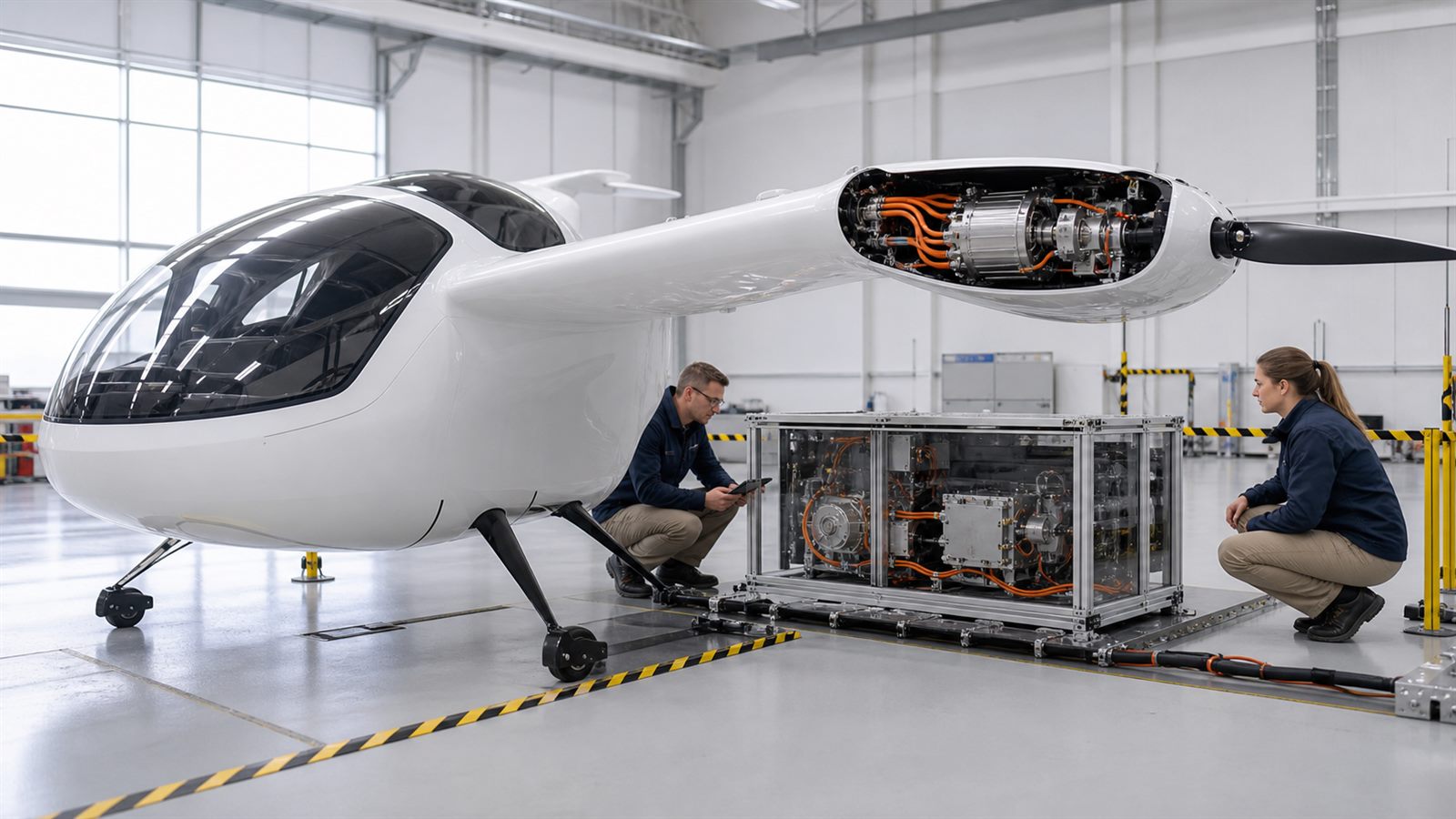
Electric aviation is often reduced to one question: when will batteries store enough energy for flight? Energy density matters, but an aircraft does not receive permission to carry people because its battery looks impressive on a chart. Regulators and manufacturers must show that the propulsion system, energy storage, software, wiring, thermal controls, structure, flight procedures, and maintenance program work safely together across foreseeable conditions and failures.
Recent certification work makes that systems problem visible. In February 2025, the European Union Aviation Safety Agency announced the first type certificate for an electric engine under its special condition for electric and hybrid propulsion systems. The Safran ENGINeUS 100 is aimed initially at small aircraft. In the United States, the Federal Aviation Administration includes electric and vertical-takeoff aircraft within its established certification process while developing supporting research and standards.
Certification Is a Process, Not a Final Flight Test
The FAA describes seven phases, beginning with design concept and continuing through requirements definition, compliance planning, implementation, testing and analysis, final certification, and post-certification activity. The applicant and regulator agree on the rules and means of compliance that apply to a particular design.
This matters for new propulsion technology because there may not be one existing rule written around the exact architecture. Regulators can use special conditions, accepted standards, analyses, ground tests, flight tests, inspections, and operational limitations to build a certification basis. Evidence accumulates throughout development rather than appearing in one dramatic demonstration.
A component certificate is only one layer. A certified electric motor is not a certified airplane. The aircraft installation must address propellers or fans, energy storage, power electronics, cooling, controls, wiring, structure, pilot information, and interaction with every other system.
Electric Propulsion Changes the Failure Map
Electric motors have relatively few moving parts and can respond quickly to control inputs. They also depend on inverters, sensors, high-voltage distribution, connectors, insulation, software, and a continuous source of electrical energy. A fault can propagate through electrical and thermal paths that differ from those in a conventional piston or turbine installation.
Engineers need to identify single failures, combinations of failures, common causes, and hidden degradation. They must show that protective devices isolate faults without removing more propulsion than expected. Redundant channels are useful only when they do not share a vulnerable battery, cooling loop, software defect, connector, or sensor assumption.
The connected, software-heavy nature of future vehicles is also why our overview of electric and autonomous transportation treats energy, automation, and infrastructure as one system.
Batteries Must Be Safe Before, During, and After a Failure
A battery pack must supply takeoff and climb power, preserve required reserves, tolerate temperature and altitude, and remain within safe limits as cells age. Certification work can include cell characterization, pack-level abuse tests, containment, ventilation, fire detection, isolation, monitoring, and procedures for damaged or overheated batteries.
Thermal runaway is not addressed by claiming that a cell chemistry is safer in general. Designers need evidence for the exact cells, pack arrangement, spacing, barriers, cooling, state-of-charge range, and installation. They must consider whether a failing cell can heat neighboring cells, release gases into occupied areas, damage control wiring, or compromise the structure.
Battery state estimation is safety-relevant. Pilots and flight computers need trustworthy information about available energy and power under current temperature, age, and load. A pack can have remaining energy but be unable to deliver required peak power. Conservative reserve logic and clear alerts matter as much as an optimistic range estimate.
High Voltage Behaves Differently at Altitude
Electric aircraft can use high voltage to reduce current and cable mass. Lower air pressure changes insulation and electrical-discharge behavior, while moisture, contamination, vibration, manufacturing variation, and connector wear can reduce margins. Wiring routes and separation must also limit the effects of chafing, fluid exposure, and maintenance errors.
Lightning and electromagnetic interference remain aircraft-level concerns. Power electronics switch large currents quickly and can create electrical noise. The propulsion system must coexist with navigation, communications, flight controls, and sensors without causing unacceptable interference, and it must tolerate the external electromagnetic environment.
The FAA’s research plan specifically identifies electric-propulsion work involving endurance, durability, reliability, environmental conditions, electromagnetic effects, and lightning. These subjects are less visible than a prototype flight but central to certification.
Thermal Management Has to Work on the Ground Too
Motors, inverters, cables, and batteries produce heat. Cooling can be more difficult during taxi, charging, or a hot turnaround when airflow is limited. A design must handle expected ambient conditions and degraded cooling without relying on a perfect dispatch schedule.
Thermal systems also consume mass and power. Pumps, radiators, ducts, coolant, sensors, and protective structure reduce the mass available for passengers or energy storage. This is why comparing only motor efficiency or cell energy density can misrepresent the useful aircraft.
Distributed Propulsion Adds Control Opportunities and Complexity
Electric power can be distributed to several motors, potentially enabling new wing layouts, control strategies, and redundancy. It also creates more propulsion units, inverters, cables, sensors, and failure combinations. The aircraft must remain controllable when thrust becomes asymmetric or a power bus is isolated.
For vertical-takeoff designs, lift depends continuously on propulsion during hover. That can make energy reserve, fault response, and flight-control integration especially demanding. Conventional-wing electric aircraft can often glide after losing power, but they still need safe margins for takeoff, climb, diversion, and landing.
Software Must Explain and Contain the Unexpected
Battery management, motor control, thermal protection, energy prediction, cockpit displays, and sometimes flight control are software-driven. Certification requires disciplined development, traceable requirements, verification, configuration management, and evidence that the system handles invalid sensor data and internal faults.
Updates after entry into service need the same care. Our article on safety-critical vehicle software updates focuses on road vehicles, but its core lessons about signatures, compatibility, recovery, and fleet monitoring also apply to connected aviation systems. Aviation approval and operational processes add their own requirements.
Charging and Airport Operations Are Part of the Product
A useful aircraft needs reliable charging, power capacity, safe connectors, battery inspection, and turnaround planning at intended airports. Fast charging can increase heat and affect battery life. Grid upgrades can take longer than installing a charger.
Operators must train pilots, mechanics, rescue services, and ground staff. They need procedures for damaged batteries, towing, storage, firefighting, and transport of replacement packs. Maintenance organizations need diagnostic equipment and approved data. A technically airworthy aircraft can still fail commercially if the operating network is too fragile.
The infrastructure challenge resembles heavy-duty road charging, though aviation duty cycles and certification are different. Our guide to megawatt charging for trucks explains why connection capacity and utilization matter alongside charger power.
Small Aircraft Are the Practical Starting Point
EASA’s first electric engine certification is significant precisely because it is bounded. The agency describes the initial applications as small two-seat aircraft, with the engine family spanning power levels suited to that class. Short training flights, local operations, and smaller payloads can fit current energy storage better than long-range airliners.
Hybrid-electric systems may address longer missions by combining batteries and electric distribution with another energy source. They add generators, fuel systems, controls, and integration complexity, so “hybrid” is not a shortcut around certification. It is a different architecture with its own failure cases.
What Claims Deserve Caution
A prototype flight does not establish certified range, reliability, payload, charging time, battery life, community noise, or operating cost. Predictions should identify the configuration, reserve assumptions, weather, battery condition, route, and certification status.
Environmental comparisons also need the electricity source, manufacturing, battery replacement, aircraft utilization, and the conventional aircraft being displaced. Electric propulsion can reduce local emissions and noise, but benefits vary by mission and energy system.
What to Watch Next
Watch for propulsion and aircraft type certificates, published means of compliance, battery containment evidence, high-voltage environmental testing, and operating data from small electric fleets. Also watch whether airports build charging capacity with common interfaces and whether manufacturers disclose support and battery-replacement plans.
Battery progress will expand what is possible, but certification progress determines what can safely carry people. The most credible electric-aircraft programs will show not only that they can fly, but that their complete system can tolerate faults, be maintained, and repeat the mission under regulated operating conditions.
Leave a Reply