
Deep-space missions are becoming data-hungry. Better cameras, spectrometers, radar instruments, and human missions can create more science data than a conventional radio link can return quickly. Laser, or optical, communications promise a much wider channel than radio without requiring an enormous spacecraft antenna.
But a laser link is not a cosmic fiber cable. It has to keep two moving terminals aligned across millions of miles, deliver enough photons to a sensitive receiver, survive atmosphere and weather at the ground station, and turn a faint signal into error-free data. NASA’s Deep Space Optical Communications demonstration showed that the approach works. Turning it into routine mission infrastructure is a systems-engineering problem.
DSOC proved an important capability
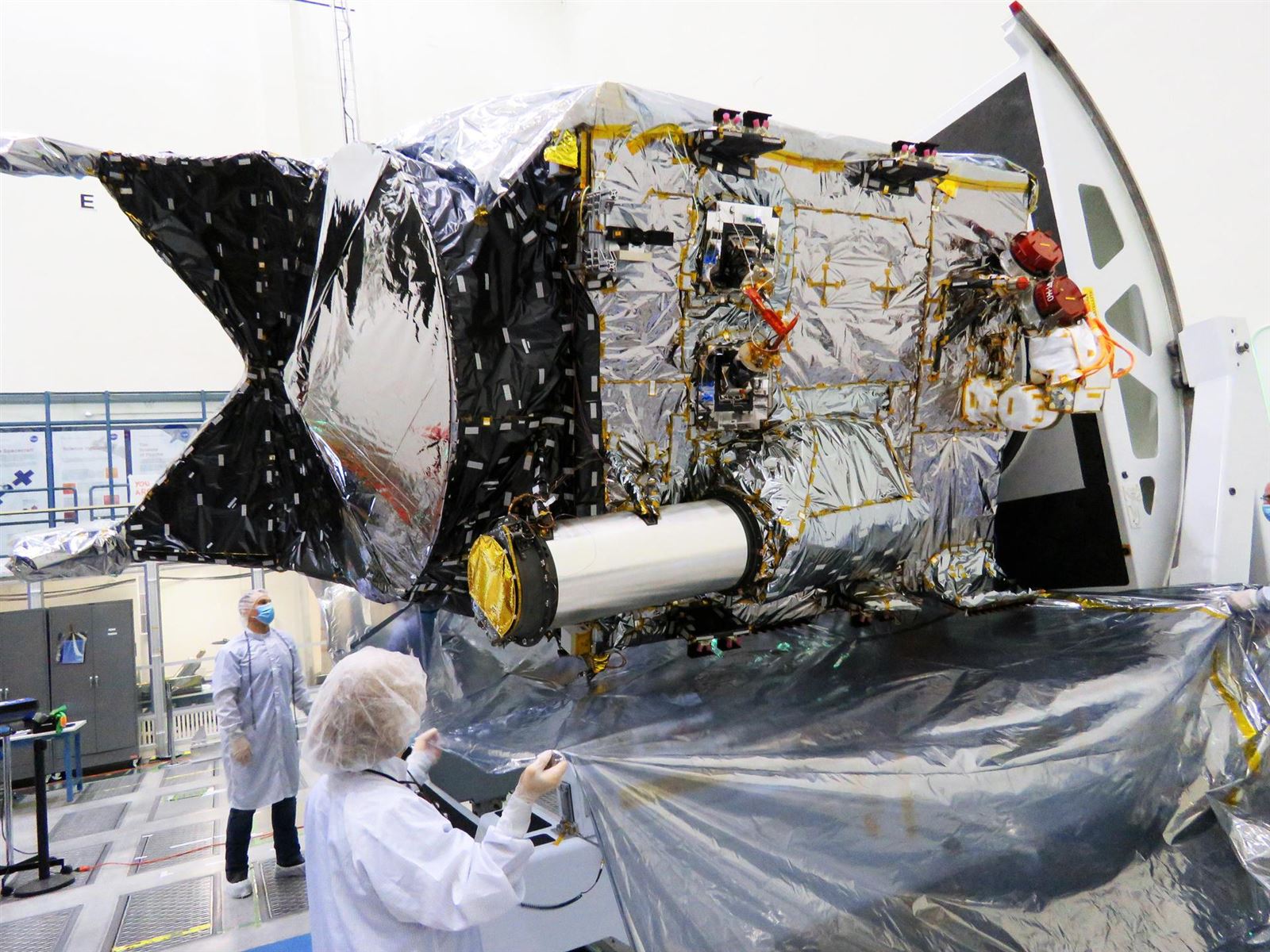
NASA’s Deep Space Optical Communications experiment flew with the Psyche spacecraft and completed its final pass in 2025. NASA describes it as the first optical-communications demonstration beyond the Earth-Moon system. Its flight laser transceiver, a ground laser transmitter, and a ground receiver worked together across deep-space distances.
The result is significant because an optical terminal can carry much more information than a comparable radio system when the link is available. NASA reports that DSOC returned 13.6 terabits of data and demonstrated a record optical link from 307 million miles away. Those are demonstrations, not a promise that every future spacecraft will receive the same speed.
A mission’s useful return still depends on distance, transmitter power, aperture size, pointing stability, receiver sensitivity, and the time it can see a ground station. Data rate falls as the spacecraft moves farther away.
A narrow beam is both the advantage and the challenge
Radio antennas spread energy over a broader angle. A laser can concentrate energy much more tightly, helping a small number of photons carry a useful signal over a long distance. That narrowness also makes the link unforgiving. A tiny pointing error can move the beam off the receiver.
DSOC used a pointing and isolation assembly to reduce the effect of spacecraft vibration on its telescope. The ground uplink laser also served as a beacon for the flight terminal to find and track. Acquisition, tracking, and pointing are not setup details; they are part of the communication system.
Future terminals must manage attitude-control jitter, structural vibration, thermal distortion, ephemeris error, and the changing light geometry around the Sun. A high-rate modem is useless while the optical terminals cannot hold one another.
Photon counting changes the receiver design
At deep-space range, received optical power can be extremely low. DSOC used a sensitive superconducting nanowire photon-counting receiver at Caltech’s Palomar Observatory for the downlink. The receiver is designed to distinguish the arriving optical signal from background noise well enough to recover coded data.
This is different from simply putting a faster camera behind a telescope. Detector efficiency, timing precision, cooling, optical filtering, telescope tracking, and atmospheric conditions shape the link budget. Brighter skies, scattered sunlight, and turbulence can all reduce the margin.
Ground infrastructure is therefore as important as flight hardware. A single observatory can be clouded out at the wrong moment. Networks of optical ground stations, geographically separated sites, and coordination with radio links can improve availability, but they also add cost and operational complexity.
Weather is a link-layer problem
Clouds can block an optical path completely. Haze, water vapor, turbulence, and daylight background can also change performance. Radio links have their own weather and spectrum constraints, but they generally tolerate cloud cover better than optical links.
The practical answer is not to declare one technology the winner. Future missions are likely to use optical links as a high-capacity complement to radio, retaining radio for robust command, low-rate telemetry, contingency operations, or times when the optical path is unavailable.
That hybrid approach resembles the relationship between new and existing infrastructure in HVDC grid interconnections: a high-performance path becomes valuable only when it integrates reliably with the wider network.
Codes and synchronization make faint signals usable
Optical links need more than a laser and a telescope. They need framing, modulation, clock recovery, coding, and error control that fit the photon-limited channel. The Consultative Committee for Space Data Systems released an updated optical communications coding and synchronization recommended standard in March 2026.
Standards matter when agencies and contractors want terminals, ground stations, and mission operations to interoperate. Without common rules, every new laser terminal becomes a bespoke experiment with its own integration cost. Standards do not remove physical link limits, but they reduce the cost of using a proven physical link across more missions.
Network protocols must also cope with long light-time delays. A retransmission request to a Mars-distance spacecraft may take many minutes or longer to complete. Missions need forward error correction, prioritized data products, onboard storage, and scheduling that anticipates an interrupted optical pass.
More bandwidth does not remove the data-management bottleneck
When a mission can return more imagery or instrument data, the bottleneck can move to onboard storage, power, ground processing, archive capacity, or the scientists who must calibrate and interpret the data. The same pattern appears in synthetic-aperture radar: more observations are useful only when ground systems can validate and analyze them.
Mission planners should therefore ask which data products are truly limited by downlink. A laser terminal can make high-resolution imaging, video, and dense science instruments more practical, but it should be paired with a plan for compression, onboard selection, storage, and data delivery.
Limitations and tradeoffs
Optical terminals require precise optics, thermal control, pointing hardware, and specialized ground receivers. They can be sensitive to geometry and atmospheric conditions. A mission that needs continuous coverage may require more ground sites than a radio-only design. Compatibility also evolves: standards can help, but early systems will still have unique hardware and operations.
Deep-space laser communications should not be mistaken for instant consumer internet from Mars. Propagation delay remains set by physics. A faster downlink sends a larger file during a contact; it does not make a round trip across the solar system feel local.
What to watch next
Watch for operational laser terminals on robotic and crewed missions, expanded optical-ground-station networks, improved weather-diversity scheduling, and wider adoption of CCSDS standards. The key evidence will be sustained availability and delivered science data, not a single peak bitrate.
DSOC turned deep-space laser communications from a long-running promise into a demonstrated capability. The next step is building a dependable network around that capability: accurate pointing, sensitive receivers, weather-aware operations, common protocols, and radio fallbacks when the light path disappears.
Leave a Reply