
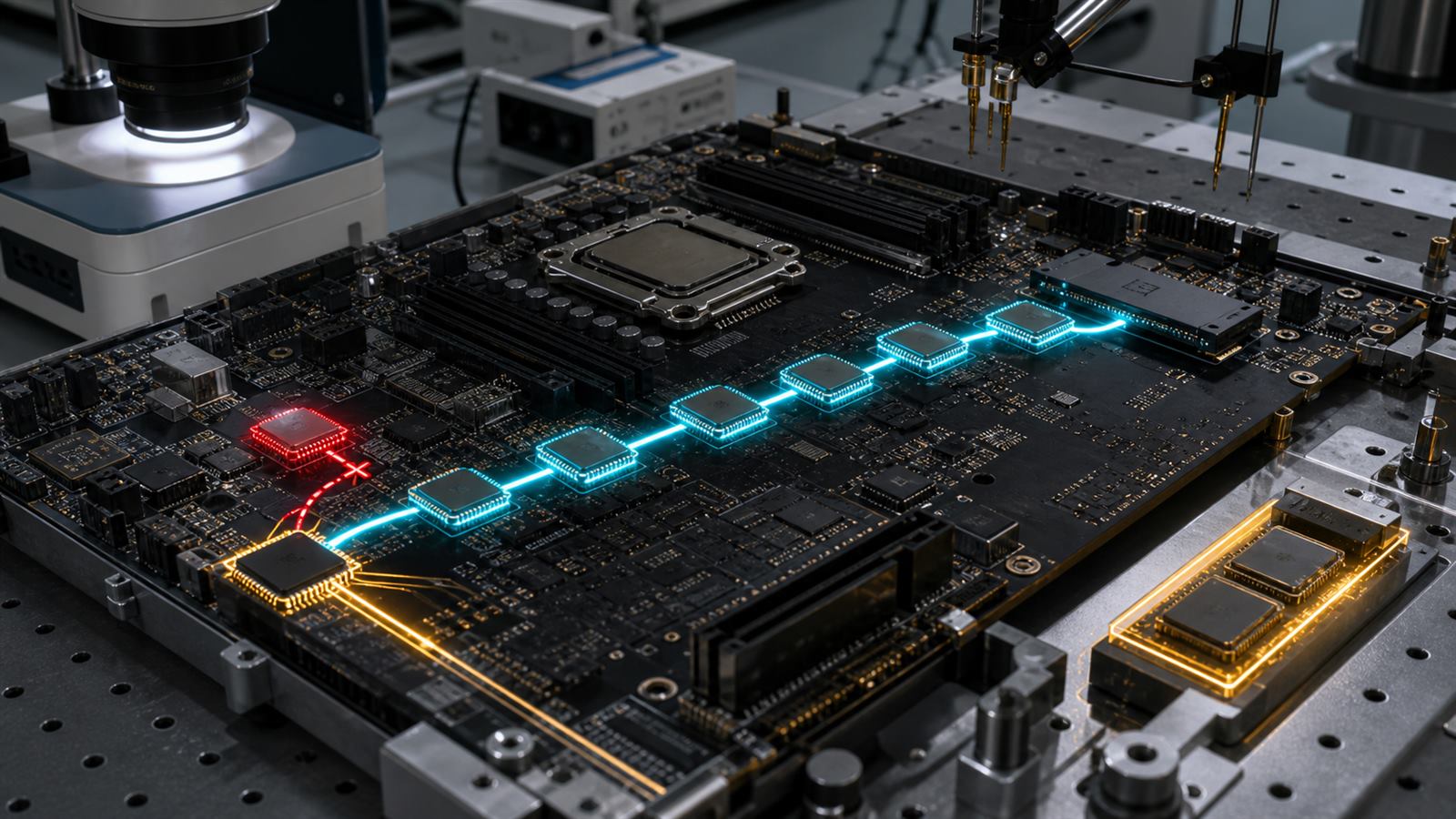
Secure Boot is often presented as a single switch that makes a computer’s startup trustworthy. The switch matters, but the label is easy to overread. Secure Boot checks whether early software is authorized by the platform’s key policy. It does not prove that signed firmware has no vulnerability, monitor everything after startup, or guarantee that a damaged device can repair itself.
A resilient platform needs a larger loop: protect firmware from unauthorized changes, detect corruption that still occurs, and recover to a known-good state. That is the difference between a device that blocks one bad bootloader and one that can survive a failed update or destructive firmware attack.
Firmware controls the machine before the operating system
Platform firmware initializes processors, memory, storage, and peripheral devices before the operating system starts. Its privileged position makes compromise unusually serious. Malware below the OS can evade tools that depend on the OS, while careless corruption can leave the computer unable to boot at all.
NIST SP 800-147 focuses on preventing unauthorized BIOS modification and authenticating firmware updates. It also notes a boundary that remains important: system firmware, option ROMs, UEFI drivers, and firmware inside other devices may not all be covered by one mechanism.
That scope question should be the first one asked of any “hardware-secured” product. A chain is only as broad as the components it actually verifies.
What UEFI Secure Boot verifies
The UEFI specification defines Secure Boot policy variables and signature databases. In a typical PC, a platform key establishes ownership, a key-exchange database authorizes changes, an allow database identifies accepted images or signers, and a forbidden database revokes known-bad images.
During startup, the firmware checks executable images against this policy before allowing them to run. That can stop an altered or unauthorized bootloader from taking control ahead of the operating system.
A valid signature establishes provenance and integrity relative to a key. It does not establish that the code is free from logic errors. This is the same distinction that appears in certificate transparency: cryptographic evidence can reveal who authorized an object without making every authorized object safe.
Trust databases need maintenance and revocation
A platform may trust many publishers and historical boot components. If one approved component later proves vulnerable, simply leaving Secure Boot enabled is not enough. The device needs a safe way to update its forbidden-signature database and stop accepting that component.
Revocation creates a deployment problem. Blocking an old loader before a compatible replacement is installed can make a working device unbootable. Updating the replacement first but delaying revocation leaves an attack window. Vendors need staged updates, dependency checks, rollback planning, and clear failure handling.
Keys also have lifecycles. Manufacturers and platform owners need protected generation, storage, rotation, delegation, and emergency replacement. An attacker who can authorize new keys can turn a signature check into an approval service for malicious code.
Verified Boot and Measured Boot answer different questions
Verified Boot enforces policy: an unauthorized component is blocked. Measured Boot records cryptographic measurements of startup components, usually extending them into registers in a Trusted Platform Module. A verifier can later compare signed evidence and an event log with an expected policy.
Microsoft’s official boot-process documentation describes this separation: Secure Boot checks the bootloader, Trusted Boot continues verification into the operating system, and Measured Boot records startup evidence for remote assessment.
Measurement does not automatically declare a device healthy. The remote service needs a fresh challenge, a trusted device identity, an interpretable event log, known-good reference values, and policy for legitimate updates. A hash can prove that something changed without explaining whether the change was authorized.
NIST adds protection, detection, and recovery
NIST SP 800-193 organizes platform firmware resilience around three principles. Protection keeps firmware code and critical data from unauthorized modification. Detection identifies corruption. Recovery restores code and data to integrity after corruption is found or an authorized recovery is requested.
These functions need roots of trust that ordinary host software cannot rewrite. Update verification, write protection, integrity measurements, and recovery decisions are weak if an already-compromised operating system can silently replace their policies.
The design parallels modern software build provenance. Both systems need authenticated origins and tamper evidence, but device resilience adds a physical availability requirement: the platform must still be able to return to service.
A recovery image must be protected too
Recovery is not merely a second copy of the same firmware in writable storage. A useful recovery path needs an authenticated image, protected metadata, an independent way to trigger restoration, and enough power-failure tolerance to avoid corrupting both active and backup copies.
Rollback control is equally important. A perfectly signed old image may contain a publicly known vulnerability. A security version counter or equivalent policy can prevent restoration below an approved minimum, while a deliberate service procedure can handle exceptional repair cases.
Recovery also needs testing. A feature that has never survived an interrupted update, damaged flash region, or lost configuration should not be treated as operational resilience. Vendors should state which components can recover automatically, which require removable media or service tools, and which failures require board replacement.
Secure startup does not secure runtime
Once authorized code starts, vulnerabilities in the operating system, drivers, management firmware, applications, or network services can still be exploited. Secure Boot is not antivirus, memory isolation, access control, or patch management.
Some peripherals initialize through option ROMs or run their own firmware. Storage controllers, network adapters, graphics devices, embedded controllers, and management processors may have separate update and verification chains. Procurement claims should name the protected components rather than using “firmware” as if it were one file.
An inventory such as an SBOM can help identify affected software, but it does not enforce boot policy or restore a corrupted flash device. Inventory, verification, detection, and recovery solve different parts of the problem.
How to evaluate a device or fleet
For an individual PC, confirm that Secure Boot is enabled, firmware updates come from the manufacturer, and recovery keys or media are stored appropriately. Do not disable Secure Boot as a routine troubleshooting step; systems that need custom operating systems can often enroll an owner-controlled key instead.
For fleet purchases, ask which firmware regions and devices are authenticated, how revocation updates are delivered, whether rollback is blocked, what measurements are available, how attestation policy handles updates, and what happens after an interrupted flash. Request a documented support period and a recovery demonstration for representative failures.
Administrators should also monitor firmware versions and configuration drift. A green Secure Boot status on one day does not prove that keys, revocation lists, or peripheral firmware will remain current for the life of the machine.
Limitations and tradeoffs
Strict allow lists can complicate repair, alternative operating systems, accessibility tools, and older hardware. Broad trust databases improve compatibility but enlarge the set of accepted code. Automatic recovery improves availability but can conceal repeated faults unless events are logged and investigated.
Remote attestation can support device access decisions, yet it introduces privacy, identity, availability, and policy-management questions. A verifier that rejects every unfamiliar measurement can lock out legitimate updates; one that accepts everything provides little security.
What to watch next
The practical advances will be narrower default trust stores, dependable revocation, broader coverage of device firmware, transparent security-version policies, standardized attestation evidence, and recovery mechanisms that work after real failures. Update support duration will matter as much as the badge printed on a new product.
Secure Boot remains a valuable first gate. Firmware resilience is the complete system around that gate: deciding what may start, noticing when integrity is lost, and restoring the platform without trusting the component that may already be compromised.
Leave a Reply