
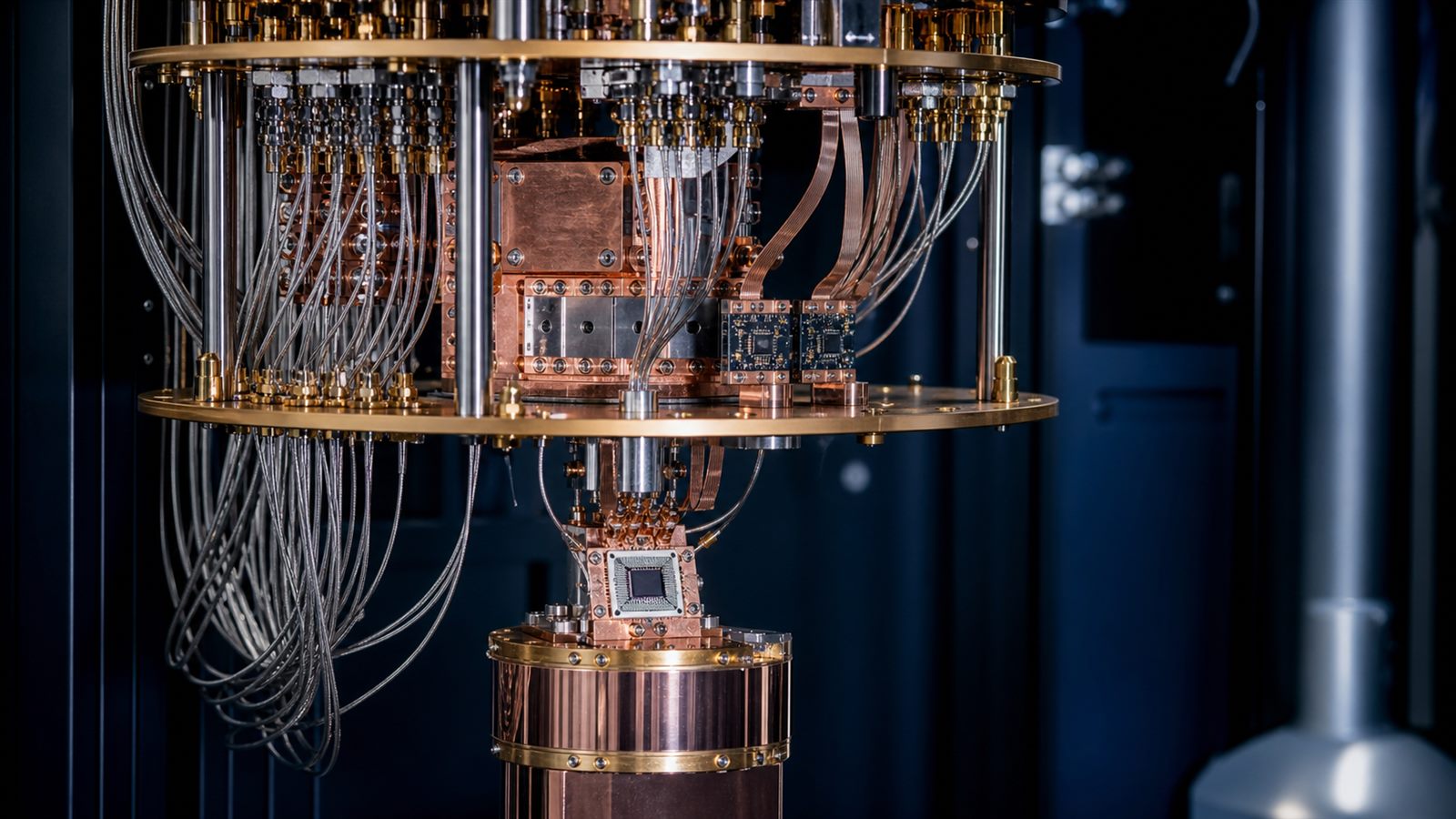
Quantum computers are usually discussed in terms of qubits, errors, and algorithms. A less glamorous component may become just as important: the classical electronics that send instructions to each qubit and read the result. Today’s superconducting systems connect ultra-cold processors to racks of room-temperature equipment through a dense collection of cables.
That arrangement works for research machines, but it becomes difficult to extend to the very large processors envisioned for fault-tolerant computing. Every line occupies space, carries heat toward the coldest stage, and adds components that must be calibrated. Researchers are therefore moving parts of the control system into the refrigerator, where they can sit closer to the qubits and share lines through multiplexing.
Quantum Hardware Still Needs Classical Instructions
A superconducting qubit is manipulated with carefully shaped microwave pulses. Other signals tune components, trigger measurements, amplify faint responses, and move data back to conventional computers. Quantum error correction would require many of these operations to happen repeatedly and with low latency.
The US National Institute of Standards and Technology describes this scaling challenge as a control and readout bottleneck. Its Flux Quantum Electronics project studies superconducting microwave and mixed-signal circuits that could operate near cryogenic qubits. The aim is to avoid a growing “rat’s nest” of wires between room-temperature racks and a processor inside a cryostat.
This problem is connected to, but distinct from, qubit quality. A processor can have excellent individual qubits and still be hard to scale if the surrounding control stack consumes too much power, creates noise, or requires one dedicated cable for every operation.
Putting Control Electronics in the Cold Changes the Architecture
Conventional electronics are most comfortable near room temperature. A dilution refrigerator, by contrast, has several temperature stages, with the quantum processor operating near absolute zero. Moving control closer to the processor requires circuits that work reliably in the cold while dissipating very little heat.
Two broad approaches are under active development. Cryogenic CMOS adapts the semiconductor technology used in ordinary computing, often placing controllers at a somewhat warmer stage of the refrigerator. Superconducting digital logic uses Josephson junctions and can operate at much lower temperatures. The technologies differ in power, speed, manufacturing, signal generation, and how closely they can be integrated with qubits.
The architectural benefit is multiplexing. One incoming control path can be distributed among several qubits by local electronics, reducing the number of cables that must cross temperature boundaries. The cost is that active circuits now sit near extremely sensitive quantum hardware.
A 2026 Experiment Integrated Digital Control With Qubits
A 2026 study in Nature Electronics reported an active quantum processor unit that combined superconducting qubits and single-flux-quantum digital control electronics in one multi-chip module. The chips were connected with flip-chip bonding, a packaging method that creates short, dense electrical connections between facing dies.
The system used digital demultiplexing to route control pulses to several qubits instead of preserving a simple one-line-per-qubit relationship. The researchers reported single-qubit gate fidelities above 99 percent and as high as 99.9 percent in their experiments.
Those results show that nearby superconducting control can operate without automatically destroying useful qubit performance. They do not demonstrate a large fault-tolerant computer. The experiment involved a limited module, and scaling it would require more routing, more simultaneous activity, more readout, and tighter management of heat and interference.
Heat and Noise Are the Central Trade-Off
The coldest stage of a dilution refrigerator has very little cooling capacity. A control circuit that seems low-power by ordinary chip standards may still release too much heat close to the qubits. Cables create passive heat paths, while active circuits generate heat whenever they switch. Engineers must decide which functions belong at room temperature, which can move to a warmer cryogenic stage, and which need to sit at millikelvin temperatures.
Electrical noise is equally important. Qubits can lose coherence when they interact with unwanted electromagnetic signals or nonequilibrium particles. Local control can shorten connections and reduce cable count, but it also places switching electronics near the device being protected. Packaging, shielding, filtering, timing, and thermal design become one combined problem.
This is why system-level evidence matters alongside a headline fidelity number. Useful tests must include many simultaneous operations, idle qubits, repeated error-correction cycles, and the thermal behavior of a complete control stack.
Wireless and Optical Links Offer Other Ways Through the Refrigerator
Researchers are also exploring alternatives to conventional copper coaxial cables. A 2025 Nature Electronics study demonstrated a wireless terahertz cryogenic interconnect built with CMOS technology. Its 260-gigahertz architecture was designed to move information between temperature stages while reducing the ratio of heat delivered to information transferred.
Optical links pursue a related goal. Fibers conduct less heat than metal cables and can carry high data rates, but converting between light and the microwave signals used by superconducting qubits introduces efficiency, noise, and packaging challenges. The most realistic future system may mix technologies: optical or wireless links between stages, cryogenic electronics for local routing, and short microwave connections at the processor.
That hybrid direction also connects with work on photonic quantum hardware, although the roles are different. In a superconducting machine, light may serve as part of the classical control or readout infrastructure rather than as the qubit itself.
Control Scaling Cannot Be Judged by Qubit Count
A vendor can increase the number of qubits in a processor while leaving major questions about control unresolved. Readers should look for the number of independent control and readout channels, the degree of multiplexing, power at each temperature stage, simultaneous gate performance, calibration overhead, and the effect of control activity on neighboring qubits.
Independent measurement is especially important because architectures make different trade-offs. A system optimized for a short demonstration may not sustain deep circuits or continuous error correction. This is another reason quantum computing needs independent benchmarks rather than a race based on one hardware number.
The surrounding software matters too. Multiplexed hardware needs schedulers that avoid conflicting pulses, calibration tools that track drift, and diagnostics that locate failures across quantum and classical components. As processors grow, control electronics will look less like laboratory instruments and more like a specialized data-center network operating across extreme temperatures.
What to Watch Next
The next milestones should demonstrate cryogenic control across larger qubit arrays while preserving coherence during simultaneous operation. Watch for measured power per controlled qubit, control-line reduction, readout integration, packaging yield, and operation over long error-correction experiments.
Also watch how teams divide functions across temperature stages. A successful design may not put everything beside the qubits. It will place each task where latency, power, noise, and repairability make sense. Comparisons with neutral-atom quantum computers are useful because other qubit platforms face different control bottlenecks.
Useful quantum computing will require better qubits and better error correction. It will also require an enormous classical machine capable of controlling those qubits without overwhelming their environment. The wiring problem is not a side issue. It is part of the computer.
Leave a Reply