
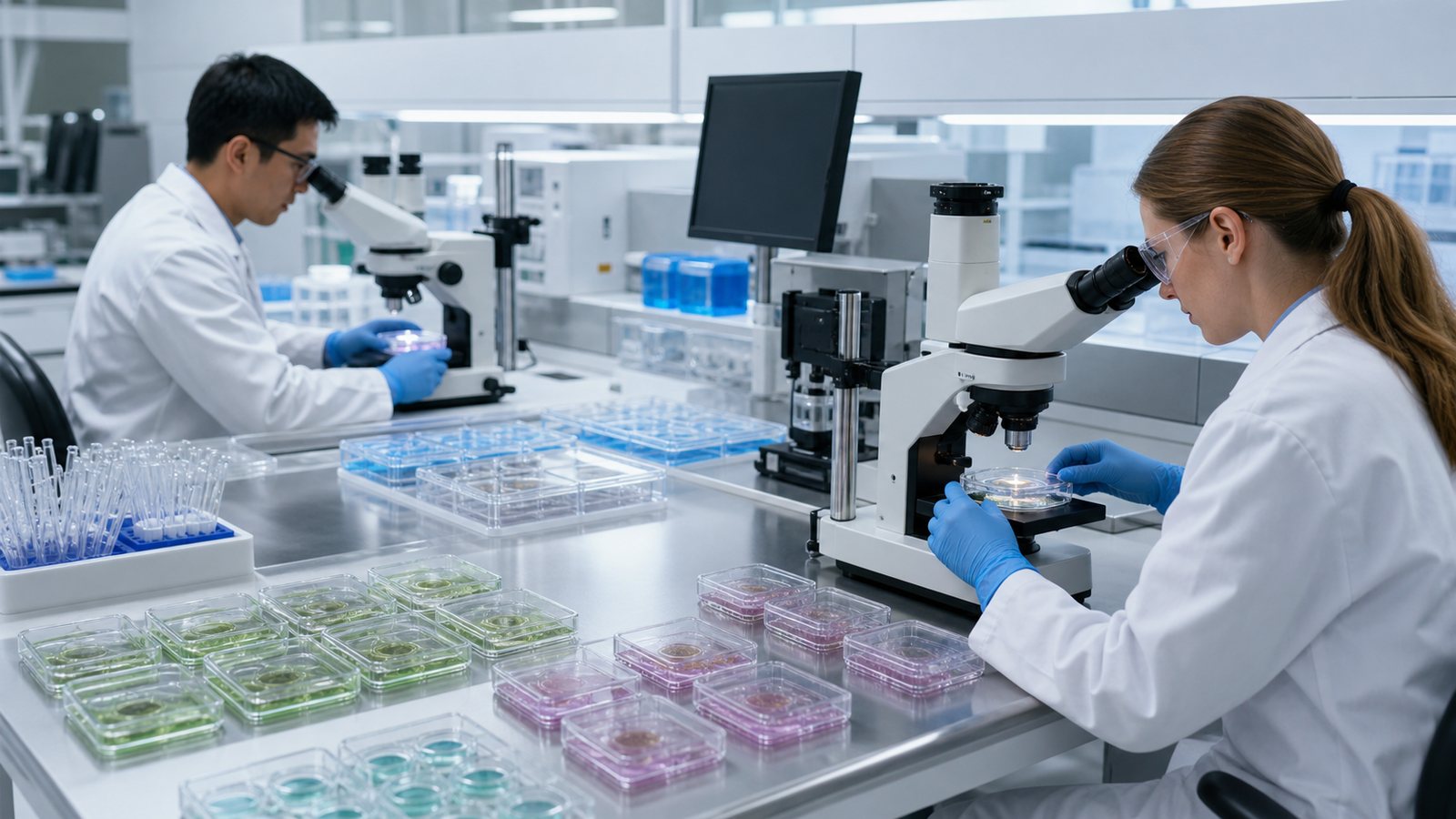
Organoids are miniature, simplified tissue models grown from cells. They can mimic selected features of organs such as the intestine, brain, liver, or lung, and they are becoming important tools for drug development, disease research, and personalized medicine. But the excitement around organoids can hide a hard engineering problem: reproducibility.
If two laboratories grow organoids from similar cells and get different results, the model may still be scientifically interesting, but it becomes harder to use for routine decisions. For organoids to move from promising research tools to dependable biotechnology platforms, scientists need better standards for cell sourcing, culture conditions, measurements, and data reporting.
Organoids Are Powerful Because They Preserve Context
Traditional cell cultures often grow as flat layers. They are useful, but they can miss three-dimensional structure, cell diversity, and tissue-like behavior. Organoids can preserve more of that context, which is why researchers use them to study development, disease mechanisms, infection, toxicity, and drug response.
The National Institutes of Health supports this direction through programs such as the Standardized Organoid Modeling program. Its focus on reproducible organoid models is a signal that the field is moving beyond one-off demonstrations. The goal is not simply to make organoids, but to make organoids that other researchers can understand and compare.
This builds on the broader shift we covered in organs-on-chips and regulatory tools. Better human-relevant models can reduce dependence on less predictive systems, but only if the model itself is well characterized.
Reproducibility Starts With Cell Identity
An organoid is not a generic product. Its behavior depends on the starting cells, donor background, genetic changes, reprogramming methods, passage number, and culture history. Two models called by the same tissue name may not be equivalent.
That makes cell identity and provenance essential. Researchers need to document where cells came from, how they were handled, what quality checks were performed, and whether the cells changed over time. Without those details, a surprising result may reflect biology, contamination, drift, or a subtle difference in protocol.
The same issue appears in genome-editing safety analysis. Biology is sensitive to starting conditions, and good measurement begins with knowing exactly what system is being measured.
Culture Conditions Can Change the Outcome
Organoids depend on media, growth factors, extracellular matrix materials, oxygen levels, timing, mechanical conditions, and handling technique. Small changes can influence size, maturation, cell composition, and response to drugs.
That is a problem for scale. A model that works in one expert lab may not transfer cleanly to a contract research organization, pharmaceutical screening facility, or hospital-linked testing program. Automation can help, but automation must be paired with validated protocols and quality controls.
Useful standards should describe not only the recipe, but the acceptable range of variation. If organoids are too large, too immature, too heterogeneous, or missing key cell types, the downstream assay may look precise while measuring the wrong thing.
Measurements Need Reference Points
Researchers often measure organoids using imaging, sequencing, protein markers, functional assays, and drug-response curves. Each method adds information, but each method also creates choices. Which markers define maturity? Which imaging features indicate healthy structure? Which statistical threshold separates a true drug effect from noise?
Reference data can help. A well-described organoid model should be compared with relevant human tissue, known controls, and expected failure modes. It should also include uncertainty. A clean chart without error estimates can be misleading.
The US Food and Drug Administration’s work on advancing alternative methods shows why evidence quality matters. New approach methodologies can be valuable, but regulators need to understand when a model is fit for a particular purpose.
Drug Screening Raises the Stakes
Organoid drug screening is attractive because it may reveal human-relevant responses earlier than some traditional tests. Cancer organoids, for example, can sometimes be grown from patient tumor samples and exposed to candidate therapies. Disease organoids can help compare compounds in a more tissue-like setting.
But screening is only useful when the assay is stable. If organoid size, composition, or maturity varies across plates, drug-response differences may come from manufacturing noise. High-throughput screening also needs consistent imaging, dosing, incubation, and analysis pipelines.
This does not make organoids unreliable. It means the field is entering a manufacturing and quality-systems phase, similar to the platform questions in gene-editing therapy development. Powerful biology needs disciplined process control.
What Better Reporting Should Include
- Cell source, donor information where appropriate, passage number, and authentication method.
- Culture media, matrix, growth factors, timing, oxygen conditions, and handling steps.
- Quality-control metrics for size, morphology, marker expression, viability, and contamination.
- Assay protocols, controls, analysis software, and uncertainty estimates.
- Known limitations, failed batches, and conditions where the model should not be used.
These details can feel tedious, but they decide whether other labs can reproduce a result. They also help companies decide whether an organoid model is ready for screening, validation, or regulatory discussion.
What to Watch Next
Watch for more public reference organoid models, shared protocols, benchmark datasets, and regulatory case studies that define fit-for-purpose use. The most important progress may not look like a dramatic image. It may look like boring metadata, quality criteria, and documented failure modes.
Organoids can make biotechnology more human-relevant, but they will earn trust through repeatability. The next phase is less about proving that miniature tissues can grow and more about proving that they can be measured, compared, and used responsibly.
Leave a Reply