
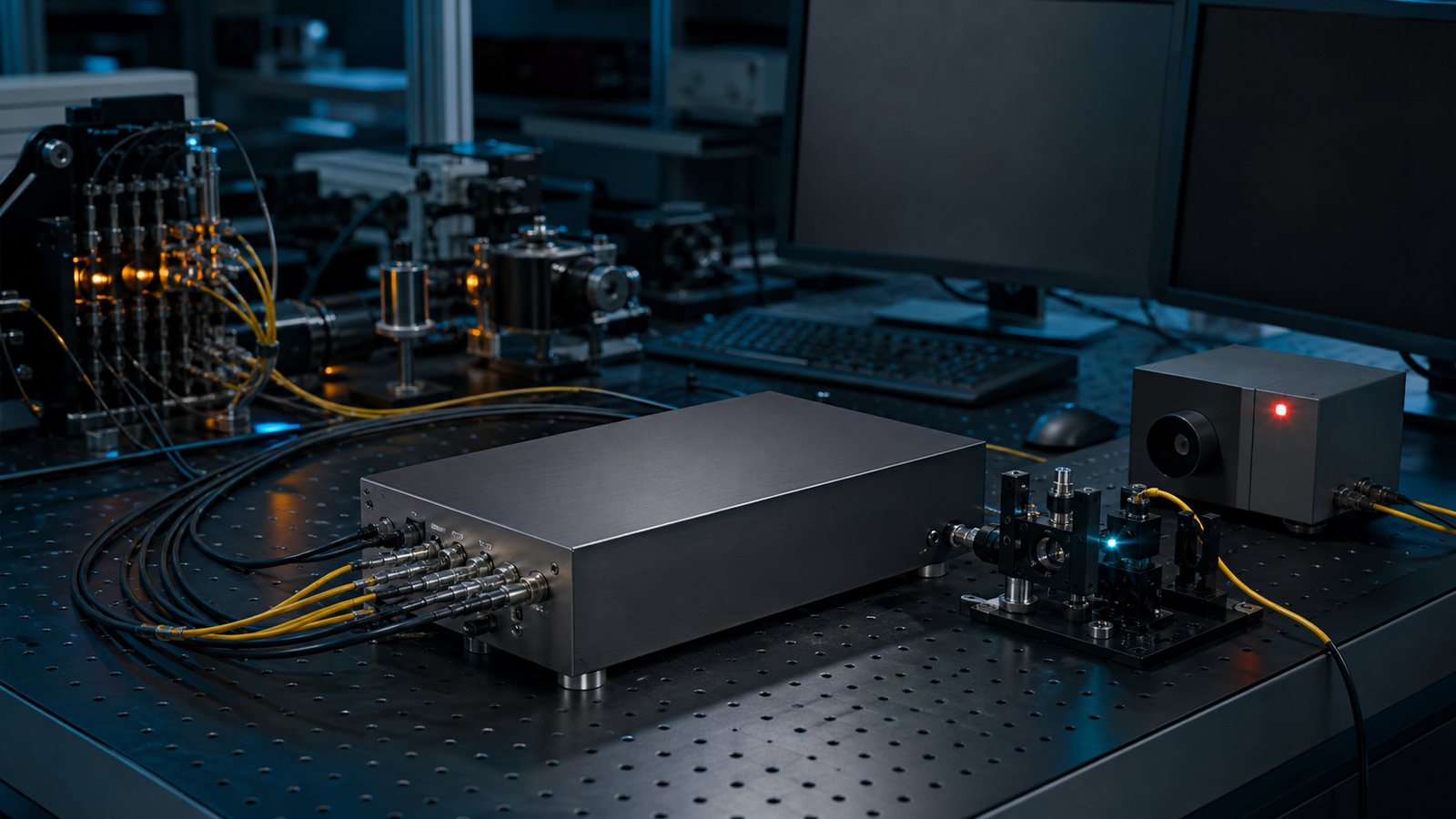
Random numbers are easy to overlook until they fail. Encryption keys, authentication tokens, simulations, lotteries, and secure protocols all depend on numbers that attackers cannot predict. Quantum random number generators, or QRNGs, promise randomness rooted in quantum physics rather than ordinary software behavior.
That promise is useful, but it is not magic. A device can use a quantum process and still produce weak output if its detector, electronics, calibration, extraction algorithm, or health checks are poorly designed. The practical question is not whether quantum randomness exists. It is how a product proves that its output is trustworthy.
Why Randomness Matters
Cryptography often assumes that keys are unpredictable. If a key generator has hidden bias, repeats values, or can be influenced by an attacker, otherwise strong encryption can fail. Randomness is therefore a foundation beneath many security systems.
Conventional random-number generators can be deterministic algorithms seeded with entropy from physical events. A quantum generator tries to use a physical quantum process, such as photon behavior, as the entropy source. In principle, that can provide a strong source of unpredictability.
This sits beside, but is separate from, the post-quantum cryptography migration discussed in our encryption upgrade article. Post-quantum cryptography changes algorithms to resist future quantum computers. Quantum random-number generation tries to improve the raw unpredictability used by security systems today.
The Entropy Source Is Only the Start
A QRNG begins with a physical process, but the device must convert that process into digital bits. That means optical components, detectors, analog electronics, digitization, filtering, and randomness extraction. Each layer can introduce bias, noise, or failure modes.
NIST’s random bit generation project and SP 800-90B focus on entropy sources and validation concepts. The lesson for QRNGs is direct: claims about randomness require measurement, modeling, and ongoing health tests, not only a reference to quantum mechanics.
A good device should estimate the minimum entropy it can reliably provide under expected conditions. It should also detect when the physical source is blocked, saturated, drifting, overheated, or otherwise outside its valid operating range.
Extraction Turns Biased Signals Into Usable Bits
Raw physical measurements are rarely perfect. They may contain bias, correlations, detector artifacts, environmental noise, or electronic interference. A randomness extractor processes the raw data to produce output that is closer to uniform and independent.
Extraction is not a way to create entropy from nothing. It can concentrate and clean entropy that is already present, but it depends on correct assumptions about the source. If the source produces less entropy than expected, the output may look statistically smooth while being weaker than claimed.
This is why certification and documentation matter. Buyers need to know the entropy model, extraction method, throughput limits, startup behavior, and health tests. A marketing claim of quantum randomness is not enough.
Statistical Tests Are Necessary but Not Sufficient
Randomness test suites can identify obvious patterns, bias, and correlations. They are useful quality checks. But passing statistical tests does not prove that a generator is secure. A flawed generator can pass a test sample and still fail under different operating conditions or adversarial influence.
NIST’s randomness testing resources are widely used for evaluation, but the deeper security question includes source design and entropy estimation. Statistical testing observes output. Security assessment also asks why the output should remain unpredictable.
This resembles the caution around AI cyber capability evaluations: a benchmark or test suite is evidence, not a complete guarantee.
QRNGs Need Operational Health Checks
A random-number generator is not useful if it silently fails. Health checks should run during startup and operation, watching for stuck bits, abnormal rates, detector saturation, signal loss, and other conditions that invalidate the entropy model.
Some failures are ordinary engineering issues. A light source can age, a sensor can drift, temperature can change behavior, and firmware can contain bugs. Other failures may be security-relevant. An attacker might try to influence a physical source or exploit a poorly isolated interface.
That makes QRNGs part of the broader device-security story. Hardware, firmware, supply chain, configuration, and monitoring all matter. A quantum source does not remove the need for secure engineering.
Where QRNGs Make Sense
QRNGs are most attractive where high-quality entropy is valuable and the cost, certification, and integration work are justified. Examples include security modules, data centers, telecom equipment, high-assurance systems, and scientific applications that need reliable randomness.
Consumer devices may also advertise quantum randomness, but ordinary buyers should be cautious. The presence of a quantum component does not automatically make a phone, router, or wallet safer. The implementation, certification, and software integration decide whether the randomness improves the whole system.
For many systems, a well-designed conventional entropy source and deterministic random bit generator may be adequate. The choice should be based on threat model and evidence, not buzzwords.
Integration is also practical. A QRNG must feed operating systems, cryptographic libraries, or hardware security modules in a way those systems can actually use. If output is buffered incorrectly, mixed poorly, or trusted without monitoring, the quantum source may add complexity without improving the final security boundary.
What to Watch Next
Watch for clearer certification paths, public entropy-source documentation, independent lab testing, and integration with hardware security modules. Also watch whether vendors disclose health-test behavior and failure handling. A generator that fails closed is more trustworthy than one that keeps outputting questionable bits.
Quantum random-number generators are a good example of practical quantum technology. They can be useful before large-scale quantum computers arrive, but their value depends on mundane engineering proof: measurement, validation, certification, and honest limits.
Leave a Reply