
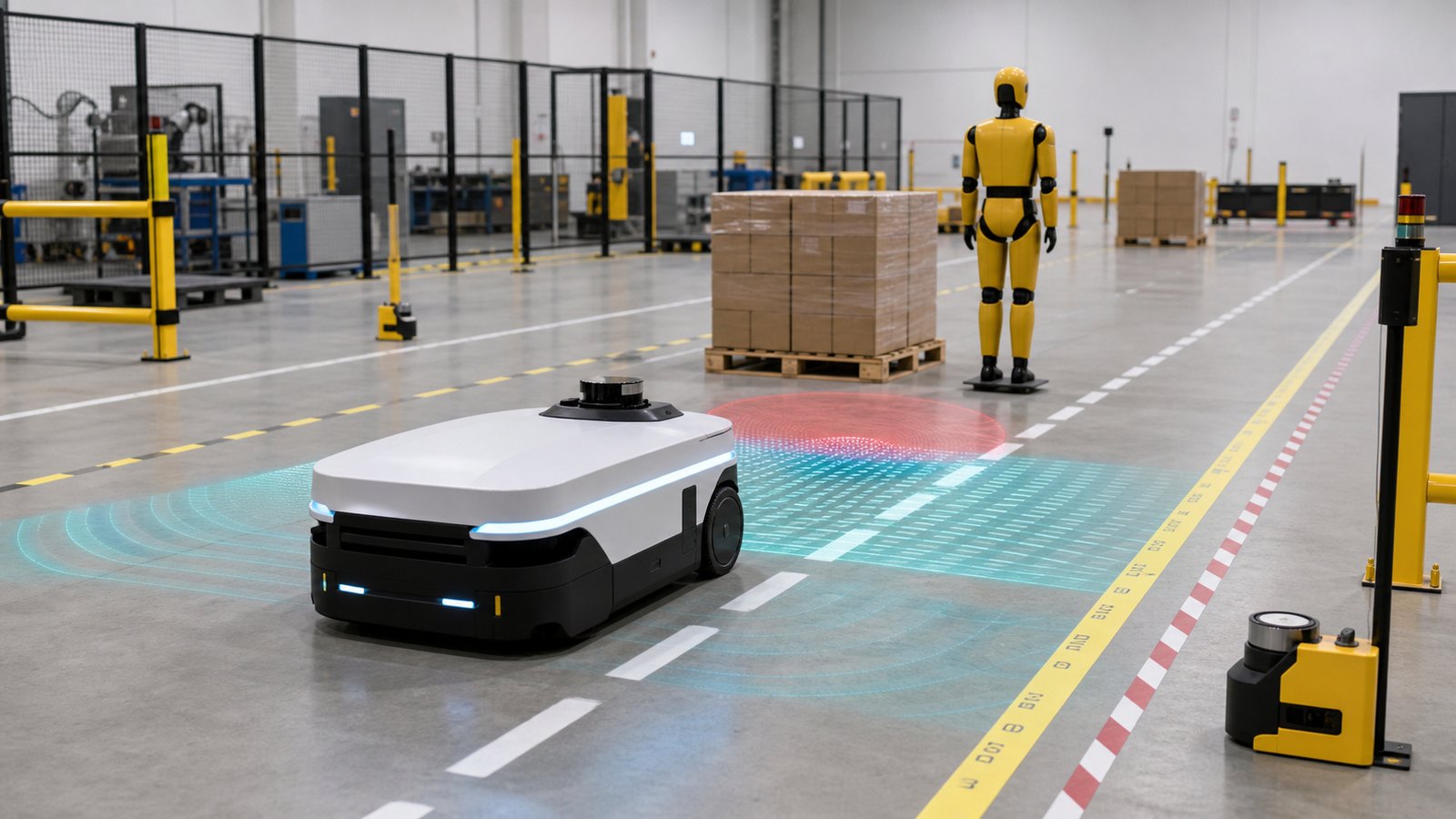
Autonomous mobile robots are becoming ordinary warehouse equipment. They move totes, carry shelves, deliver parts, and help logistics teams handle repetitive transport work. The technology can be useful, but safe deployment is not just a question of buying a robot with sensors. Mobile robots share space with people, forklifts, pallets, doors, charging stations, and other machines. That makes safety a systems problem.
For ordinary technology readers, the key point is simple: a mobile robot is not safe merely because it stops in a demo. It must be evaluated in its specified operating environment, with the right loads, floor conditions, traffic rules, speeds, visibility limits, and human workflows. The practical future of warehouse robotics depends as much on standards and test methods as on autonomy software.
Mobile robots are different from fixed robots
Traditional industrial robots often work inside fenced cells or defined collaborative workspaces. Autonomous mobile robots move through changing environments. A warehouse aisle may contain shrink wrap, dust, reflections, temporary obstacles, open pallets, workers carrying boxes, or another robot crossing the same path. The robot’s sensors and software must interpret that changing scene while following site rules.
This is why mobile robot safety cannot be reduced to one lidar sensor or one emergency stop button. The robot, payload, route design, traffic management system, worker training, maintenance procedure, and facility layout all matter. A robot that is safe in one aisle may be inappropriate in another if slopes, blind corners, loading practices, or pedestrian traffic differ.
Standards give buyers a vocabulary
Industrial mobile robot standards such as ANSI/RIA R15.08 and ISO 3691-4 help define safety expectations for different classes of mobile systems. They are not exciting in the way a robot demo is exciting, but they give manufacturers, integrators, and facility operators a shared vocabulary for risk assessment, operating environments, protective functions, and user responsibilities.
NIST’s work on mobile robotics systems research and standard test methods is important for the same reason. Common performance metrics make it easier to compare robots across mobility, perception, manipulation, and safety-related behavior. Without repeatable tests, buyers risk evaluating robots by video clips, vendor claims, or narrow pilots that do not reflect daily operations.
Safety starts before the robot arrives
A credible deployment begins with the workflow. What task will the robot perform? What route will it use? Who can enter that space? What happens if a pallet blocks the route? How fast can the robot move with and without a load? How will workers know whether a robot is yielding, rerouting, charging, or stopped? How are failures reported?
Those questions sound procedural, but they determine whether autonomy helps or creates confusion. A warehouse can add robots faster than it updates training, signage, incident reporting, and traffic planning. That gap is where near misses can appear. The lessons are similar to those in Robot Agility Needs Repeatable Tests Before Buyers Can Trust the Demo: repeatable measurement matters more than impressive motion.
Interoperability is a safety issue too
Many facilities do not want to be locked into one robot vendor forever. They may use separate systems for picking, towing, inventory scanning, cleaning, and transport. If each fleet has its own map, traffic manager, status format, and operating assumptions, the site can become harder to manage. Interoperability work from groups such as MassRobotics aims to let autonomous mobile robots share basic information such as position, speed, direction, health, and task status.
Interoperability does not solve safety by itself. A shared status format is not the same as a unified traffic-control system or a complete risk assessment. But it helps humans and software understand what mixed robot fleets are doing. That matters as warehouses move from isolated pilots to everyday multi-vendor automation.
Limits buyers should not ignore
Mobile robots can struggle with messy edge cases: hanging plastic, mirrors, low obstacles, unusual floor markings, clutter, damaged pallets, wireless dead zones, or people behaving unpredictably. A system may perform well during a vendor-supervised pilot and still need months of tuning before it is reliable in normal operations.
Payloads also change risk. A small robot carrying light totes is different from a large mobile base carrying a heavy shelf or fitted with a robot arm. The robot’s braking distance, stability, center of gravity, sensor field of view, and safe speed all depend on the task. That connects to the tactile and manipulation questions raised in Robot Hands Need Better Touch, Not Just Better Vision. Mobility and manipulation become harder when robots physically interact with the world.
What good deployment looks like
A good deployment is boring in the right ways. Routes are mapped and reviewed. Workers understand robot behavior. Emergency stops and recovery procedures are tested. Speed limits match the environment. Near misses are recorded. Software updates are controlled. Charging areas do not create trip hazards. The operator knows which organization is responsible for maintenance, cybersecurity, and incident response.
Cybersecurity also belongs in the safety discussion. A connected robot fleet depends on wireless networks, cloud dashboards, local controllers, and sometimes APIs connected to warehouse-management systems. Exposure management ideas like those in CTEM Turns Vulnerability Management Into Continuous Exposure Reduction apply to robotics because a software failure can become a physical operations problem.
What to watch next
Watch for more transparent test reports, clearer user responsibilities, mixed-fleet interoperability, and standards that keep pace with mobile manipulators and humanoid robots. Humanoid demos will get attention, but warehouse mobile robots are where many businesses will meet practical autonomy first.
The durable robotics market will not be built on dramatic videos alone. It will be built on machines that can be evaluated, integrated, maintained, and operated safely in real workplaces. Standards are not the glamorous part of robotics, but they are what let automation scale without turning every deployment into an experiment.
Sources: NIST Mobile Robotics Systems Research and Standard Test Methods; MassRobotics AMR Interoperability Standard overview; A3 presentation introducing R15.08 industrial mobile robot safety.
Leave a Reply