
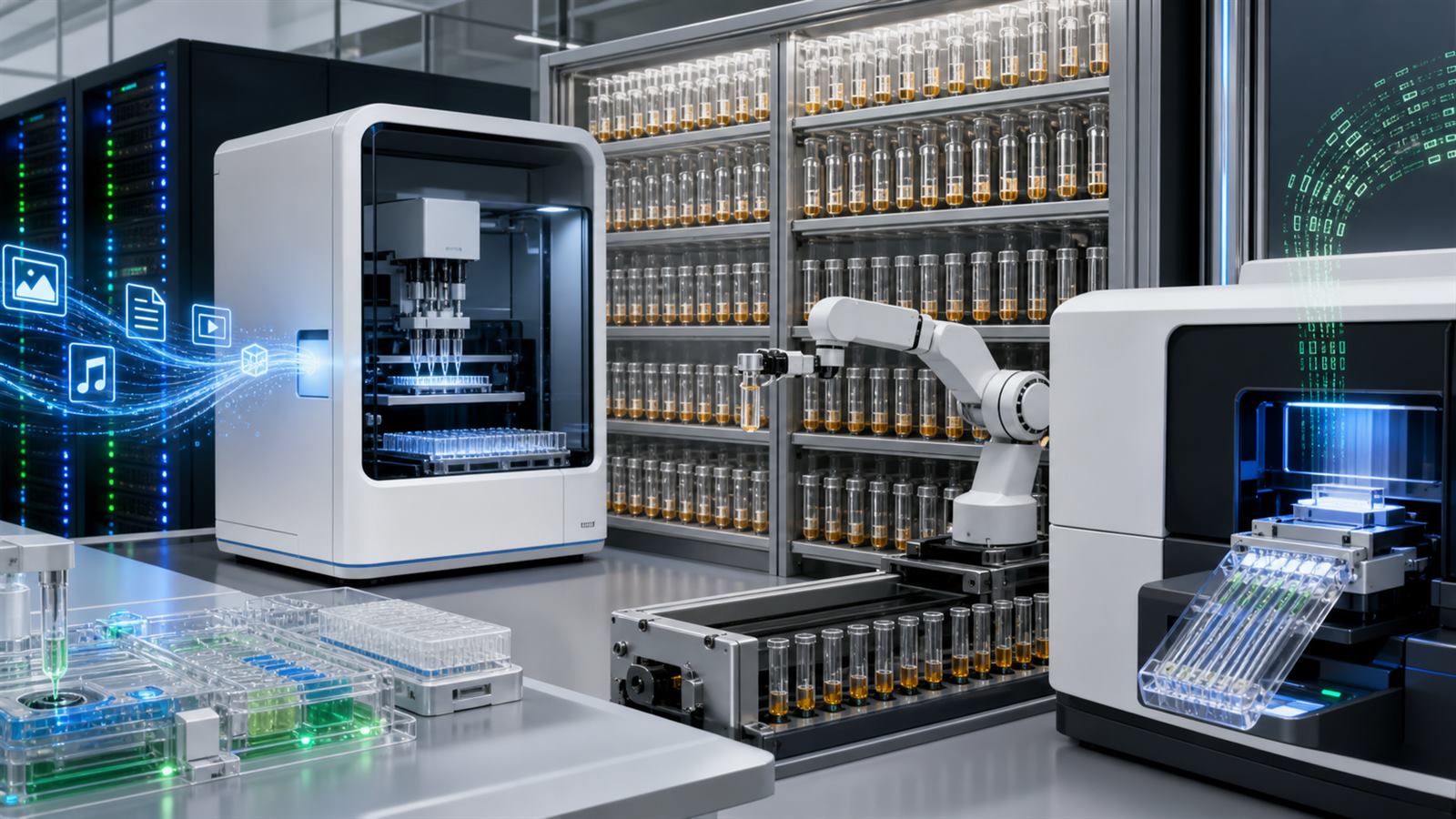
DNA is often introduced as an almost impossibly dense storage material. In principle, a small quantity of synthetic DNA can represent a large digital archive, and dry DNA can remain stable far longer than magnetic tape when it is prepared and stored correctly. Those properties make it attractive for data that must survive for decades but is rarely opened.
Density and durability, however, are only properties of the medium. A usable archive also needs a file format, addresses, error correction, a way to find one object without reading everything, durable packaging, and enough metadata for a future system to decode the molecules. DNA storage will become practical only when that complete chain is reliable and affordable.
DNA is the medium, not the file system
Ordinary storage hides several layers. An application creates a file, a file system assigns locations and metadata, a controller protects blocks against errors, and a drive turns those blocks into physical states. DNA storage needs equivalents for all of them, even though its physical medium is a pool of molecules rather than ordered sectors on a disk.
The SNIA DNA Data Storage Technology Review, published in 2025, describes an end-to-end pipeline that includes coding, DNA synthesis, preservation, retrieval, sequencing, and decoding. Demonstrations have connected those stages, but the review characterizes commercialization as nascent. The important comparison is therefore not DNA density against a hard drive platter. It is one complete, recoverable archive against another.
A codec translates bits into constrained molecules
A DNA storage codec maps binary data into sequences built from adenine, cytosine, guanine, and thymine. A naive two-bits-per-base mapping looks efficient, but synthesis and sequencing do not treat every possible sequence equally. Long runs of one base, extreme ratios of certain bases, and repeated patterns can raise error rates or complicate identification.
Practical encoders add sequence constraints, indexes, checks, and redundancy. They may divide a file into many short packets because current systems generally synthesize short strands rather than one chromosome-length data object. Every extra address or parity symbol reduces headline density, but removing those protections can make the archive impossible to reconstruct.
This is a familiar lesson from biotechnology. Our explanation of programming cells with synthetic biology shows that DNA is a physical substrate with context-dependent behavior, not an abstract string that can be manipulated without constraints.
Errors are more complicated than a flipped bit
Electronic storage often models an error as a bit changing value. DNA pipelines can introduce substitutions, insertions, deletions, missing strands, uneven numbers of copies, and contamination. Some molecules may never be recovered from a sample, while others appear many times in the sequencing output.
Error-correcting codes and consensus decoding compensate for these effects. Addresses help group reads that belong to the same packet, and redundancy lets software reconstruct missing information. The decoder also has to decide which reads are genuine enough to use. Long-read and short-read instruments have different error profiles; our guide to long-read sequencing and short-read limits explains why read length alone does not determine data quality.
A storage claim should therefore report the original data size, synthesized bases, redundancy, sequencing coverage, failed strands, recovered bytes, and final error rate. Quoting only theoretical bases per gram conceals most of the engineering problem.
Random access must avoid reading the entire pool
An archive containing millions of short strands is physically unordered. To retrieve one file, a system needs molecular addresses and a selective operation that enriches the desired strands before sequencing. Otherwise, opening one photograph could require reading the whole archive.
A landmark 2018 Nature Biotechnology experiment stored more than 200 megabytes across over 13 million DNA oligonucleotides. The researchers used a primer library to select individual files and reported error-free recovery of 35 files. This showed that large-pool random access is possible, but it did not remove the need to manage primer interactions, amplification bias, sample handling, and repeated access.
Researchers continue to explore alternatives. A 2025 Nature Communications study used CRISPR-Cas9-based selection and machine-guided sequence design to support random access and content-oriented search. It is promising research, not evidence that commercial DNA archives can already search arbitrary content at cloud-storage speed.
A future reader needs instructions from the archive itself
A durable medium is not useful if the decoder disappears. A DNA vial stored for a century may outlive the company, software, sequencer model, and codec that created it. The archive needs a discoverable bootstrap record describing its format, organization, codec, and required interpretation steps.
SNIA’s DNA Data Storage Sector Zero specification addresses this problem by defining a recommended method for storing vendor and codec information needed to interpret the rest of an archive. It is the molecular equivalent of leaving a readable map at the entrance, although the map still depends on agreed conventions and a compatible reader.
Interoperability will require more than one specification. Archive identity, containers, indexes, error metrics, environmental records, and migration procedures all need stable definitions. Open test archives will be important because two implementations can follow the same broad idea while making incompatible assumptions.
The physical container is part of the storage system
DNA stability depends on moisture, heat, oxygen, light, chemical preparation, and packaging. Dry, protected samples can be durable, but a laboratory tube is not automatically a century-scale product. Designers need validated containers, environmental limits, tamper evidence, inventory controls, and procedures that prevent one retrieval from degrading the remaining material.
Synthetic data DNA is not intended to function as a living organism, yet sequence screening and physical containment still matter. Encoders should avoid creating sequences with unintended biological significance, and facilities need controls against sample mix-ups or unauthorized copying. Encryption remains necessary for confidential information because anyone who obtains and sequences an unencrypted sample may be able to reconstruct it.
Writing cost and latency define the realistic market
DNA synthesis is the write operation, and sequencing is the read operation. Both involve biochemical processing, instruments, consumables, and time. Performance is measured in hours or longer for many workflows, not the microseconds expected from memory or solid-state storage. Rewriting a small block is also awkward when the archive consists of sealed molecular packets.
That points toward a cold archival tier: information written once, stored compactly with little operating energy, and read rarely. Scientific records, cultural preservation, and mandated retention are more plausible early uses than active databases, video streaming, or backups that must be restored immediately. Tape remains a formidable competitor because it has standardized formats, mature robotics, known costs, and a large installed base.
How to evaluate a DNA storage claim
Ask whether the result covered the full write-store-retrieve-read cycle or only one stage. Check net user data after indexes and redundancy, recovery rate across independent samples, random-access selectivity, storage conditions, time to first byte, total throughput, energy, cost, and whether the archive was opened more than once.
Also look for an escape path from the original vendor. A serious archive should explain how a future reader discovers the codec, verifies integrity, replaces obsolete equipment, and migrates data without losing provenance. Demonstrating that DNA can hold bits is no longer enough; demonstrating operational custody over decades is the real test.
What to watch next
The most meaningful progress will be cheaper high-throughput synthesis, less destructive random access, standardized archive metadata, independent interoperability tests, and long-duration stability evidence. Better codecs will matter, but so will robotics, packaging, sequencing economics, and auditable chain of custody.
DNA storage is credible as a future archival medium precisely because its limitations are becoming clearer. The winning system will not be the one with the most dramatic density calculation. It will be the one that can reliably return the right file, prove that the bytes are intact, and tell a future reader how to do it again.
Leave a Reply