
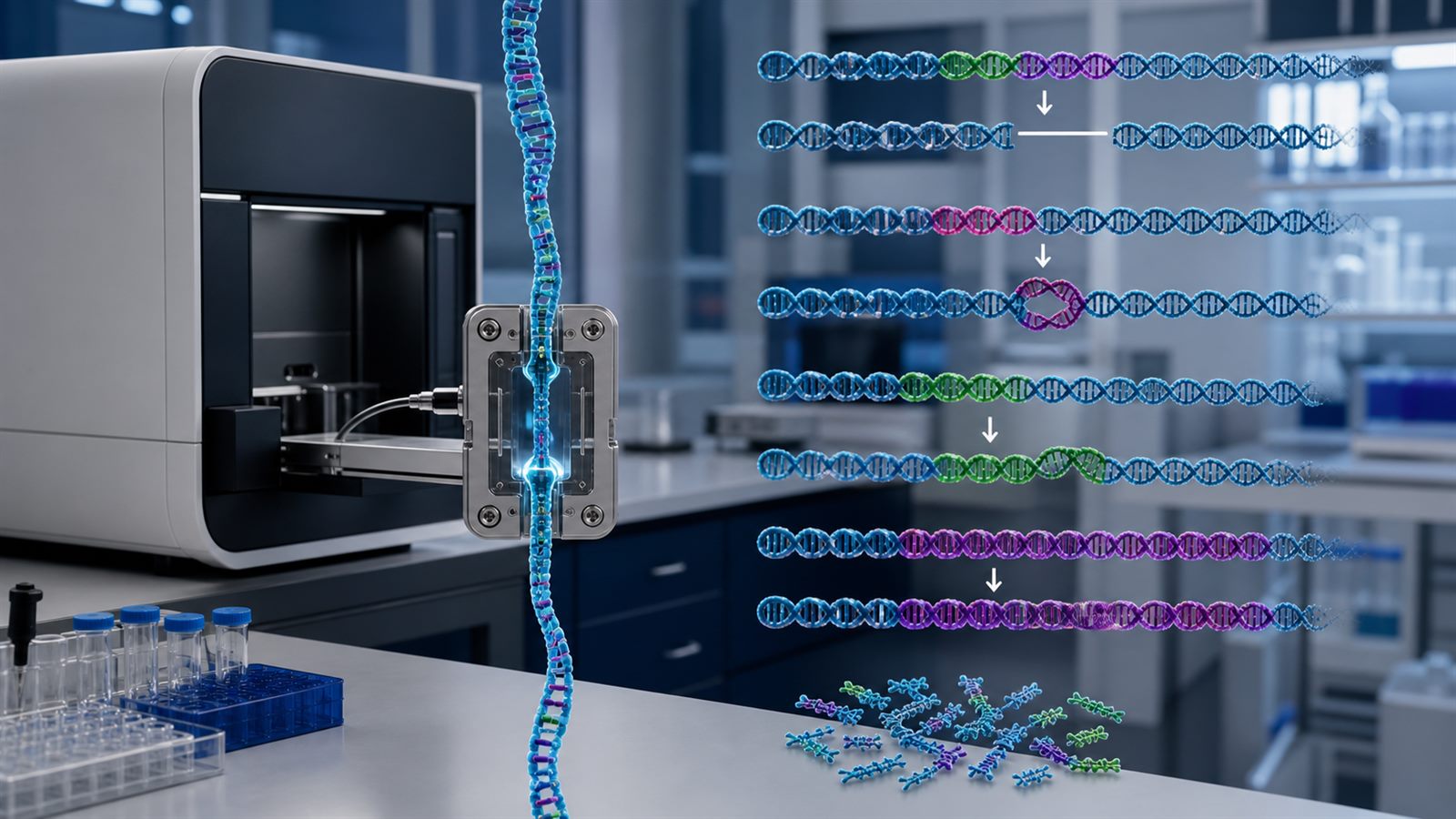
A human genome is not only a three-billion-letter string dotted with single-letter changes. Large segments can be deleted, duplicated, inverted, inserted, moved, or repeated a different number of times. These structural variants can reshape genes and their regulation, yet many are difficult to reconstruct from conventional sequencing that reads DNA in short fragments.
Long-read sequencing approaches the same genome with molecules that may span thousands to hundreds of thousands of DNA bases. A single read can cross a repetitive region and connect the unique sequence on both sides. That extra context can turn an ambiguous pile of fragments into a recognizable event. It does not make genome interpretation automatic, but it changes which variants scientists can observe with confidence.
Structural variation changes more than one DNA letter
Structural variant is a broad term commonly applied to changes of roughly 50 bases or more. A deletion removes a segment; a duplication adds another copy; an inversion reverses a region; an insertion adds sequence that is absent from a reference; and a translocation joins material from different locations. Tandem repeats can expand or contract, sometimes by many repeat units.
The boundaries matter. A rearrangement can interrupt a protein-coding gene, alter the number of gene copies, move an enhancer, or change the three-dimensional neighborhood that controls gene activity. Some variants have clear biological consequences, many are harmless, and others remain uncertain. Detection is therefore the beginning of analysis, not a diagnosis.
The National Human Genome Research Institute explains that long-read methods are especially useful for repetitive and complex genomic regions because their reads extend much farther than typical short-read sequences. That ability is the central advantage, even though different instruments use different sensing chemistry and analysis pipelines.
Short reads lose context inside repeated sequence
Imagine tearing several copies of a nearly identical paragraph into tiny strips and then trying to rebuild the original pages. A strip containing a common phrase may fit in several places. DNA repeats create the same mapping problem. If a read is shorter than the repeated region, software may not know which copy produced it.
Paired short reads can provide distance and orientation clues, while changes in coverage can reveal gains or losses. Sophisticated callers combine those signals with split alignments and local assembly. They detect many important variants, especially in well-characterized regions. Problems grow when breakpoints lie inside long repeats, when inserted sequence is not represented in the reference, or when several changes occur close together.
A long molecule can anchor in unique sequence before the repeat, travel through the difficult section, and anchor again afterward. That direct continuity helps place breakpoints, measure repeat length, and identify the inserted sequence itself. It can also distinguish changes on the chromosome inherited from one parent from those on the other.
Long reads support phasing and genome assembly
Humans normally carry two copies of each autosomal chromosome. Standard reference-based analysis can list variants without showing which changes occur together on the same copy. Long reads often contain multiple nearby markers, allowing software to phase them into longer haplotypes. This can reveal whether two disruptive variants affect one gene copy or both.
Long reads also improve de novo assembly, in which a person’s sequence is reconstructed into large contiguous pieces before comparison. Assembly-based analysis can represent complex alternatives that are awkward to describe only as edits against one linear reference. It is particularly useful in duplicated regions, immune-related loci, and areas near centromeres and other repeat-rich structures.
Large population projects are showing the scale of this difference. A 2025 Nature study of 1,019 individuals used long-read sequencing to characterize structural variation across diverse human genomes. Another 2025 study produced near-complete assemblies from 65 human genomes, expanding the set of sequence and structural variation available for population analysis.
Better detection does not remove technical error
Long-read platforms have improved substantially, but accuracy depends on the technology, chemistry, run conditions, base-calling model, coverage, and genomic context. Some workflows generate highly accurate consensus reads from repeated observations of the same molecule. Others emphasize very long molecules and real-time output. The right choice depends on whether a project prioritizes single-base accuracy, maximum length, methylation signals, speed, or cost.
DNA extraction is a practical constraint. Long molecules break under rough handling, and archived or formalin-fixed tissue may already be fragmented or chemically damaged. High-molecular-weight preparation can require more careful collection and quality control than a short-read workflow. A nominally long-read instrument cannot restore information that was lost before the sample reached it.
Coverage also matters. Low coverage can miss a variant or support the wrong assembly path, especially in a mosaic sample where only a fraction of cells carry the change. Repeats longer than the reads can remain unresolved. GC-rich sequence, homologous genes, and extremely large rearrangements can still challenge both sequencing and software.
Benchmarks are essential for knowing what a pipeline misses
A variant caller can produce a polished file without revealing every blind spot. Developers need reference materials with carefully characterized variants so they can measure precision, recall, breakpoint accuracy, and performance by genomic region. Comparisons should separate easy sequence from repeats and other difficult contexts instead of reporting one reassuring average.
The US National Institute of Standards and Technology coordinates the Genome in a Bottle consortium, which develops benchmark genomes, data, and methods for evaluating sequencing results. Its HG002 benchmark work includes small variants and structural variants. Such resources help laboratories validate an entire workflow, including sample preparation, sequencing, alignment or assembly, variant calling, filtering, and reporting.
Independent confirmation remains appropriate for findings with major clinical or research consequences. The validation method should match the event. A small breakpoint assay may confirm a junction but fail to establish the full size or copy number of a complex rearrangement. Orthogonal evidence can include targeted sequencing, optical mapping, cytogenetics, copy-number assays, or family data.
A variant call is not the same as an explanation
Finding more variants increases the interpretation workload. Population frequency, inheritance, gene function, dosage sensitivity, regulatory context, and phenotype all influence whether a change is meaningful. A rare structural variant is not automatically harmful, and absence from a database may reflect limited sampling rather than danger.
This distinction parallels our discussion of sequencing in genome-editing safety analysis: a measurement method can strengthen detection without deciding clinical significance on its own. For individualized treatment, as in the case of personalized CRISPR platforms for rare disease, the chain from molecular evidence to intervention requires separate functional, manufacturing, and regulatory evidence.
Long reads can connect sequence with other molecular layers
Some long-read technologies can infer base modifications from the same physical signal used to read DNA. That creates an opportunity to associate structural variation, haplotype, and methylation without splitting the sample into entirely separate assays. Long RNA reads can similarly capture full transcript isoforms and show how rearrangements alter splicing.
Those capabilities complement, rather than replace, methods that preserve location in tissue. Our overview of spatial proteomics explains why molecular identity and tissue context answer different questions. A resolved genome can identify a rearrangement, while spatial and cellular measurements may be needed to see where its downstream effects occur.
What ordinary readers should watch next
The important progress is not simply a higher maximum read length. Watch for better accuracy in medically relevant repeats, more representative population references, transparent performance by variant class, interoperable pangenome tools, and benchmarked end-to-end workflows. Falling cost and simpler sample preparation will determine whether long reads move from specialist centers into routine laboratories.
Researchers should also report what remains inaccessible. A study’s coverage, molecule-length distribution, benchmark regions, confirmation strategy, ancestry mix, and sample quality can matter as much as its headline variant count. Stronger instruments reveal more of the genome, but responsible conclusions still depend on calibrated uncertainty.
Long-read sequencing is valuable because genomes are physical molecules, not disordered bags of letters. Preserving more of each molecule retains the context needed to cross repeats, phase chromosomes, and reconstruct complex events. The result is a more complete map of structural variation, paired with a new obligation to validate and interpret what that map contains.
Leave a Reply