
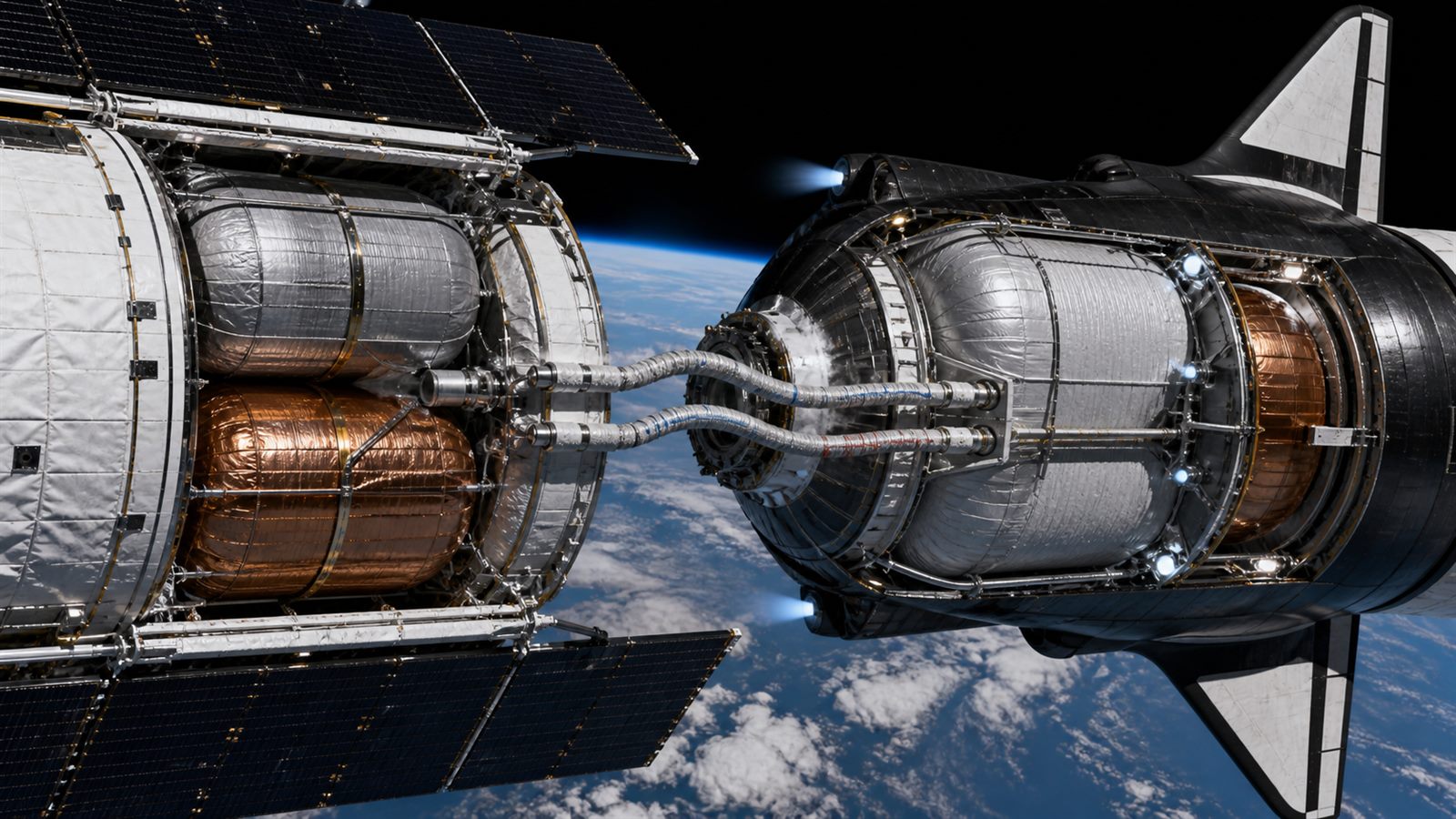
Reusable rockets can lower the cost of reaching orbit, but they do not remove the mass penalty of carrying every kilogram of propellant from the ground. A spacecraft that can refill after launch could depart with less fuel, accept a larger payload, or continue to the Moon and beyond without requiring one enormous booster. That promise depends on a deceptively difficult operation: storing and transferring extremely cold liquids in space.
Liquid oxygen, methane, and hydrogen are attractive rocket propellants, yet they boil far below ordinary temperatures. On Earth, gravity helps separate liquid from vapor and keeps fluid near a tank outlet. In orbit, the liquid can drift, bubbles can reach pumps and lines, and sunlight continually adds heat. Orbital refueling is therefore not merely a docking task. It is a combined problem in thermal control, fluid physics, measurement, autonomy, and interface design.
Why cryogenic liquids behave differently in orbit
A launch vehicle burns propellant quickly, often over minutes. A depot or lunar transfer vehicle may need to hold it for weeks or months. Even a well-insulated tank absorbs some heat from the Sun, warm spacecraft structures, and onboard equipment. That energy causes part of the liquid to evaporate, increasing tank pressure and potentially forcing operators to vent valuable propellant.
Microgravity adds another complication. Instead of forming a stable pool at the bottom of the tank, liquid can coat walls, float as a mass, or break into smaller regions. Engineers cannot assume that an outlet is submerged. Surface tension, tank geometry, acceleration, temperature, and the ratio of liquid to vapor all influence where the propellant goes.
NASA’s Cryogenic Fluid Management program treats storage, transfer, pressure control, and quantity measurement as connected technologies. A pump that moves liquid efficiently is of limited use if the receiving tank cannot reject the resulting heat or measure when it is full.
A transfer begins before either valve opens
The vehicles must first rendezvous, align, and connect while protecting delicate seals and lines. A mechanical docking connection may carry loads, while a separate fluid interface provides leak-tight paths for propellant and vapor. Electrical power, data, grounding, and fault signals may also cross the interface.
Before transfer, a small controlled acceleration can settle the liquid toward an outlet. The acceleration might come from thrusters or from another propellant-management method. Lines and couplers then need conditioning. If very cold liquid enters warm plumbing too quickly, vigorous boiling can create pressure spikes, unstable flow, and wasted propellant. A chilldown sequence cools the path gradually before sustained liquid transfer begins.
During flow, controllers monitor pressure, temperature, valve position, estimated mass, and vehicle motion. Transfer may be driven by a pump, by raising pressure in the source tank, or by carefully controlling pressure difference between the tanks. Shutdown must avoid trapping expanding liquid in a closed line. The interface then needs to disconnect without leaving an ice-contaminated seal or a hazardous leak.
Keeping propellant cold can be active or passive
Multilayer insulation, sunshields, low-conductivity supports, and careful placement reduce incoming heat. Vehicle orientation can keep a tank away from direct sunlight, although that choice may conflict with power generation, communications, or thermal needs elsewhere on the spacecraft.
Long-duration storage may require active cooling. Cryocoolers move heat from the tank to a radiator, consuming electrical power but potentially approaching zero boil-off. The trade is not simply propellant versus electricity: coolers, radiators, wiring, redundancy, and control hardware all add mass and failure modes. Hydrogen is especially demanding because it must remain colder than oxygen or methane.
Measuring the remaining liquid is a major engineering problem
Traditional level sensors assume gravity creates a predictable liquid surface. That assumption fails in orbit. A tank can report the correct pressure and temperature while the actual liquid distribution remains uncertain. Yet both vehicles need to know how much mass moved, whether an outlet is about to ingest vapor, and how much capacity remains.
Possible approaches include radio-frequency measurements, capacitance, thermal probes, acoustic methods, and bookkeeping based on flow and tank conditions. Each has limits across different fill levels and fluid configurations. Reliable systems will probably combine several measurements with physical models rather than trust one gauge. The requirement is not a visually neat fuel bar; it is a defensible mass estimate with known uncertainty.
Standard interfaces could turn refueling into infrastructure
A one-off demonstration can use hardware built specifically for two vehicles. A useful market needs interfaces that tolerate repeated connections, manufacturing variation, thermal cycling, and imperfect alignment. Common mechanical envelopes, pressure limits, contamination rules, data messages, and emergency shutdown behavior would let tankers and customer vehicles evolve independently.
This is closely related to the wider challenge of standard interfaces for satellite servicing. A refueling port is more than a fitting: it establishes which vehicle controls each step, how faults are isolated, and what evidence proves a safe connection. Autonomous inspection is important because crews cannot manually check every coupler in a scalable orbital network.
NASA’s public fluid-transfer technology catalog describes couplers and large-scale transfer work intended to mature these building blocks. Commercial programs can pursue different hardware, but published test methods and interface expectations can reduce the number of incompatible systems.
Demonstrations must climb a realistic test ladder
Ground tests can validate seals, pumps, insulation, valves, chilldown procedures, and safety systems at useful scale. Drop towers and parabolic flights provide brief low-gravity data. Suborbital and orbital experiments can then examine long-duration thermal behavior and fluid motion that cannot be reproduced completely on Earth.
NASA describes LOXSAT as a planned orbital demonstration for multiple liquid-oxygen management technologies, including storage, pressure control, transfer, and gauging. A separate NASA-industry demonstration effort is aimed at large-scale cryogenic transfer relevant to future missions. These programs matter because success with one valve or a small tank does not automatically validate a full mission sequence.
NASA technical guidance also notes that in-space cryogenic transfer between independent spacecraft remains a central capability for human lunar landing architectures. A March 2024 flight demonstrated an internal liquid-oxygen movement between tanks on one spacecraft, an important step but not the same as routine transfer through a repeatedly connected interface between two vehicles. That distinction should remain clear when interpreting announcements.
The Moon makes refueling more valuable and more complicated
Propellant produced from local resources could eventually reduce what must be launched from Earth. Water-derived oxygen and hydrogen are one possible route, while methane systems would require an appropriate carbon source or imported fuel. Before that vision becomes practical, prospecting, extraction, processing, storage, power, and transport all need to work together.
Lunar operations also face abrasive dust, extreme thermal cycles, and communication constraints. Our guides to engineering around lunar dust and the emerging lunar communications and navigation layer show why a depot cannot be considered in isolation. Dust-tolerant connectors, precise navigation, remote supervision, and dependable power become part of the refueling problem.
Reliability and economics will decide whether depots scale
An orbital depot creates value only when enough vehicles use it and enough tanker flights arrive. Launch delays can strand a customer or increase boil-off. A failed valve can affect an entire mission chain. Operators need redundant isolation, safe disposal modes, leak detection, traffic coordination, and clear custody accounting for the transferred propellant.
The economics depend on delivered cost per usable kilogram, not launch price alone. Losses during storage and chilldown, tanker dry mass, docking hardware, extra maneuvers, maintenance, and schedule risk all count. Refueling can still be transformative, but it must beat simpler alternatives for a specific mission, such as launching a larger upper stage or accepting a smaller payload.
What to watch next
The strongest evidence will come from complete orbital sequences: long-duration storage, accurate gauging, repeated autonomous docking, line chilldown, substantial liquid transfer, clean disconnect, and verified engine use of the received propellant. Public data about mass transferred, losses, pressure stability, and repeatability will be more informative than a broad claim that a test occurred.
Cryogenic transfer is sometimes presented as a futuristic filling station. In engineering terms, it is closer to a tightly managed industrial process operating without gravity, immediate human access, or generous thermal margins. Solving it would not guarantee an orbital economy, but it would remove one of the hardest physical barriers to reusable transportation beyond low Earth orbit.
Leave a Reply