
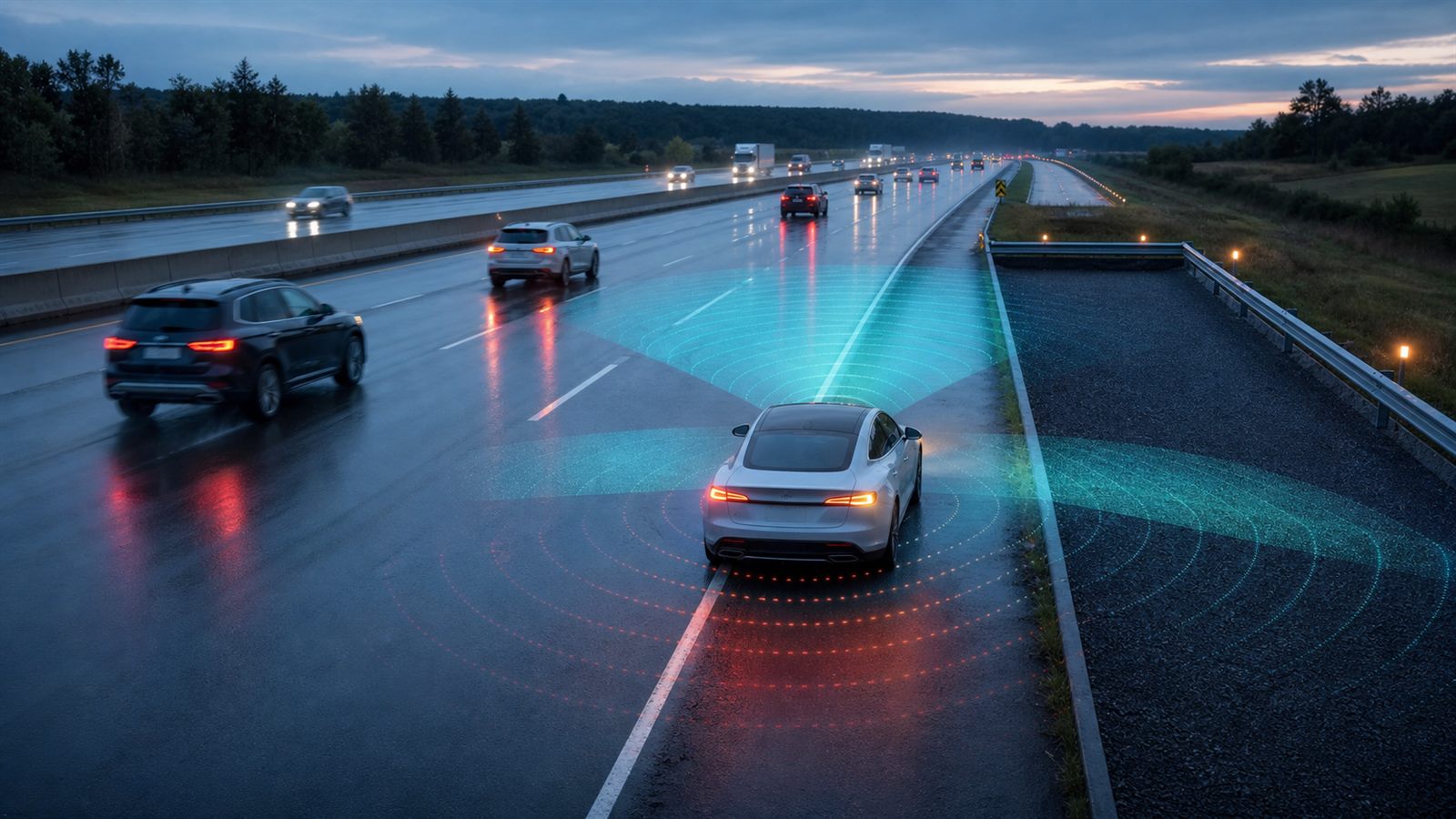
Automated driving is often presented as a question of how well a vehicle follows lanes, recognizes objects, and plans a route. The harder safety question begins when the system can no longer continue. A sensor may be obscured, a component may fail, weather may leave the operational design domain, or a human driver may not respond to a takeover request.
A responsible system needs a fallback that reduces risk without creating a new emergency. Regulators call the resulting stable state a minimal risk condition, and the controlled action used to reach it a minimal risk maneuver. Depending on the road, traffic, failure, and automation level, that may mean slowing in lane, moving to a shoulder or refuge area, stopping, warning other road users, and preventing an unsafe restart.
Automation needs a defined boundary
An operational design domain, or ODD, describes where an automated driving feature is intended to work. It can include road type, speed, weather, lighting, mapping coverage, lane markings, and other conditions. A system must recognize both internal faults and situations that move beyond this boundary.
That recognition is not merely a dashboard message. The vehicle needs enough diagnostic coverage to identify degraded cameras, radar, lidar, positioning, steering, braking, power, communications, or compute. It also needs a decision threshold that avoids two bad outcomes: continuing when capability is inadequate, or stopping unnecessarily in a location that creates greater danger.
This is why fallback belongs in the safety architecture from the beginning. It cannot be added as a single emergency routine after the normal driving software is complete.
A maneuver and a condition are different
The minimal risk maneuver is the dynamic part: the vehicle changes speed or position while continuing to monitor traffic. The minimal risk condition is the stable result. NHTSA’s automated-driving guidance lists fallback to a minimal risk condition among its core safety elements and says higher automation should be able to reach that condition without driver intervention when no driver is available.
Stopping in the travel lane may be necessary but not ideal
If steering is unavailable or the environment cannot be understood reliably, remaining in the current lane and braking predictably may be safer than attempting a lane change. Yet a stationary vehicle in a live lane creates rear-impact risk, particularly on a high-speed road or in poor visibility.
More capable systems may identify a shoulder, emergency bay, or other target stop area and move toward it after checking adjacent traffic. The current UNECE Regulation No. 157 for automated lane keeping says the target should provide the greatest achievable reduction of risk under the circumstances. If the system can safely perform the required lane change, the stop can occur outside the travel lane; otherwise it follows an appropriate trajectory and stops within its available path.
That choice is an optimization under uncertainty. A blocked shoulder, road works, a motorcycle in the blind area, or weak lane markings can turn an apparently safer path into a hazard. The fallback planner therefore needs much of the same perception and prediction capability as normal driving, even while some subsystem is degraded.
Driver takeover is not an instant safety mechanism
At conditional automation levels, the system may request that a human resume the driving task. The driver needs time to notice the request, understand the scene, place hands and feet correctly, and decide what to do. A person who has not been monitoring the road cannot reliably become fully informed at the moment a warning sounds.
Regulations specify escalating transition demands and require the automation to continue operating during the transition. If the driver does not respond, a minimum risk maneuver follows. The fallback cannot assume that an inattentive, impaired, or confused person will rescue the system. That is particularly important because poor handover design can transfer control at exactly the moment the driving task is most difficult.
For vehicles designed without a driver, remote assistance may help interpret an unusual situation, but communications loss must not make safety depend on a distant operator. The onboard system still needs a locally executable fallback.
Redundancy must preserve enough capability to retreat
A safe stop may require steering, braking, localization, object detection, hazard lights, power, and compute after a primary failure. Redundancy is therefore not simply two copies of every component. Designers identify which functions must remain available for each failure and build independent or diverse paths where necessary.
For example, a vehicle may use a separate safety controller to command controlled braking if the main autonomy computer stops responding. Backup electrical power may keep steering and signals active long enough to leave the lane. Multiple sensing methods can support a reduced-capability view when one sensor type is obscured. The fallback path must avoid sharing a hidden single point of failure with the normal path.
Software updates also affect this safety case. Our analysis of over-the-air vehicle updates explains why deployment, rollback, and configuration control become safety-critical when software changes vehicle behavior.
Other road users need predictable signals
A vehicle performing a fallback shares the road with people who do not know its internal state. Smooth deceleration, stable lane position, turn indicators, and hazard lights help make its intentions legible. Abrupt braking or indecisive lateral motion may increase risk even if the vehicle ultimately stops.
The European Union’s type-approval rules for fully automated vehicles require a minimal risk maneuver toward the safest possible stop and communication to occupants and other road users according to traffic rules. They also restrict leaving the stopped condition until checks or an operator confirm that the cause is no longer present.
Connected messages can add context, but they cannot be the only warning because many nearby vehicles, cyclists, and pedestrians will not receive them. This is one reason V2X safety depends on interoperability while conventional signals remain essential.
Testing has to include degraded combinations
A demonstration on an empty test track cannot establish fallback safety. Validation needs failures at different speeds, road geometries, traffic densities, weather conditions, and positions relative to shoulders or exits. It should include sensor blockage, partial braking or steering capability, lost maps, weak localization, compute faults, unresponsive occupants, and communication failure.
Some combinations are too dangerous or rare to reproduce repeatedly on public roads. Simulation, hardware-in-the-loop systems, proving grounds, closed roads, and controlled public testing therefore complement one another. The connection to automated-driving testbeds is direct: a regulator needs evidence that the fallback works across the declared ODD, not just a polished video of one stop.
Useful metrics include whether the system detected degradation, time to transition demand, path stability, deceleration, clearance from traffic, signaling, residual risk at the stop location, and ability to remain secure until recovery. A simple pass or fail hides important margins.
A stopped vehicle still needs an operating plan
Reaching a minimal risk condition ends the maneuver, not the incident. Occupants may need instructions or a way to request help. A fleet vehicle may need remote assessment, towing, software recovery, or safe passenger transfer. The vehicle should not resume normal operation merely because a fault temporarily disappears.
Fleet operators also need to protect the stopped vehicle from secondary collisions and coordinate with road authorities when it blocks traffic. Event data must preserve enough information to understand why fallback began without exposing unnecessary personal data. Maintenance teams need a clear release process before the vehicle returns to service.
What to watch next
The strongest progress will be evidence that minimum risk maneuvers work beyond a narrow test route. Watch for published ODD boundaries, scenario-based validation, independent assessment, safe shoulder selection, robust fallback after communications loss, and clear procedures for restarting or recovering a stopped vehicle. Comparisons should distinguish driver-supervised assistance, conditional automation, and driverless systems because their fallback responsibilities differ.
Automated vehicles will never encounter only the situations their normal planner prefers. Their credibility depends on what happens when capability falls below the level required to continue. A minimal risk maneuver is not a dramatic crash-avoidance trick. It is a disciplined, testable retreat from a task the system can no longer perform safely.
Leave a Reply