
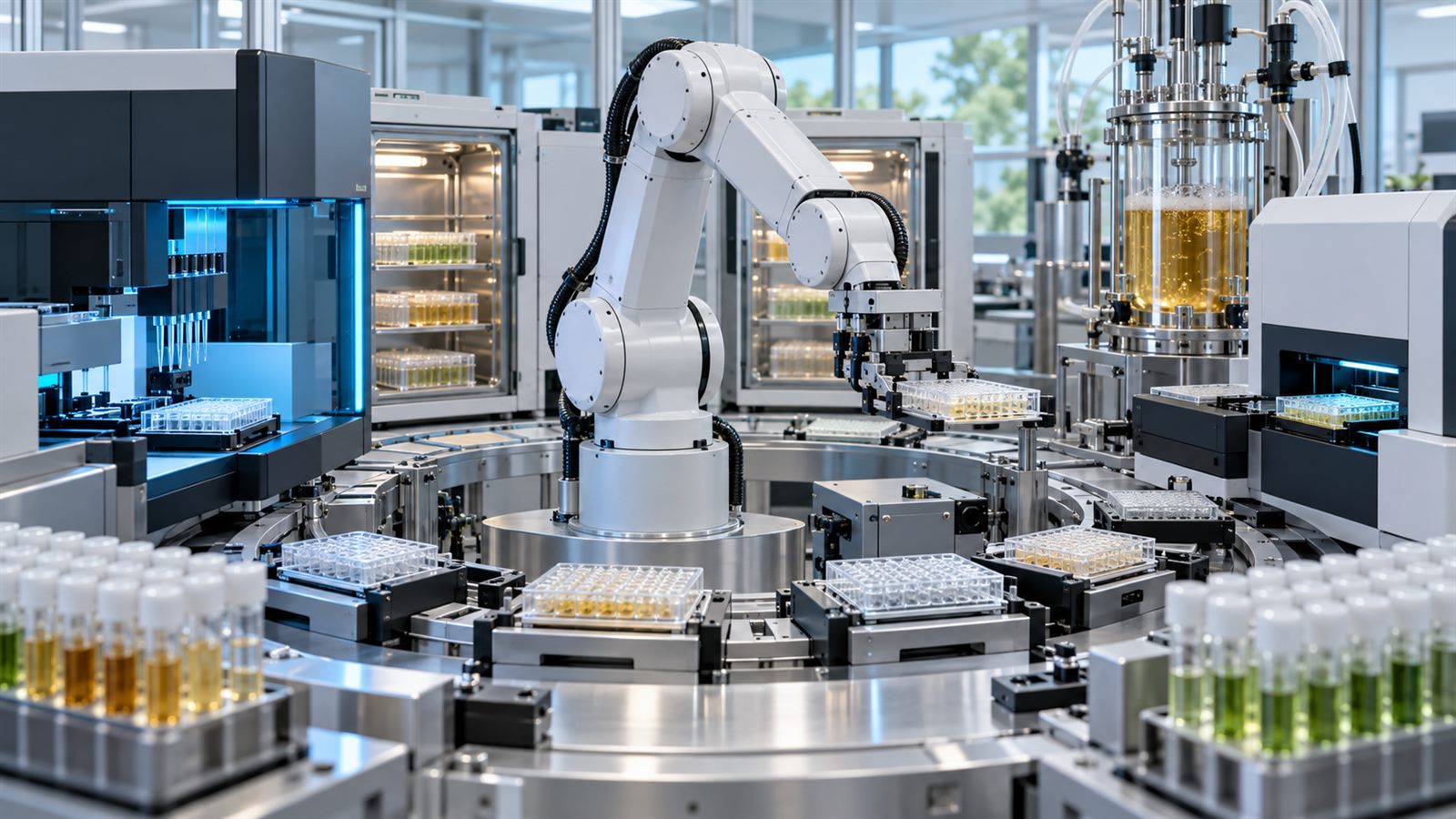
A modern biofoundry looks less like a traditional biology bench and more like a compact automated factory. Robotic liquid handlers move samples through incubators and analytical instruments. Software schedules experiments, tracks every plate and tube, and feeds measurements into models that propose the next set of designs.
The goal is not to make biology behave exactly like computer code. Living systems remain variable, context-dependent, and capable of surprising researchers. A biofoundry is valuable because it can run a disciplined design-build-test-learn cycle at a scale and consistency that manual work struggles to match. It automates experiments so that scientists can learn from biology faster.
A biofoundry is an integrated workflow, not one robot
Automated pipetting is only one component. A functioning biofoundry connects biological design software, DNA assembly, cell transformation, cultivation, sample preparation, measurement instruments, data storage, analysis, and quality control. Each handoff needs an agreed sample identity, format, volume, timing, and error response.
The NIST Engineering Biology Program describes this approach as a transition from laborious trial and error toward automated design-build-test-learn, or DBTL. NIST’s Living Measurement Systems Foundry uses automation for microbial growth, manipulation, sample preparation, and measurement while generating data for more predictive engineering.
Design turns a biological goal into testable variants
The design stage begins with a target behavior: a microbe that produces a molecule, a protein with improved activity, or a genetic circuit that responds under defined conditions. Software can propose DNA sequences, pathway changes, promoters, protein variants, or experiment combinations. Models help narrow a search space that is far too large to test exhaustively.
A model’s proposal is still a hypothesis. A DNA part that works in one organism, growth medium, temperature, or genomic location may behave differently in another. Good design therefore includes controls, replicates, and measurements that can distinguish a useful effect from ordinary biological variation.
This is one reason genome-editing safety depends on sequencing and bioinformatics. A successful edit is not defined only by the intended sequence change; researchers also need evidence about the wider result.
Build converts digital plans into physical biology
During the build stage, the foundry assembles DNA, introduces it into cells or prepares cell-free systems, and creates a library of physical variants. Automation can dispense tiny volumes, normalize concentrations, track barcodes, and execute the same protocol across hundreds or thousands of wells.
That repeatability is useful, but the process is not perfectly deterministic. DNA assembly can fail, cells can grow at different rates, and contamination or evaporation can alter results. The workflow needs checkpoints that confirm identity, purity, and expected construction before later measurements consume time and reagents.
NIST’s automation program combines liquid handling, incubation, sequencing preparation, cell-free expression, and large experimental designs. The important feature is not that every task is robotic. It is that the tasks are connected to measurement and uncertainty.
Test needs measurements that are comparable
The test stage measures what the engineered system actually did. Depending on the project, that may include growth, product yield, protein expression, metabolites, sequence identity, cell fitness, or responses to environmental conditions. High throughput creates more data, but more data is not automatically better evidence.
Instrument calibration, plate position effects, batch variation, reference materials, and data-processing choices can all change a result. A foundry must record enough metadata to compare experiments across days, instruments, operators, and facilities. Otherwise, automation can reproduce a hidden bias very efficiently.
The challenge resembles the reproducibility problem for organoid platforms: biological detail is useful only when the workflow can show that measurements are stable and interpretable.
Learn should choose the next informative experiment
In the learn stage, statistical models and machine learning connect design choices to measured outcomes. The most useful model may not simply predict the highest performer. It can identify which next experiment will reduce uncertainty or separate competing explanations.
NIST describes autonomous laboratories as closed feedback loops in which algorithms select samples and measurements to maximize knowledge gained from each iteration. Full autonomy remains an emerging model, and human judgment still defines goals, reviews unexpected results, and decides when evidence is sufficient.
The loop also depends on negative results. A failed construct or low-producing strain can teach the model where design assumptions break down, but only if the sample history and failure mode are recorded rather than discarded.
Software and provenance are core laboratory equipment
A biofoundry needs machine-readable protocols and persistent identifiers for samples, designs, containers, instruments, and data files. The system should be able to reconstruct which source material entered each well, which operations were performed, and which analysis produced a reported result.
Versioning matters because protocols and software change. If a liquid-handling step, analysis pipeline, or reference database is updated, later results may not be directly comparable with earlier runs. Audit trails make debugging possible and help collaborators reproduce the same process at another site.
Standards make foundries more than isolated machines
Different laboratories use different robots, data systems, organisms, and measurement instruments. Common vocabulary, data formats, controls, and performance metrics allow a workflow to travel without requiring identical hardware.
NIST’s project on engineering biology metrics and technical standards brings together stakeholders from the United States, Europe, Asia, and Australia. It identifies standards and metrics as tools for safety, reproducibility, scale-up, and commerce. The goal is not to freeze innovation, but to make results easier to compare and reuse.
Scale-up begins after the foundry finds a promising design
A microbe that performs well in a microplate may behave differently in a large bioreactor. Mixing, oxygen transfer, heat removal, nutrient gradients, foam, contamination control, and downstream purification all change with scale. A biofoundry can optimize a biological design while missing the physical constraints that dominate manufacturing.
The Agile BioFoundry, a U.S. national-laboratory consortium, links DBTL capabilities to industrial biomanufacturing of fuels and chemicals. Its structure reflects an important point: strain development, process development, and manufacturing translation need to exchange data early rather than operate as separate worlds.
The same lesson appears in personalized cancer-vaccine manufacturing, where a good molecular design is only one part of a time-sensitive production and quality workflow.
Automation changes the failure modes
Robots reduce some manual variation but introduce dependence on scheduling software, deck layouts, calibration, sensors, and data interfaces. A blocked pipette tip or incorrect plate definition can propagate across a large batch before anyone notices. Systems need pause conditions, controls, exception handling, and physical verification.
Cybersecurity and access control also matter because digital files can encode valuable strains, protocols, and design strategies. Responsible operation requires biosafety review, inventory controls, appropriate screening, and clear authority over what an automated system is allowed to build.
Limitations and what to watch next
Biofoundries do not remove the need for skilled biologists, process engineers, or quality specialists. They cannot make a poorly defined objective measurable, guarantee that a model generalizes, or turn a laboratory result directly into a safe commercial product. Not every project needs high throughput; a small number of carefully chosen experiments may be better.
Watch for more portable protocols, reference materials, shared data models, automated uncertainty tracking, and tighter links between foundry-scale experiments and pilot bioreactors. The decisive advance will not be a robot that runs the most plates. It will be a workflow that produces results other teams can understand, reproduce, and translate into reliable manufacturing.
Featured image: AI-generated editorial visualization of an automated biofoundry workflow. It is not a photograph of a named laboratory or a hands-on test.
Leave a Reply