
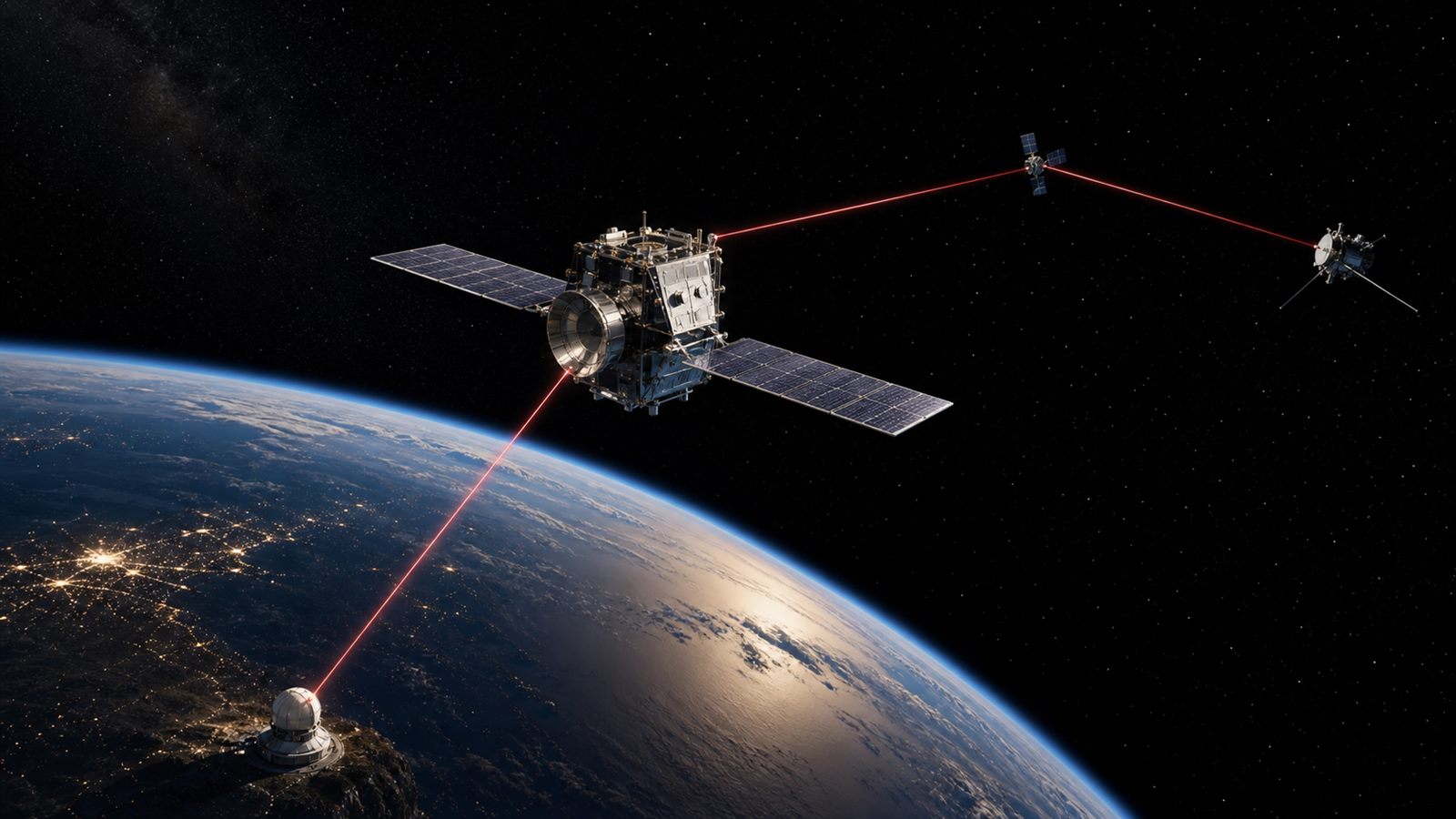
Laser communications have spent years proving that light can move data across space. The next challenge is turning impressive demonstrations into infrastructure that operators can schedule, monitor, and trust. That means more than putting a laser terminal on a spacecraft. It requires compatible terminals, precise pointing, optical ground stations, weather-aware routing, network control, and a radio link that can carry essential traffic when clouds block the optical path.
NASA’s Deep Space Optical Communications experiment showed how far the technology can reach. The payload on the Psyche spacecraft completed its final pass in September 2025 after 65 passes and a maximum distance of about 218 million miles. European programs are now working toward optical networks that connect satellites in different orbits with ground infrastructure. The story is shifting from a single record-setting link to a system of links.
Why Use Light Instead of Radio?
Optical communications use much higher carrier frequencies than conventional radio systems. A narrow laser beam can support high data rates with compact terminals and can reduce interference outside the intended path. For science missions, more downlink capacity can mean more images and measurements returned from the same spacecraft.
A narrow beam is also demanding. The transmitter must point accurately at a receiver that may be moving rapidly and may appear as a tiny target across an enormous distance. Spacecraft vibration, thermal distortion, orbital uncertainty, and atmospheric turbulence can all affect acquisition and tracking.
Radio remains indispensable. It is well understood, can cover wide areas, and can pass through clouds. Future systems are likely to combine optical links for high-capacity transfers with radio for command, telemetry, acquisition support, and resilience.
Deep-Space Optical Communications Proved the Physics
NASA and the Jet Propulsion Laboratory built DSOC as a technology demonstration attached to Psyche, not as the mission’s primary communications system. It used a flight laser transceiver, a ground uplink transmitter, and a ground downlink receiver. The experiment achieved optical communications beyond the Earth-Moon system and continued at increasing distances as Psyche traveled through the solar system.
The significance is not one headline bitrate taken out of context. DSOC exercised acquisition, pointing, atmospheric compensation, photon-sensitive reception, and operations over many passes. It also showed why deep-space optical links need powerful ground facilities and careful scheduling. A demonstration can use specialized assets that a routine mission network must make more available and economical.
Deep-space links have a different scale from the lunar communications networks being planned around the Moon, but both need interoperability and service concepts that let missions use shared infrastructure.
Networks Need Relays, Not Only Direct Downlinks
A spacecraft does not always have a clear view of a ground station. An optical relay can receive traffic from one satellite and send it onward through an inter-satellite link or down to another ground location. A network can route around orbital geometry, ground-station demand, or local weather.
The European Space Agency’s High-throughput Optical Network, or HydRON, is designed around this broader idea. ESA describes a multi-orbit optical transport network with space and ground segments. Its architecture includes inter-satellite links, optical ground stations, and network management, with interoperability as a central goal.
That is a harder engineering problem than maximizing the performance of one terminal pair. Terminals from different missions and suppliers must agree on interfaces and procedures. Schedulers need accurate orbit, availability, and weather information. Operators need service-level measures such as successful acquisition, delivered data, latency, and outage recovery.
Clouds Make Ground Diversity Essential
Cloud cover can completely interrupt an optical downlink, while aerosols, turbulence, and low elevation angles can degrade it. A ground network therefore needs geographically separated sites with different weather patterns. Forecasts and real-time sensors can help choose the best station for an upcoming pass.
Diversity is not free. Every site needs a telescope, tracking equipment, communications backhaul, maintenance, security, and integration with the network. Data may also need temporary storage on the spacecraft or relay until a route opens. Designing for average clear weather is not enough when a mission has time-sensitive data.
Space weather is a different hazard from ordinary clouds, but it makes the same operational point: infrastructure needs observation and procedures, not just capable hardware. Our guide to space weather forecasting explains that system view.
Pointing Is a Control Problem at Several Scales
A spacecraft first uses its attitude system and orbital knowledge to aim the terminal toward the expected receiver location. The optical terminal then acquires a beacon or target and applies fine steering to keep the narrow beam aligned. Ground systems may compensate for atmospheric distortion and the small angular difference caused by light travel time and relative motion.
The process must recover when acquisition fails. Operators need to know whether the cause was pointing, weather, timing, hardware, or a network configuration error. Routine service requires repeatable diagnostics and automatic fallback, not a one-off team of experiment specialists.
Interoperability Will Decide Whether a Market Forms
Shared optical infrastructure is most valuable when a mission can buy service from more than one compatible ground or relay provider. That requires standards for physical links, coding, acquisition, timing, interfaces, and operational data. It also requires testing that proves two independently built terminals can work together.
Without interoperability, each mission may remain tied to a custom terminal and a small set of ground assets. That can reproduce the cost and scheduling constraints the network is supposed to solve. ESA’s HydRON work emphasizes an end-to-end test environment and cooperation between institutions and industry for this reason.
Small satellites illustrate the potential benefit. Constellations can generate more imagery and sensor data than limited radio windows can return. Our article on small-satellite Earth observation describes why data delivery is part of the product, not an afterthought.
Security Is Different, Not Automatic
A narrow beam is harder to intercept accidentally than a wide radio broadcast, but it does not make the network secure by itself. Ground stations, scheduling systems, control software, credentials, supply chains, and terrestrial backhaul remain attack surfaces. Data still needs appropriate authentication and encryption.
Denial of service is also possible through cyberattack, optical interference, or disruption of a critical ground site. A resilient design separates command authority, monitors terminal behavior, protects software updates, and provides alternate routes and radio fallback.
Economics Will Be Measured in Delivered Data
An optical terminal can promise a high peak rate, but a mission operator cares about how much validated data reaches its destination over time. Weather losses, acquisition failures, limited ground availability, relay fees, onboard storage, and integration work all affect that number.
Commercial adoption will depend on predictable service and standardized procurement. Operators will compare terminal mass and power, coverage, pass availability, latency, security, and total delivered cost. A network that offers graceful radio fallback may be more valuable than a faster optical-only link with uncertain availability.
What to Watch Next
Watch for multi-vendor interoperability tests, operational relay demonstrations, expansion of optical ground-station networks, and contracts defined as communications services rather than isolated hardware experiments. Also watch how networks combine near-Earth, lunar, and deep-space use cases without pretending they have identical requirements.
Laser communications no longer need to prove that a beam can cross space. The harder proof is operational: acquire the right terminal on schedule, move useful data through changing routes and weather, recover from failure, and do it often enough that missions can treat optical capacity as infrastructure.
Leave a Reply