
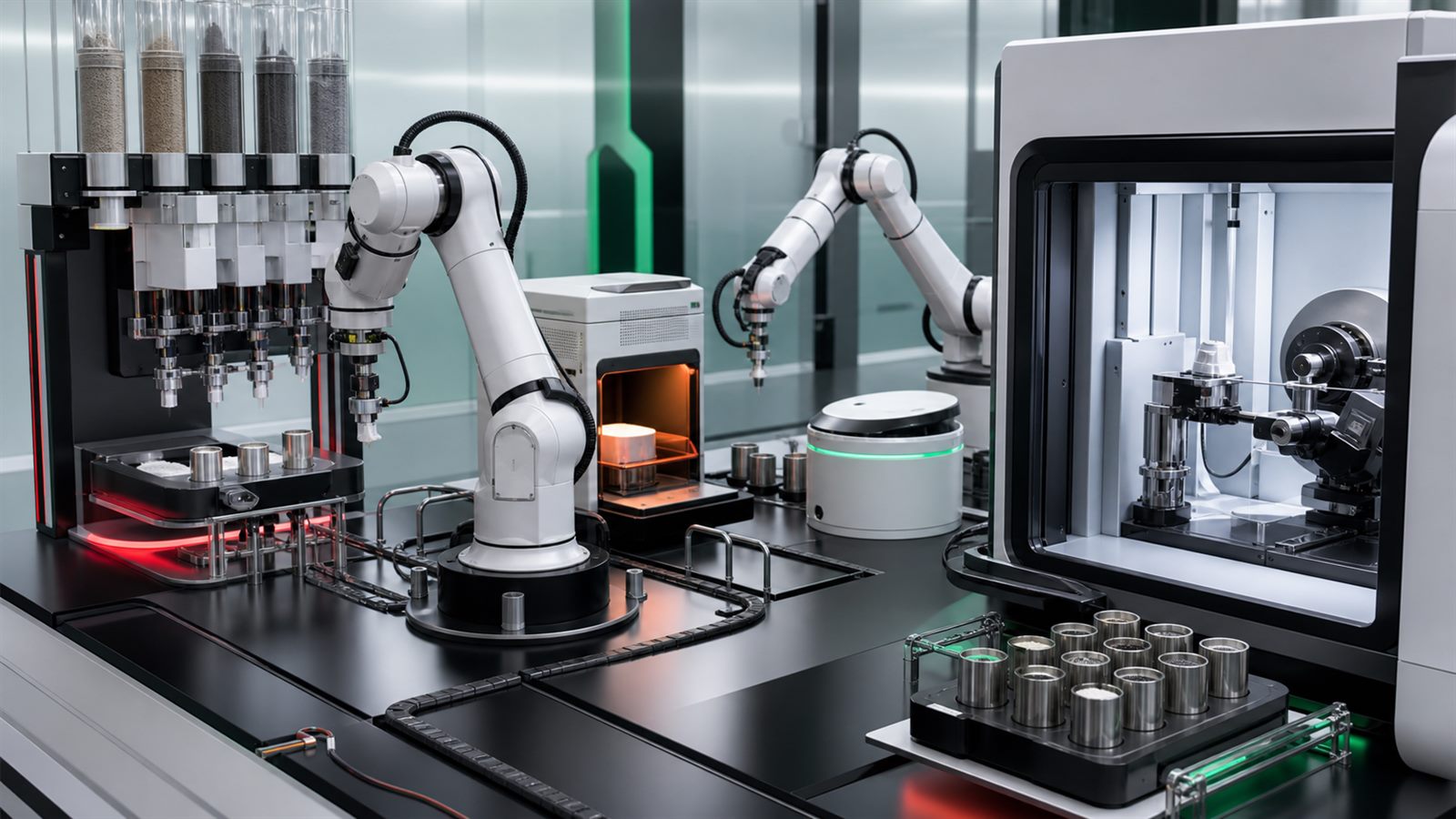
A self-driving laboratory is more than a robot arm beside an artificial-intelligence model. It is a closed experimental system that proposes a test, prepares a sample, controls instruments, records results, evaluates uncertainty, and chooses what to try next. If any link in that loop is fragile, the laboratory may produce data quickly without producing knowledge that another team can reproduce.
That is why the next engineering challenge is interoperability. Scientific instruments were usually designed for expert human operators, often with proprietary control software and inconsistent data formats. Autonomous research requires those instruments, sample holders, algorithms, and data systems to communicate with enough precision that a result can be traced and repeated.
What makes a laboratory self-driving
Traditional automation repeats a fixed sequence. An autonomous laboratory adds decision-making: an algorithm uses previous measurements to select the next experiment according to an objective, such as finding a material with a target property or mapping a formulation’s phase behavior. Robotic equipment executes the choice, characterization instruments return measurements, and the loop continues.
NIST’s Autonomous Formulation Lab illustrates the concept by linking AI-directed planning with robotic preparation and in-situ scattering and other measurements. Its stated goals include reproducible methods, data standards, and shareable datasets. Those less visible elements matter as much as the robot because they allow results to move beyond one custom installation.
Instrument control is still fragmented
Many laboratory instruments expose vendor-specific commands, file formats, and timing behavior. A human can adapt when an instrument reports an unexpected state. Software needs an explicit description of whether a command succeeded, which sample was measured, what calibration was active, and whether the result is complete.
NIST says the transition from human-operated instruments to AI-controlled infrastructure has often relied on fragile integrations. Its standards program is considering instrument control and communication, sample management, data and knowledge management, and algorithm integration as connected problems. Protocols such as MQTT, SiLA, and EPICS offer useful foundations, but materials laboratories also need agreement about experimental meaning, not only message transport.
Samples need identities and histories
A digital command is useless if the physical sample cannot be identified reliably. Autonomous workflows must track source materials, preparation steps, container geometry, position, environmental exposure, and every transformation. When a robot transfers powder, mixes a liquid, or heats a specimen, the system needs to preserve provenance across that physical change.
Sample holders complicate interoperability because one instrument may accept a thin film while another requires powder, a flow cell, or a battery device. A common identifier and machine-readable history can prevent a result from being attached to the wrong specimen. It also lets a later researcher understand whether two nominally identical samples actually followed the same process.
AI-ready data must include context
A measurement file alone is rarely enough to train a reliable model. The dataset needs units, instrument configuration, calibration records, processing steps, environmental conditions, uncertainty, and failed experiments. Otherwise, an optimizer may learn a pattern caused by equipment drift or an undocumented preprocessing choice.
Negative and inconclusive results are particularly important. If only successful syntheses are stored, the model receives a distorted view of the search space. Machine-actionable metadata should therefore capture what was attempted, why it was selected, and how the outcome was judged. This is where reproducibility and AI performance become the same infrastructure problem.
The A-Lab result shows both promise and caution
A 2023 Nature paper described an autonomous laboratory for inorganic materials synthesis that combined literature-derived recipes, machine-learning interpretation, active learning, robotics, and automated X-ray diffraction. The system conducted 353 experiments over 17 days and reported successful synthesis of 36 of 57 target compounds under the study’s criteria.
The numbers are evidence from one particular platform and materials domain, not a general speed limit for science. The paper also attracted discussion about how novelty and synthesis success should be interpreted. That debate reinforces a useful principle: automated measurements and model judgments still need transparent criteria and expert review. A closed loop can accelerate a mistake as efficiently as it accelerates a discovery.
Algorithms need portable interfaces
An optimization algorithm should ideally express a high-level request without being rewritten for every pump, furnace, or diffractometer. NIST compares the need with scientific modeling environments that present a common abstraction over different computational codes. For experiments, that could mean standardized descriptions of capabilities, constraints, actions, and results.
Portability would also improve comparison. The same planner could be tested across multiple laboratories, and different planners could operate the same equipment under controlled conditions. This resembles the challenge of coordinating mixed robot fleets through shared interfaces, though laboratory work adds stricter scientific provenance and uncertainty requirements.
Safety cannot be inferred from a successful run
An autonomous system may handle heat, pressure, reactive chemicals, radiation sources, or delicate instruments. Safe operation requires hardware interlocks, bounded action spaces, collision prevention, ventilation monitoring, and a defined human stop procedure. The AI planner should not be able to override physical protections.
Testing should include abnormal conditions: a blocked dispenser, a missing sample, a sensor that drifts, a network interruption, or an instrument that returns a partial file. Repeatable test methods, like those discussed for robot agility and reliability, reveal whether a system fails safely rather than merely completing a demonstration.
Humans remain responsible for the scientific question
Autonomy can search a defined space more consistently than a person can run thousands of routine iterations. Humans still choose meaningful objectives, decide what constraints are ethical and practical, inspect unexpected results, and connect measurements to theory. The best systems treat automation as a way to expand scientific attention, not remove scientific judgment.
General-purpose robot models may eventually simplify manipulation and instrument use, but the limitations described in robot foundation models and physical AI remain relevant. Flexible behavior must be paired with calibrated uncertainty and deterministic safety controls.
Limitations
Self-driving labs are expensive to build, and integration effort can exceed the cost of the visible robots. A method that works with liquids may not transfer to brittle solids or biological samples. Proprietary interfaces can prevent full data capture, while automated analysis can conceal model assumptions from users.
Reproducibility also requires more than publishing software. Other laboratories need compatible materials, calibration standards, environmental controls, and enough procedural detail to reconstruct the experiment. Standardization should preserve room for novel instruments rather than freezing one architecture too early.
What to watch next
Watch for common sample identifiers, open capability descriptions for instruments, standardized uncertainty metadata, portable optimization interfaces, and benchmark experiments that can be repeated across institutions. Procurement may become a major lever if research organizations require machine-readable control and exportable raw data from new instruments.
The most important autonomous laboratory will not be the one with the most dramatic robot. It will be the one whose decisions, samples, measurements, and failures can be understood and reproduced somewhere else.
Sources: NIST: Autonomous Laboratories; NIST: Standards for a Modular and Autonomous Laboratory Ecosystem; NIST Autonomous Formulation Lab; Nature: An autonomous laboratory for the accelerated synthesis of novel materials.
Leave a Reply