
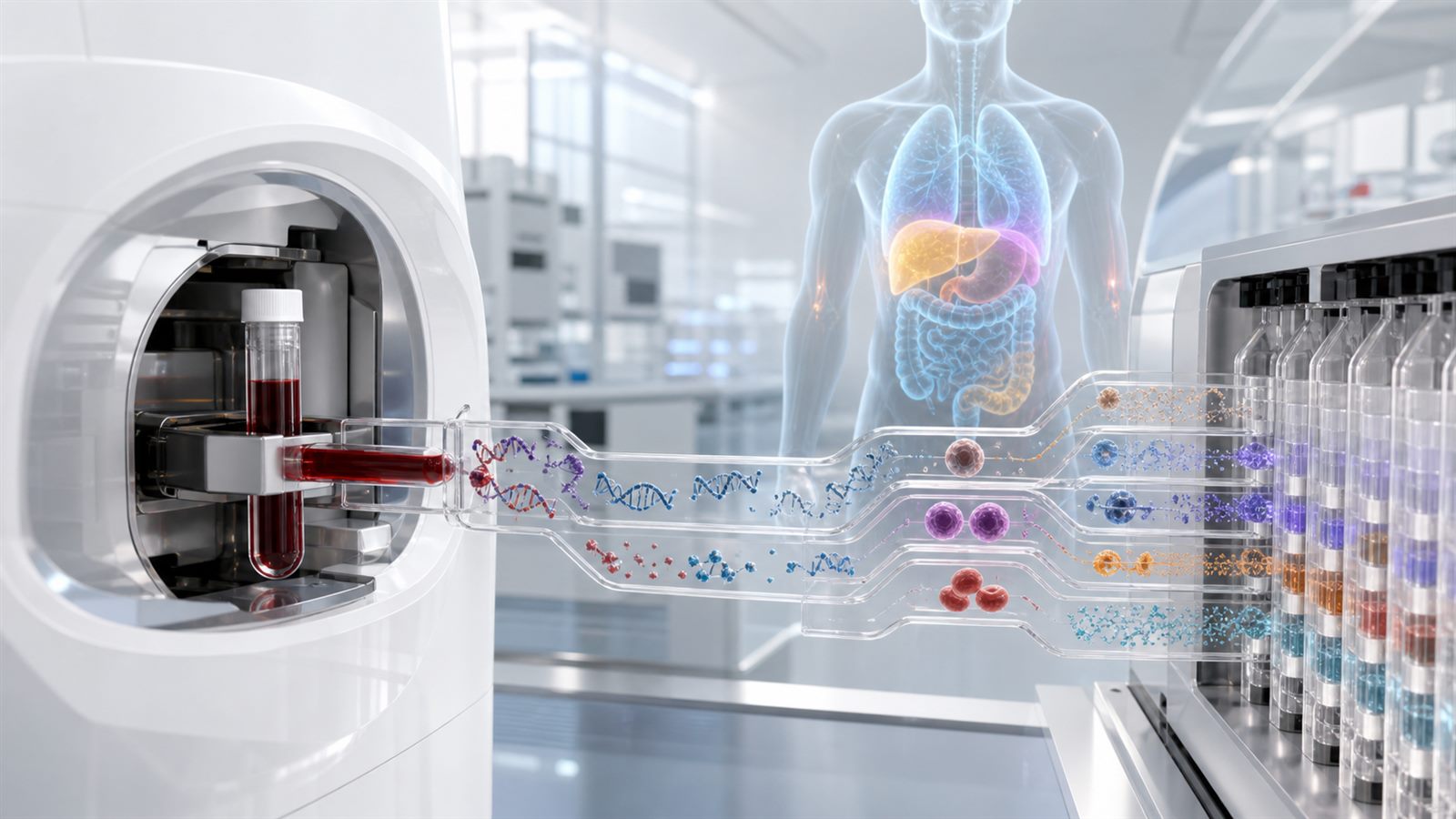
A single blood draw that looks for many cancers is an appealing idea. Tumors can release fragments of DNA, proteins, cells, and other biological signals into the bloodstream. Multi-cancer detection tests use laboratory instruments and algorithms to search those signals for patterns associated with several cancer types at once.
The difficult question is not whether a machine can detect a molecular pattern. It is whether screening people without symptoms leads to earlier useful treatment, fewer cancer deaths, and an acceptable burden of false alarms and invasive follow-up. That requires evidence from complete screening pathways, not only impressive laboratory accuracy.
Multi-cancer tests combine several layers of biotechnology
A multi-cancer detection test may analyze cell-free DNA, methylation patterns, proteins, circulating tumor cells, or combinations of biomarkers. Sequencing and other high-throughput instruments convert a blood sample into a large set of measurements. A statistical or machine-learning model then estimates whether a cancer-associated signal is present and may predict where in the body it originated.
This is a different engineering problem from measuring one well-defined substance. The test has to distinguish weak tumor signals from normal biological variation across many people and many possible cancers. Sample collection, storage, laboratory processing, reference data, and model updates can all affect the result.
Screening is not the same as diagnosis
A screening test is an initial filter for people who do not have symptoms. A positive result does not by itself establish that cancer is present. It starts a diagnostic process that may include imaging, repeat blood tests, endoscopy, biopsy, or specialist assessment.
That distinction changes how performance should be judged. The relevant product is not just the assay; it is the assay plus the pathway that resolves positive results. A test that generates a plausible signal but cannot guide doctors toward a timely diagnosis may add anxiety and procedures without delivering a benefit.
Early-stage sensitivity is the demanding measurement
Advanced cancers generally release more material into blood than small, localized tumors. The National Cancer Institute notes that current data show multi-cancer tests performing better for later-stage disease than for early-stage disease. Yet the main purpose of population screening is to find important cancers early enough to change an outcome.
An overall sensitivity number can conceal major differences by cancer type and stage. Readers should look for results broken down by stage, organ, and prespecified population. A test that is very sensitive to a few cancers with strong signals may look impressive in aggregate while missing small tumors that screening most needs to find.
A tissue-of-origin prediction must be actionable
When a test reports a possible cancer signal, its predicted tissue of origin helps determine the next examination. A wrong or vague prediction can send the diagnostic search in the wrong direction. Even a correct prediction may not identify a lesion that imaging or biopsy can locate.
This is why molecular measurement and anatomical confirmation have to work together. Technologies such as spatial proteomics show how much biological context depends on where signals occur inside tissue. A blood test deliberately gives up much of that spatial information for convenience and reach.
Low prevalence changes the meaning of accuracy
In a screening population, any one cancer is relatively uncommon. Even a test with high specificity can therefore produce false positives that outnumber true positives. The positive predictive value, meaning the share of positive results that are ultimately confirmed as cancer, depends on both test accuracy and how common the disease is in the tested population.
Performance from a group already known to contain many cancer cases cannot simply be transferred to average-risk screening. Trials need representative participants without diagnosed cancer and a consistent process for finding which positive and negative results were correct.
Follow-up burden is part of the safety case
A useful study should report how many scans, biopsies, specialist visits, and months of uncertainty follow a positive result. It should also record complications and whether a diagnostic search ends without finding cancer. These outcomes matter because screening reaches many healthy people in order to help a much smaller number with previously undetected disease.
The US Food and Drug Administration has highlighted the complexity of establishing ground truth and designing clinical validation for tests that cover many cancers. Each claimed use, target population, measured analyte, and follow-up pathway affects the balance of probable benefit and harm.
False negatives and overdiagnosis point in opposite directions
A false-negative result may create false reassurance. Someone could ignore symptoms or skip established screening because one broad blood test was negative. Multi-cancer testing should therefore be evaluated as an addition to recommended screening, not assumed to replace mammography, cervical screening, colorectal screening, or other proven programs.
At the other extreme, a test may find a slow-growing cancer that would never have caused illness during a person’s lifetime. That is overdiagnosis. Detecting more cancers is not automatically the same as preventing more deaths, particularly if detection leads to treatment that was not needed.
Stage shift is useful evidence but not the final outcome
Researchers may first ask whether screening reduces the number of cancers diagnosed at a late stage. A favorable stage shift would support the idea that tests are finding disease earlier. It is still a surrogate outcome: earlier classification can look better without necessarily extending life, and screening itself can move the recorded diagnosis date forward.
Randomized trials that measure cancer-specific and overall mortality provide stronger evidence. They take longer and require many participants, but they can capture benefits and harms across the complete care pathway. The same validation discipline applies in other fields, including AI-assisted drug discovery, where generating promising candidates is only the start of proving clinical value.
NCI is building infrastructure for larger trials
The National Cancer Institute created the Cancer Screening Research Network to evaluate emerging screening technologies. Its Vanguard Study is a feasibility study for a future, much larger randomized trial of multi-cancer detection. It examines enrollment, test delivery, result return, and how patients and clinicians act after normal or abnormal results.
That operational work is important. A screening program has to function across laboratories, primary care, imaging centers, and diverse communities. Evidence from a tightly controlled research cohort may not predict access, adherence, or diagnostic delays in everyday care.
What evidence should technology readers ask for?
Useful reports should separate analytical validity, clinical validity, and clinical utility. Analytical validity asks whether the laboratory measures its target reliably. Clinical validity asks how accurately the result identifies cancer in the intended population. Clinical utility asks whether using the result improves health outcomes enough to justify the harms and cost.
Readers should also check whether the validation population is independent of the data used to train the algorithm, whether results are reported for early stages, and whether performance is consistent across age, sex, ancestry, health conditions, and collection sites. As with tumor sequencing for personalized vaccines, the molecular test is only one part of a much larger clinical and manufacturing system.
Limitations
Multi-cancer tests vary in biomarkers, algorithms, target populations, and claimed cancer coverage, so one result cannot represent the whole category. Commercial availability does not establish that a test reduces mortality. Regulatory status and clinical evidence can also change, and screening decisions belong in a conversation with a qualified health professional.
This article is a technology overview, not personal medical guidance. A broad blood test should not be treated as a substitute for symptoms being assessed or for established screening recommended for an individual’s age and risk.
What to watch next
Watch for randomized evidence on late-stage incidence and mortality, standardized diagnostic pathways after a positive signal, detailed reporting of false positives and unresolved cases, and results from populations that reflect real screening programs. Better assays will matter, but so will faster imaging, reliable referrals, and equitable access to follow-up.
Multi-cancer detection may eventually expand the reach of screening. The decisive milestone will not be finding more molecular signals in blood; it will be proving that acting on those signals helps people more than it harms them.
Sources: National Cancer Institute questions and answers on multi-cancer detection tests; NCI Vanguard Study record; NCI Cancer Screening Overview; FDA advisory meeting materials on multi-cancer detection tests.
Leave a Reply