
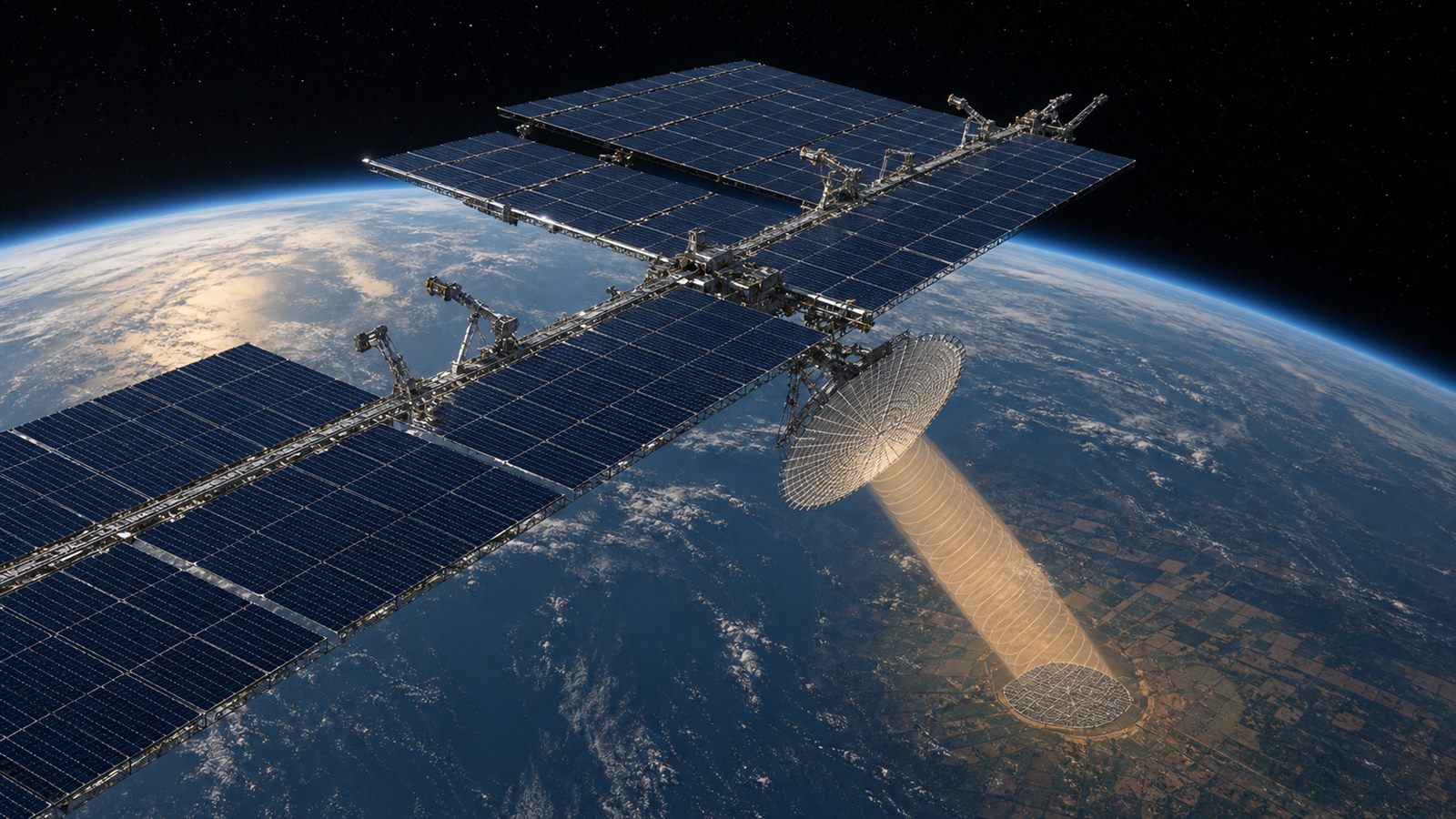
Space-based solar power begins with a real advantage: solar collectors in orbit can receive sunlight without ordinary clouds, weather, or the daily night cycle that affects ground installations. The energy could be converted into radio-frequency or laser transmission and sent to a receiver connected to an electrical grid.
The physics is credible enough for serious research. The challenge is turning small demonstrations into a power station that may span hundreds of meters or more, operate far from repair crews, direct energy safely, and compete with rapidly improving terrestrial power systems. Space solar is therefore an infrastructure question as much as an energy question.
The energy passes through a long conversion chain
A complete system must convert sunlight into electricity, electricity into a transmitted beam, the beam through space and atmosphere, and the received energy back into grid-quality electricity. Every stage loses some energy. The satellite also consumes power for pointing, communication, thermal control, and maintenance.
Efficiency claims should state whether they describe one component or the end-to-end chain. A highly efficient solar cell does not compensate automatically for transmission losses, imperfect receiver capture, or downtime. Demonstrations need calibrated measurements from collected sunlight to delivered electricity.
Orbit changes the engineering trade-offs
Geostationary orbit can keep a satellite over roughly the same region of Earth, simplifying ground receiver geometry and offering long periods of sunlight. It is much farther away than low Earth orbit, increasing launch energy, communication delay, maintenance difficulty, and beam-control demands. Eclipses still occur during parts of the year.
Lower orbits are easier to reach but move rapidly across the sky. Providing continuous service would require multiple satellites, tracking receivers, energy storage, or a network that hands power delivery from one spacecraft to another.
Power output requires enormous collecting area
Utility-scale electricity means collecting and transmitting far more power than a communications satellite handles. Even lightweight photovoltaic panels, antennas, wiring, radiators, structures, and propulsion add substantial mass when multiplied across a very large platform.
NASA’s technology assessment found major capability gaps in autonomous operation, efficient power beaming, and the assembly and maintenance of large orbital systems. Its modeled 2050 concepts were more expensive than terrestrial sustainable alternatives under the study assumptions, though the report noted that costs could fall if those gaps close.
Launch cost is only the first logistics problem
Lower launch prices help, but a power station may require many flights and a steady supply chain. Hardware must survive vibration during launch, deploy reliably, and operate for years under radiation, temperature cycles, and micrometeoroid exposure. Replacing failed modules may require spare parts and servicing vehicles.
Lifecycle analysis needs to include launch vehicles, orbital transfer, manufacturing, replacement, and end-of-life disposal. A design that uses less mass but fails frequently can create higher cost and more debris risk.
Assembly and maintenance need autonomous robots
No single rocket fairing can hold a kilometer-scale structure in its operating form. Modules would need to unfold or be assembled in orbit with accurate alignment. Robots may have to connect power and data interfaces, inspect joints, replace panels, and stabilize flexible structures.
NASA’s in-space servicing, assembly, and manufacturing work is developing many of the underlying capabilities. Standard interfaces would be especially valuable, echoing the argument in our article on scalable satellite servicing. Space solar cannot assume every repair will be a custom mission.
Wireless power transmission must scale safely
Radio-frequency power beaming uses a large phased array to steer energy toward a receiving antenna, often called a rectenna. The beam would be broad compared with a weapon-like laser, but pointing accuracy, sidelobes, aviation, satellites crossing the path, spectrum coordination, and exposure limits still require rigorous design.
Caltech’s Space Solar Power Demonstrator showed wireless power transfer in space and detected transmitted power on Earth at a tiny experimental scale. That demonstrates elements of the chain, not utility economics. Scaling by many orders of magnitude introduces thermal, control, manufacturing, and regulatory problems that a small prototype cannot reproduce.
The ground receiver is major infrastructure
A rectenna would occupy land, connect to high-voltage equipment, and require planning permission, environmental assessment, security, and maintenance. Its acceptable beam intensity affects how large the receiving area must be. The best location may not be near the strongest transmission grid.
Space power does not remove terrestrial grid constraints. New substations and transmission may still be necessary, just as ordinary renewable projects can wait in interconnection queues.
Orbital sustainability belongs in the design
A huge structure presents a large collision cross-section and may be difficult to maneuver. Designers need debris tracking, shielding, modular isolation, repair plans, propulsion, and a credible end-of-life strategy. A failure should not create thousands of uncontrolled components.
The disposal and passivation requirements discussed in our coverage of orbital debris mitigation become harder at this scale. Geostationary systems also need coordination with other spacecraft and radio services.
Terrestrial alternatives set the economic benchmark
A space system should be compared with ground solar, wind, storage, nuclear power, transmission, demand flexibility, and combinations of those resources available at the same future date. Terrestrial technology will not stand still while an orbital system is developed.
Space solar may have special value for remote locations, disaster recovery, lunar infrastructure, or places where land and grid constraints are unusually high. Those narrower uses could justify demonstrations before a full baseload power station.
Limitations
Most utility-scale designs remain conceptual. Cost, mass, efficiency, lifetime, launch cadence, and receiver assumptions vary widely, so headline comparisons can differ by orders of magnitude. Small wireless-power experiments do not validate environmental impact, long-distance efficiency, or commercial reliability.
Policy questions also remain: who licenses the beam, allocates spectrum and orbit, accepts liability, monitors exposure, and controls power delivery across national borders?
What to watch next
Watch for end-to-end demonstrations that publish measured efficiency, beam control, thermal performance, and mass; autonomous assembly tests; modular repair interfaces; lifecycle emissions studies; and realistic comparisons with future terrestrial grids. ESA’s SOLARIS work and NASA assessments are useful because they treat the decision as a system study rather than a single dramatic experiment.
Space-based solar power does not need new physics. It needs an orbital industrial system that can be built, maintained, regulated, and paid for.
Sources: NASA space-based solar power assessment; ESA SOLARIS initiative; Caltech Space Solar Power Project; NASA In-Space Servicing, Assembly, and Manufacturing.
Leave a Reply