
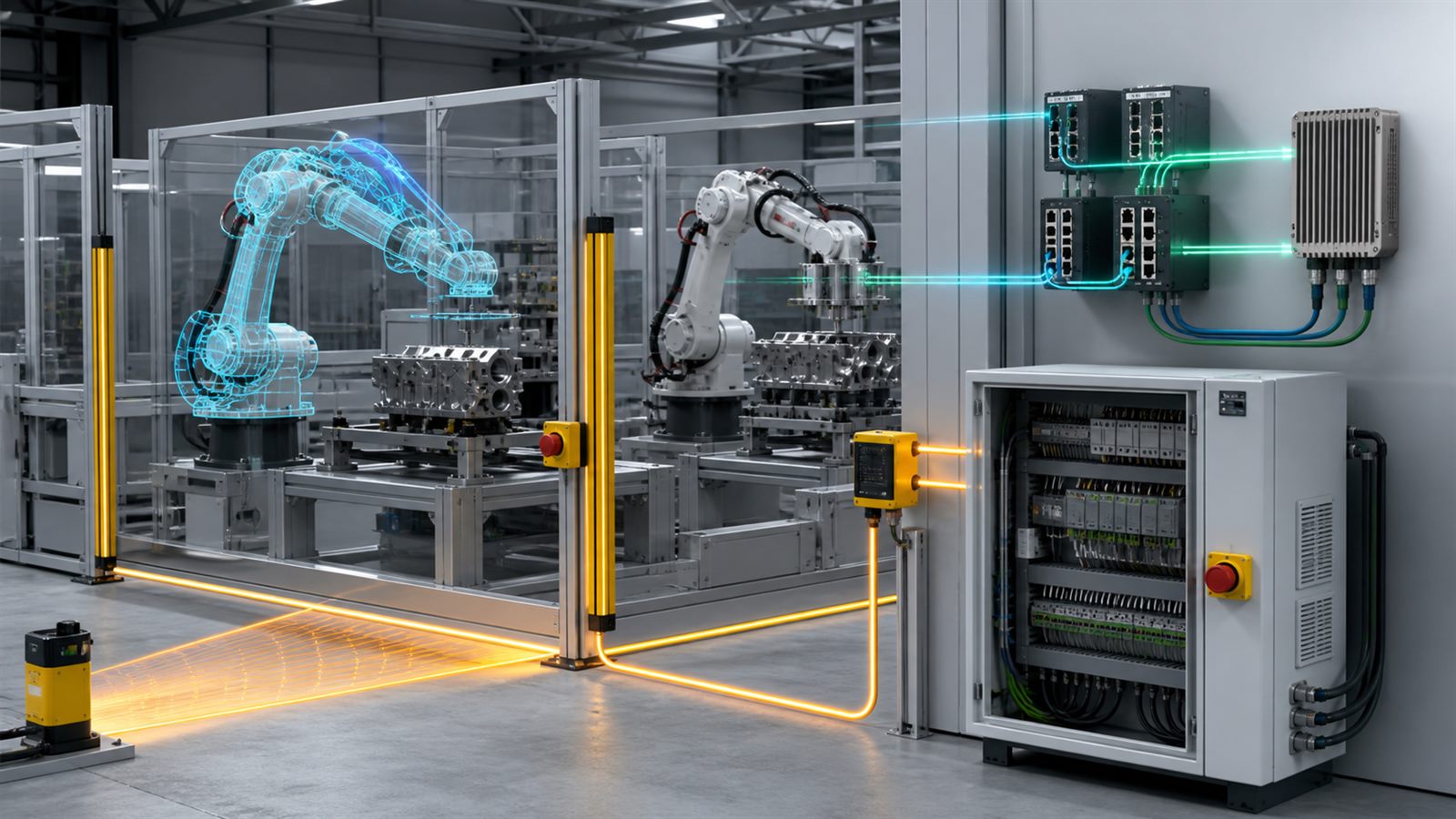
An industrial robot is both a computer system and a machine that moves with force. Its controller receives programs, reads sensors, drives motors, coordinates tools, and exchanges data with production systems. A cybersecurity failure can therefore affect more than confidential information: it can change motion, stop production, damage work, or undermine assumptions used by safety systems.
Industrial automation has strict timing, availability, recovery, and physical-safety requirements. Robot security must be engineered across the product, integrator, factory network, safety architecture, maintenance process, and incident response plan.
A robot cell contains more than a robot arm
A typical cell can include a robot controller, drives, programmable logic controller, safety PLC, vision system, end effector, sensors, human-machine interface, industrial switches, engineering workstation, and connections to manufacturing software. Vendors and integrators may provide different pieces.
Each component has firmware, configuration, identities, communication protocols, and a support lifecycle. A welding robot, packaging arm, mobile manipulator, and laboratory robot create different consequences if a command is delayed or changed.
Cyber risk becomes physical through control
An attacker or accidental change could alter a program, tool frame, speed limit, calibration value, safety-zone configuration, or production recipe. A denial-of-service event may halt a line, while false sensor data can make equipment respond to a condition that does not exist.
Silent changes to quality parameters can create defective products, and corrupted logs can hide the cause. Security planning should consider safety, product integrity, equipment damage, downtime, and recovery evidence alongside data theft.
Safety functions and cybersecurity have different jobs
Machine safety reduces risk from foreseeable hazards using guards, interlocks, scanners, emergency stops, safe speed limits, and validated control functions. Cybersecurity reduces the chance that unauthorized or corrupted actions reach the system. Neither discipline replaces the other.
A safety function should not depend entirely on an ordinary business network or cloud service. At the same time, a safety controller still has configuration and lifecycle risks. The boundary between standard control and safety control must be documented so a security change does not weaken a validated protective function.
Availability changes the defensive design
Office systems can often reboot, scan files aggressively, or isolate a device when suspicious behavior appears. Stopping industrial equipment without understanding its state can trap material, damage tooling, interrupt cooling, or create a difficult restart. Some legacy controllers cannot run endpoint agents.
NIST’s operational-technology guidance emphasizes performance, reliability, and safety alongside security. Controls should be tested against robot cycle time and failure behavior. A monitoring tool that overloads a controller or blocks deterministic traffic can create the operational problem it was meant to prevent.
Asset inventory is the starting point
A factory cannot protect a controller, engineering laptop, remote gateway, or unmanaged switch it does not know exists. The inventory should record model, firmware, network location, owner, supported protocols, safety role, dependencies, backups, remote-access path, and vendor support status.
Logical diagrams need physical context. A network device connected to a packaging robot carries a different risk from one connected to a test bench. Mapping assets to cells and processes helps teams prioritize controls and plan maintenance windows.
Segmentation limits how far a failure can travel
Robot cells should not share unrestricted connectivity with office computers or every production device. Segmented zones and controlled conduits can limit communication to required paths. Industrial firewalls and monitored gateways reduce exposure.
Segmentation must reflect real operations. Engineers may need recipe downloads, diagnostics, historian data, and vendor support. Blocking undocumented traffic before understanding it can interrupt production, so teams should observe, document, test, and phase changes.
Remote access needs explicit ownership
Remote diagnostics can reduce downtime, especially when a specialized integrator supports the cell. It can also create an entry point that remains forgotten after commissioning. Shared accounts, always-on tunnels, and unmanaged vendor laptops weaken accountability.
Access should be approved, time-limited where practical, authenticated, logged, and limited to the necessary system. The site needs a reliable way to disable remote connectivity without disabling local safety or losing the evidence needed for investigation.
Software integrity starts before installation
Robot programs, controller firmware, libraries, vision models, and configuration packages should have known sources and controlled versions. Digital signatures and integrity checks can help detect unauthorized changes. Application allowlisting can prevent unknown software from running on compatible workstations and servers.
Provenance is useful but limited. As our article on software build provenance explains, knowing how an artifact was produced does not prove it is free of vulnerabilities. Secure development, testing, defect handling, patch management, and end-of-life planning remain necessary.
Patching needs a robot-specific test path
A security update may change timing, drivers, certificates, or controller behavior. Installing it directly on production can create risk; delaying indefinitely leaves known weaknesses. A credible process evaluates severity, exposure, compensating controls, vendor guidance, and downtime.
Updates should be tested on representative equipment or a controlled staging environment, with backups and a rollback plan. After installation, teams should verify safety functions, calibration, network communication, cycle performance, and quality output rather than checking only that the controller restarted.
Behavioral monitoring should understand physics
Network monitoring can reveal unexpected connections, protocols, or data rates without installing software on every controller. File-integrity monitoring can flag changed programs. Physical process monitoring can compare commanded motion, sensor readings, energy use, and cycle timing with expected behavior.
NIST has demonstrated behavioral anomaly detection in a robotics-based manufacturing environment. An alert is still evidence for investigation, not proof of an attack. Tool wear, maintenance, new products, and legitimate program changes can also shift behavior. A digital twin may help organize expected states, but it must be validated and protected from bad inputs.
The integrator owns important safety-security connections
ISO 10218-2:2025 addresses industrial robot application integration across design, commissioning, operation, maintenance, and decommissioning. Cybersecurity standards such as IEC 62443 address secure product development and automation-system security processes. Applying both perspectives exposes gaps that one supplier cannot solve alone.
The robot maker controls the base product, the integrator designs the application, and the factory operates the result. Contracts and documentation should identify who manages accounts, certificates, patches, backups, remote support, vulnerability notices, and safe recovery throughout the cell’s life.
Recovery must restore a known physical state
A backup is only useful if it includes the correct programs, safety configurations, calibration data, recipes, controller settings, and dependencies. Restoration should occur into a controlled environment, followed by integrity checks and staged recommissioning.
NIST’s 2026 manufacturing response-and-recovery work emphasizes operational resilience in industrial control environments. For robots, recovery is not finished when files return. Guards, interlocks, coordinate frames, tools, payload settings, and process quality must be verified before normal production resumes.
Incident exercises should include operations and safety teams
A cyber response plan written only by IT may assume a device can be unplugged immediately. A joint exercise can define who can stop a cell, how to stabilize equipment, which logs to retain, and how to communicate with vendors.
The exercise should include a safe restart, not just containment. Lessons from robot safety standards for shared workspaces and mobile-robot safety remain relevant because people interact with the system during maintenance and recovery.
Limitations
Industrial robot architectures vary widely, and controls suitable for a new Ethernet-connected cell may not fit isolated legacy equipment. Standards define processes and requirements but do not certify that a particular deployment is secure. NIST reference architectures are examples, not universal product endorsements.
Security monitoring can produce false positives, and aggressive isolation can create operational hazards. Digital twins cannot detect every attack, especially when models or reference data are compromised. Risk decisions require the robot manufacturer, integrator, owner, safety specialists, and cybersecurity team.
What to watch next
Watch for robot vendors adopting secure development and signed-update practices, clearer vulnerability support periods, tested asset inventories, interoperable security logs, cell-level recovery exercises, and safety validation after patches. The evolution of NIST OT guidance and the IEC 62443 series should make connected automation responsibilities more explicit.
A secure robot is not merely one that rejects unauthorized logins. It is a system that preserves trustworthy motion, safe boundaries, product integrity, and recoverable operation through years of software and production change.
Sources: NIST SP 800-82 Revision 3, Guide to Operational Technology Security; NIST SP 1800-10, Protecting Information and System Integrity in Industrial Control System Environments; NIST SP 1800-41 manufacturing response and recovery draft; ISO 10218-2:2025, safety requirements for industrial robot applications and cells; IEC 62443-4-1 secure product development lifecycle requirements.
Leave a Reply