
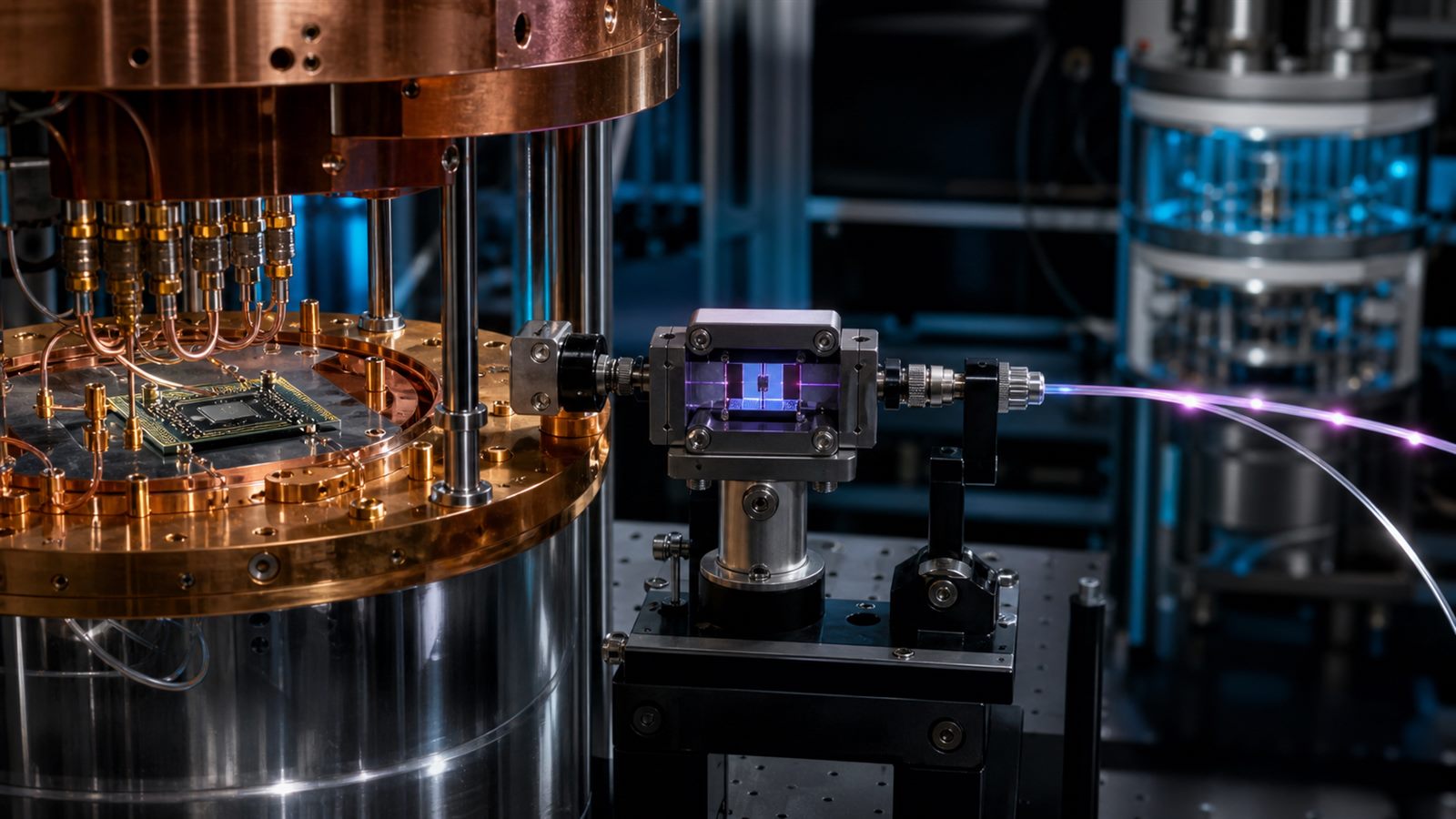
Superconducting quantum processors speak in microwaves. Optical fiber carries information most effectively as light. Connecting those two worlds is not a matter of plugging in a different cable: a quantum transducer must convert a fragile state without measuring it, copying it, or burying it in noise.
That requirement makes microwave-to-optical transduction one of the most consequential hardware problems in modular quantum computing. A useful device could let separate cryogenic processors share quantum states over fiber, reducing the need to force every qubit into one refrigerator. It could also provide an interface between processors and the longer-distance links described in our guide to quantum networks and repeaters. Laboratory progress is real, but a transducer that works in one carefully tuned experiment is still far from a dependable network component.
Why microwave qubits and optical fiber do not naturally match
Many leading superconducting circuits store and manipulate quantum information at microwave frequencies, typically inside a dilution refrigerator at temperatures close to absolute zero. Microwave control fits the electrical nature of those circuits, but microwave photons are awkward travelers. At ordinary temperatures, thermal background energy can overwhelm single microwave photons. Coaxial cables also conduct heat into a refrigerator, adding to the cryogenic wiring problem that becomes harder as systems grow.
Optical photons have a different advantage. They can travel through standard fiber with relatively low loss, and their much higher frequency makes thermal occupation negligible at room temperature. Photonics already offers mature components for routing, filtering, multiplexing, and detection. The challenge is that an optical photon does not directly interact strongly with a microwave circuit. A transducer therefore needs an intermediate physical process that couples both frequency domains while preserving the encoded quantum information.
What the converter has to preserve
A classical frequency converter can tolerate amplification, measurement, and some reconstruction. A quantum converter cannot freely use those shortcuts. An unknown quantum state cannot be copied, and a measurement generally destroys the superposition that the network is meant to carry. The transducer must act coherently: the input microwave state should emerge as a corresponding optical state, or the device should generate useful entanglement between microwave and optical modes.
The US National Institute of Standards and Technology says networking superconducting computers will require conversion between microwave operation and low-loss optical transmission, while noting that no present technology reaches the required fidelity. NIST is exploring vibrating membrane converters and is building test systems for remote microwave entanglement. This framing matters because the target is not merely visible optical output. The output must still contain usable quantum information.
Several hardware routes are competing
Electro-optomechanical devices use a mechanical vibration as the intermediary. A microwave resonator couples electrical energy into motion, and an optical cavity couples that motion into light. Piezoelectric materials can strengthen the microwave-to-mechanical step, while nanophotonic structures confine light in a small volume. The attraction is an integrated path from established microwave circuitry to chip-scale photonics. The difficulties include mechanical loss, fabrication variation, pump-induced heating, and the need to isolate an extremely weak signal from noise.
Electro-optic converters instead use a material whose optical properties respond directly to an electric field. Thin-film lithium niobate is widely studied because it supports strong electro-optic interaction and integrated optical resonators. Other teams are investigating rare-earth ions, spins, atoms, and magnons as intermediaries. A 2025 Nature Physics experiment, for example, used ytterbium ions in a crystal for single-photon-level conversion. These platforms trade different combinations of coupling strength, bandwidth, tunability, pump requirements, and manufacturability.
Efficiency is only one line on the scorecard
Conversion efficiency is easy to understand: it measures how much of the input reaches the output. But a high number can be misleading if the converter also produces unwanted photons. Added noise is especially serious because a false photon can look like the quantum signal. Researchers therefore report input-referred noise and examine whether a device operates in a quantum-enabled regime, generally meaning that the noise is below the scale of a single input photon.
Bandwidth and repetition rate determine how quickly states can be transferred. Fidelity describes how accurately the output represents the input. Stability determines whether the device stays aligned rather than requiring constant laboratory adjustment. Bidirectional operation may be needed when a link must send and receive states. Pump power and heat are system-level constraints: an optical pump that warms the millikelvin stage can erase the benefit of replacing electrical wiring with fiber.
A 2025 silicon nanomechanics study demonstrated efficient continuous conversion while operating with less than one photon of input-referred noise. That is a meaningful combination, but it does not by itself establish a field-ready module. Useful engineering comparisons must place efficiency, noise, bandwidth, duty cycle, operating temperature, and packaging conditions side by side.
A local optical link is not automatically a quantum internet
The first valuable applications may sit inside a data center or even between two nearby refrigerators. Fiber could reduce the thermal load of interconnects and help create modular machines in which smaller processors are linked. That is different from a metropolitan or continental quantum network, which also needs photon loss management, memories, entanglement swapping, synchronization, classical control, and eventually repeaters.
The distinction affects performance targets. A short, deterministic connection between neighboring modules may prioritize bandwidth and packaging. A long-distance entanglement link may tolerate a low success rate if heralding identifies the successful events, but it demands excellent state quality and compatibility with telecom wavelengths. The right transducer depends on the architecture around it rather than one universal benchmark.
Why integration may be harder than the physics demonstration
A complete converter needs microwave resonators, optical cavities, couplers, filters, pumps, shielding, control electronics, and fiber packaging that survive repeated thermal cycles. Materials that are excellent for photonics may be difficult to place next to high-coherence superconducting circuits. Stray optical light can create quasiparticles and degrade a qubit. Fabrication tolerances can shift resonances, forcing individual tuning. Every extra component also changes the resource budget behind a supposedly scalable design, just as fault-tolerant algorithms need full hardware estimates rather than qubit counts alone.
This is why claims about a universal quantum modem deserve caution. The published result may characterize the converter in isolation, use a strong calibration signal, or report peak efficiency over a narrow operating window. The more demanding demonstration is end to end: create a state in one superconducting node, convert it, transmit it, convert or detect it at another node, and verify entanglement or state fidelity repeatedly.
What to watch next
The strongest milestones will combine low added noise and high efficiency in the same device, under the thermal and optical conditions of an operating qubit. Watch for remote entanglement between independently controlled superconducting processors, telecom-band output, longer continuous operating periods, packaging that tolerates thermal cycling, and fabrication results across more than one device. NIST’s networking and transduction program is one useful public benchmark because it treats the converter as part of a testable channel rather than an isolated component.
Quantum transducers will not make processors large or fault tolerant on their own. Their promise is narrower and still powerful: they could turn separate cryogenic islands into modules that exchange quantum states through photonic infrastructure. The decisive progress will be measured not by a brighter optical signal, but by whether the state at the far end remains useful for computation or networking.
Leave a Reply