
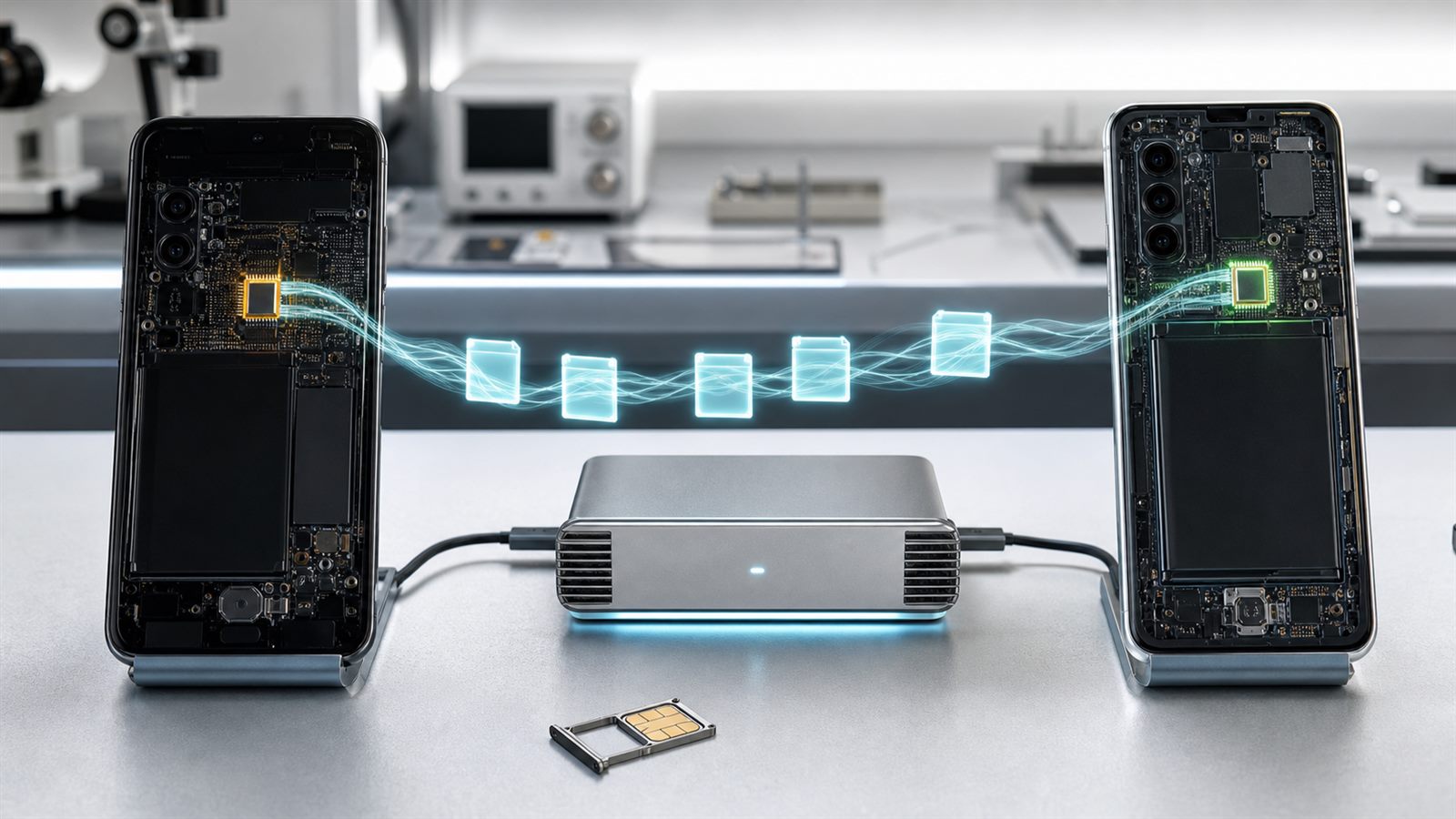
An eSIM removes the small plastic card from phone setup, but it does not remove the carrier, account checks, or activation infrastructure behind mobile service. That is why moving to a new phone can feel instant on one network and become a support case on another. The radio hardware may be ready while the subscription is still waiting to be authorized, downloaded, and installed.
For consumers, the useful mental model is not “a SIM stored in the cloud.” An eSIM is a secure element in the device that holds carrier profiles. Moving service means coordinating the old phone, the new phone, their operating systems, the carrier’s provisioning systems, and the account owner’s identity. This turns phone replacement into a provisioning and recovery workflow, with consequences for travel, repair, resale, and account security.
The embedded chip and the subscription profile are different things
The permanent hardware is called an eUICC. It can securely store and manage one or more operator profiles. A profile contains the credentials and configuration that let the phone authenticate to a mobile network. The GSMA’s consumer architecture also includes a Local Profile Assistant on the device and a carrier-side preparation service commonly called the SM-DP+. The GSMA SGP.22 specification describes this remote SIM provisioning system.
Downloading a profile is therefore more like securely issuing a credential than copying an ordinary file. The carrier must decide that the subscription is eligible, associate it with the target device, and deliver an activation code or equivalent authorization. The phone then establishes a secure channel to obtain and install the profile. A backup of photos and apps does not necessarily include a transferable copy of that credential.
Why the same phone can offer several activation paths
A carrier may assign an eSIM automatically during setup, support direct device-to-device transfer, provide a QR activation code, use its own app, or require manual account service. Apple lists carriers separately according to whether they support carrier activation, Quick Transfer, or other methods. On supported networks, Quick Transfer can move a number from an old iPhone without contacting the carrier. That convenience is an ecosystem integration, not an inherent property of every eSIM.
Android’s reference transfer architecture makes the dependencies clearer. The target and source devices pair, the system asks which profiles are eligible, the carrier issues a temporary token or activation code, and the target device’s profile assistant downloads the profile from provisioning infrastructure. The Android Open Source Project documentation notes that carrier implementation can make the operation nearly instant or delay it until after device setup.
Compatibility can vary by carrier, plan type, country, phone model, operating-system version, and whether the move crosses platforms. A phone displaying an “Add eSIM” button proves that it can host a profile; it does not prove that a particular subscription can be transferred automatically.
A planned upgrade and a broken phone are very different cases
The easiest move happens while the old phone still works, both devices are available, the account credentials are known, and the carrier recognizes the transfer path. The user can confirm service on the new phone before erasing or trading in the old one. That sequencing matters. Apple’s resale guidance distinguishes erasing device data from erasing an eSIM profile, a reminder that the subscription must be handled deliberately rather than treated like an app.
A failed, lost, or inaccessible phone removes the source device from the workflow. Recovery may then require the carrier to issue a replacement profile after account verification. The customer may need access to an account email, a carrier PIN, a trusted device, or an identity check. A QR code that was intended for one activation may no longer work. Exact procedures differ, so anyone who relies on one number for work or authentication should learn the carrier’s replacement process before the phone fails.
This recovery issue intersects with repairability. The EU’s smartphone repair and energy-label rules make hardware longevity easier to compare, but service continuity remains partly controlled by carrier software. A repairable phone is more useful when replacing it, lending it, or moving its number does not depend on a fragile activation path.
eSIM changes the attack surface, not the need for account security
An embedded SIM cannot be pulled from a stolen phone and inserted into another device. Remote provisioning also uses protected channels and security-certified components. Those are meaningful advantages. But the valuable asset is often the phone number and the carrier account, not the physical card. If an attacker persuades a provider to redirect the number, the absence of a removable SIM does not prevent the takeover.
The US Federal Communications Commission’s SIM swap and port-out order requires stronger customer authentication, notifications for SIM-change and port requests, and procedures for responding to fraud. The rules reflect a broader lesson: service transfer must be easy for the legitimate owner without becoming easy for an impersonator.
Consumers should treat the carrier login, recovery email, account PIN, and any number-transfer lock as parts of the phone’s security boundary. SMS can still be useful, but a phone number is a recoverable carrier service rather than an unchangeable identity key. Important accounts are generally more resilient when they also support authenticator apps, hardware security keys, or platform passkeys.
Travel profiles are convenient, but labels and defaults matter
A multi-profile eSIM phone can keep a home number while adding a local or regional data plan. That avoids storing tiny cards and can make comparison easier. It also creates configuration choices: which line provides mobile data, which number handles calls and messages, whether data switching is allowed, and what happens when one plan has no coverage. Roaming charges can still occur if the wrong line remains active for data.
Travel profiles also vary in what they provide. Some are data-only and do not include a conventional phone number or voice service. Some route traffic through infrastructure far from the user’s location, affecting latency or how websites infer geography. Validity periods may begin at purchase, installation, or first network connection. The profile’s marketing page is not a substitute for checking those operational details.
A practical phone-switching sequence
Before changing devices, confirm that the new model supports the carrier’s required bands and eSIM policy. Update both phones, know the carrier account credentials, and keep the old device powered and connected. Start the operating system’s supported transfer flow before wiping anything. After activation, test outgoing and incoming calls, messages, and mobile data. Check which line is the default when the phone holds more than one profile.
Only after those checks should the old phone be erased or handed over. That order resembles the discipline needed when evaluating USB-C capabilities: a common-looking interface hides different levels of implementation. It also matters for long-lived devices, including phones using higher-capacity silicon-carbon batteries, because a good hardware upgrade is not complete until the service identity moves safely.
What to watch next
The next phase is less about putting eSIM hardware in more phones and more about consistent transfer. Watch for broader cross-platform moves, prepaid-plan support, clearer carrier eligibility messages, reliable recovery when the old device is unavailable, and less dependence on single-use codes. Better transfer standards will still require carrier integration, fraud controls, and support procedures that work across borders.
eSIM can make activation faster and travel more flexible. It can also expose where mobile service is still tied to fragmented provisioning systems. Buyers should judge it by the complete lifecycle: initial activation, routine switching, emergency recovery, repair, resale, and account protection.
Primary and authoritative sources
- GSMA: SGP.22 Consumer eSIM Technical Specification
- Android Open Source Project: eSIM Transfer Carrier Integration
- Apple Support: Carriers and Service Providers Offering eSIM
- Apple Support: Preparing a Device for Sale or Trade-In
- Federal Communications Commission: Protecting Consumers from SIM Swap and Port-Out Fraud
Leave a Reply