
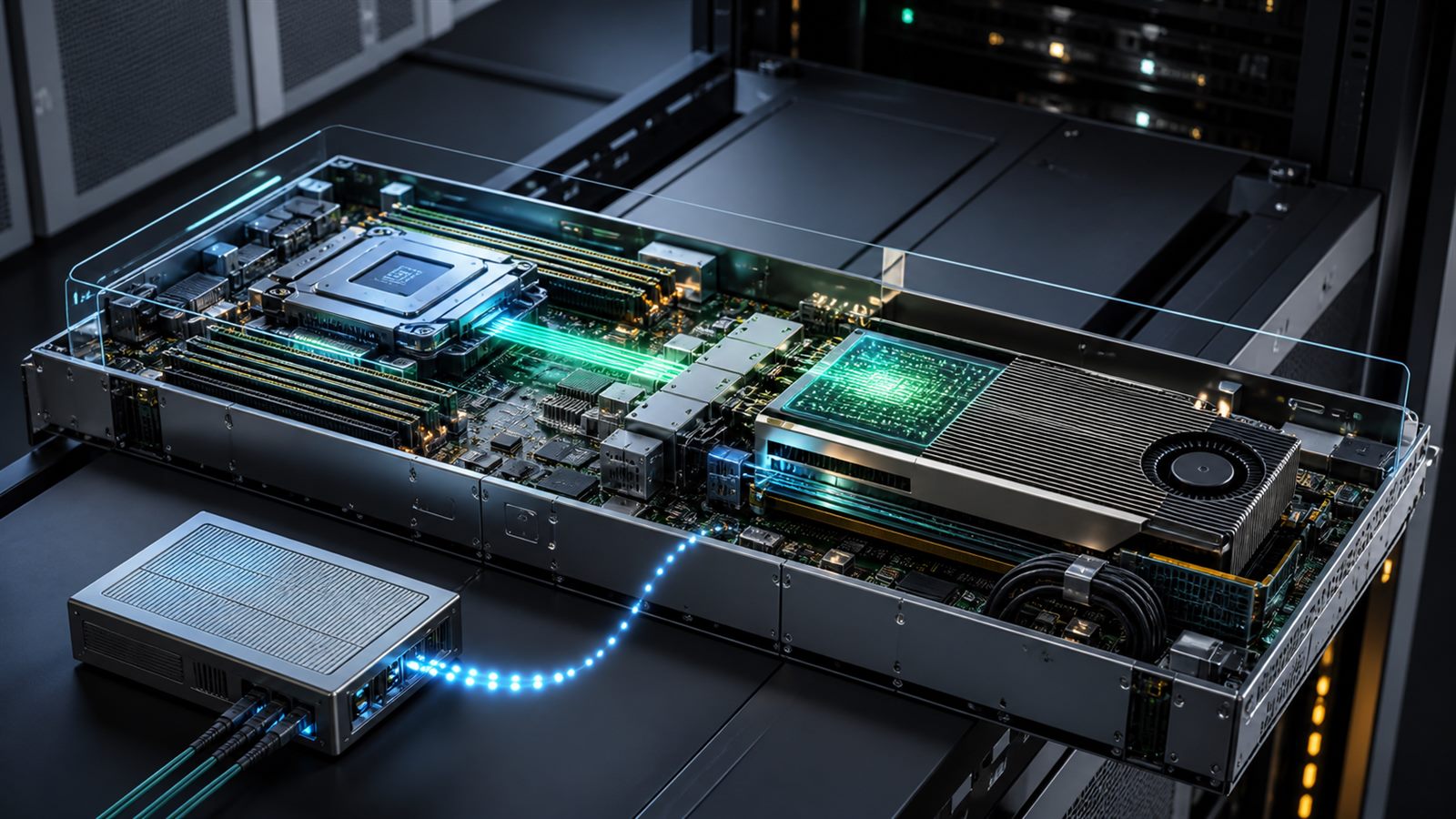
AI systems often process the information an organization is least willing to expose: private prompts, customer records, proprietary documents, model weights, and the intermediate data created during inference. Encryption protects files at rest and network traffic in transit, but conventional computing still decrypts data in memory while a processor uses it. Confidential computing is designed to narrow that gap.
The idea is to run a workload inside a hardware-protected trusted execution environment, or TEE. Memory isolation and encryption reduce what the host operating system, hypervisor, cloud administrator, or a compromised neighboring workload can inspect. Remote attestation can then provide evidence about the hardware and software state before an owner releases data or cryptographic keys. That is useful for AI, but it is not a blanket guarantee that the model, application, or result is trustworthy.
What confidential computing adds to ordinary encryption
Storage encryption protects a model checkpoint or dataset on disk. Transport encryption protects it while it crosses a network. Both protections normally end when the data reaches the machine that will calculate on it. A privileged administrator, malicious hypervisor, memory-scraping tool, or compromised host could potentially target that exposed working state.
The Confidential Computing Consortium defines the field around protecting data in use through a hardware-based, attested TEE. Instead of assuming that every layer beneath an application is trusted, the design moves an important part of the trust boundary into the processor. Memory associated with the protected guest or enclave is encrypted and isolated from the surrounding host.
This changes an infrastructure risk, not the behavior of the model. A TEE can make it harder for the cloud operator to read a private prompt or proprietary weight file. It does not determine whether the model hallucinates, follows an unsafe instruction, or returns sensitive information that the application was authorized to provide.
Attestation is the admission check
Isolation is only valuable if a data owner can establish what is inside the protected environment. Remote attestation addresses that problem. Hardware produces signed evidence about identity, firmware, configuration, and measured software state. A verifier compares that evidence with an approved policy. If the result matches, a key broker can release the decryption key or credential needed by the workload.
NVIDIA’s GPU attestation documentation describes verification of GPU hardware and software claims before confidential-computing modes are trusted. For AI systems, this matters because the calculation may cross a CPU, accelerator, memory, driver, interconnect, and virtual machine. Protecting the CPU while leaving the GPU path outside the boundary would create a conspicuous gap.
Attestation should be read as a specific claim: an identified platform is in a measured state that satisfies a policy. It is not proof that millions of lines of application code contain no vulnerability. It is also not a timeless certificate. Firmware changes, revoked components, expired credentials, and configuration drift mean verification and policy maintenance are continuing operational jobs.
AI creates two valuable assets to protect
The first asset is data. Training, fine-tuning, retrieval, and inference may involve medical records, financial data, unpublished research, internal messages, or personal identifiers. A confidential environment can reduce exposure to infrastructure operators when those inputs are processed. It can also support collaboration in which one party supplies data and another supplies a model without either side handing the raw asset to the other in conventional form.
The second asset is the model itself. Weights, system prompts, adapters, and inference logic can represent substantial intellectual property. A provider may want to run that model on another organization’s hardware without allowing the host to inspect it. The same isolation and conditional key release can protect both the input and the model package while they are active.
This is different from the resource questions covered in our article on AI server cooling and compute architecture. Confidential AI adds roots of trust, protected I/O, attestation services, key brokers, and policy decisions to the hardware stack. Those components must scale alongside accelerators and networks.
The CPU-to-GPU boundary is an engineering problem
Modern AI inference frequently depends on accelerators, so data may move beyond a confidential CPU guest. Confidential GPU systems attempt to extend protection through the accelerator, including device memory and the connection carrying data between CPU and GPU. Cloud services now expose such configurations, and current NVIDIA platforms provide confidential-computing and attestation mechanisms for supported accelerators.
The exact boundary still matters. Data may enter through an API gateway, be retrieved from a database, pass through preprocessing code, reach an accelerator, and leave through logging or monitoring systems. A protected GPU cannot compensate for an application that writes full prompts to an ordinary log store. Likewise, a secure VM cannot protect a result after an authorized client downloads it.
Operators therefore need a data-flow map, not just a product label. They must identify where plaintext exists, where keys are released, which components are measured, what telemetry leaves the TEE, and how updates change the attested state.
What a TEE does not solve
Confidential computing does not validate training data, detect bias, prevent prompt injection, or enforce the business purpose for which a result is used. Malicious code running inside an approved TEE can still misuse data it is allowed to decrypt. A vulnerable inference service may expose information through its output even if the host cannot read memory. Model extraction, membership inference, and excessive application permissions remain separate risks.
It also does not remove supply-chain security. The verifier needs reliable reference measurements and certificate status. Workload owners need a controlled build process, signed artifacts, reviewed policies, and a recovery plan when attestation fails. This echoes our analysis of AI agent protocols: a transport or interoperability layer does not automatically create trust in the software using it.
Side-channel resistance deserves separate scrutiny. Hardware isolation reduces direct memory access, but timing, resource contention, speculative execution, and application-level behavior can reveal information under some conditions. Security claims should name the threat model and supported configuration rather than saying an AI workload is simply “private.”
NIST is treating confidential AI as a deployable architecture
In May 2026, NIST published an initial draft of IR 8320E on confidential computing for cloud workloads. The document presents an example approach for protecting data acted upon by AI in cloud infrastructure. Its draft status matters: it is a technical blueprint for evaluation and discussion, not a final universal certification.
The NIST framing is helpful because it focuses on a system rather than one processor feature. Machine identity, key management, roots of trust, access policy, and validation all have to work together. That is the same operational perspective needed for AI risk management in critical infrastructure, where a model benchmark is only one part of the control environment.
Performance and operability still count
Memory encryption, integrity checks, protected device paths, and attestation add work. The overhead depends on hardware generation, workload shape, memory traffic, network design, and whether an accelerator is involved. A small benchmark under ideal conditions cannot describe every model-serving system. Teams need to measure latency, throughput, startup time, capacity, and failure behavior using their own workload.
Operational questions may be more important than peak overhead. Can a fleet rotate keys without interrupting service? What happens when an attestation service is unavailable? How quickly can a patched image receive an approved measurement? Can incident responders obtain enough telemetry without leaking the data the TEE exists to protect? A design that cannot be updated or diagnosed safely will not remain trustworthy for long.
What to watch next
The strongest progress will make confidential AI easier to verify across vendors. Watch for interoperable attestation formats, clear CPU-to-GPU protection boundaries, reproducible reference measurements, policy-controlled key release, and independent testing of supported configurations. Better documentation should also distinguish production support from preview features and state which devices, drivers, firmware, and orchestration layers are inside the claim.
Confidential computing fills a real gap by reducing exposure while AI data and models are being processed. Its value is precise: it can change which infrastructure operators and compromised host layers must be trusted. It does not make the model correct, the application authorized, or the output harmless. The mature question is not whether an AI service is “confidential,” but exactly which data is protected, from whom, during which steps, and under what verifiable policy.
Leave a Reply