
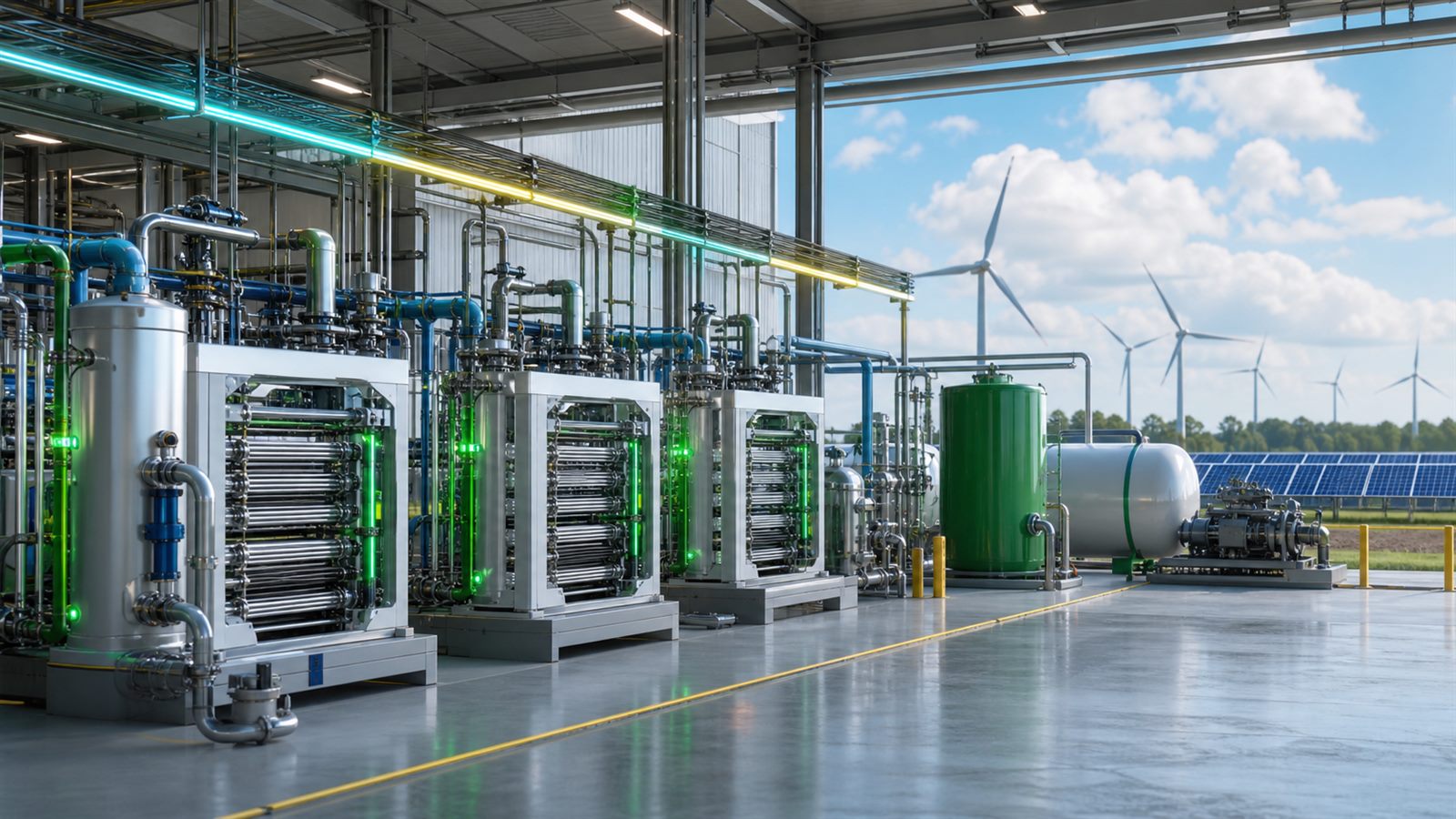
Electrolyzers can turn electricity and water into hydrogen, which makes them tempting partners for wind and solar farms. When renewable generation rises, the plant can increase production; when power becomes scarce or expensive, it can reduce load. That flexibility sounds like a natural match, but an electrolyzer is an electrochemical factory rather than a perfectly responsive battery.
Frequent starts, stops, and changes in power can affect efficiency, gas purity, temperature, pressure, catalysts, membranes, and downstream equipment. A plant designed to absorb variable electricity therefore needs more than a fast control signal. It needs hardware, storage, operating limits, and an economic plan that preserve stack life while still producing useful volumes of low-emissions hydrogen.
Hydrogen is only as clean as its electricity
Electrolysis splits water into hydrogen and oxygen using electricity. The process does not produce carbon dioxide at the stack, but its full emissions depend heavily on where the electricity comes from and when it is consumed. The US Department of Energy’s electrolysis overview emphasizes that electricity source, cost, efficiency, and associated emissions all belong in the assessment.
This is why flexibility matters. A plant may be able to favor hours with abundant wind, solar, hydro, or nuclear generation. It can potentially use electricity that would otherwise be curtailed. But a low annual average price or emissions figure can hide the actual hourly pattern. Claims about renewable hydrogen need matching rules and operating data that show when the electrolyzer ran, not merely the nameplate capacity of a nearby generator.
The main electrolyzer families respond differently
Proton exchange membrane, or PEM, electrolyzers use a solid polymer membrane and can respond quickly across a useful operating range. They are attractive for variable power, but today’s designs rely on scarce platinum-group materials, especially iridium at the oxygen-producing electrode. Lowering catalyst loading can reduce material constraints while making durability more demanding.
Liquid alkaline electrolyzers use a liquid electrolyte and are a mature industrial option. They can be economical at scale, although their minimum load, gas crossover, pressure behavior, and response depend on design. Solid oxide electrolyzers operate at high temperature and can achieve high electrical efficiency when heat is available. Thermal management makes abrupt cycling a different challenge than it is for a low-temperature stack.
No family is universally “best for renewables.” The answer depends on the power profile, hydrogen demand, heat source, operating pressure, water quality, plant size, and how often the system crosses its preferred operating region.
Flexible load is not the same as unlimited cycling
Within an approved operating window, an electrolyzer can ramp power and provide a controllable industrial load. Problems emerge when a schedule repeatedly pushes cells through high voltage, low load, shutdown, restart, pressure change, or temperature transition. Components experience different chemical and mechanical stresses, and some degradation mechanisms accumulate faster under cycling.
A peer-reviewed national-laboratory study of PEM cells at low iridium loading found that cycling accelerated performance loss compared with steady operation. Model wind and solar profiles were less severe than artificial high-frequency square and triangle cycles, showing why a realistic duty cycle matters. The researchers linked losses to iridium dissolution and changes around the catalyst layer, and concluded that both component development and control strategies are needed.
That result should not be simplified into “renewables damage electrolyzers.” Actual renewable profiles, control smoothing, standby choices, and stack design determine the stress. It does show why a durability claim based only on constant full-power operation may not predict life in a flexible plant.
Efficiency changes across the operating range
An electrolyzer’s headline efficiency is usually measured at specified current density and conditions. At part load, some electrical losses decline, while fixed auxiliary loads such as pumps, controls, cooling, water treatment, and compression become larger relative to hydrogen output. At very low load, gas crossover can affect purity and safe operation. Starting a hot or pressurized system also differs from starting a cold plant.
The useful metric is therefore a plant-level efficiency curve, not one stack point. Operators need to know electricity consumed per unit of delivered hydrogen across load, including balance-of-plant equipment. If downstream compression or synthesis equipment prefers stable flow, aggressively following every power fluctuation at the stack may simply move inefficiency elsewhere.
Buffers can separate power variability from hydrogen demand
A small battery, thermal buffer, hydrogen storage vessel, or multiple independently controlled stack modules can smooth operation. The electrolyzer may follow slower renewable changes while a battery handles rapid fluctuations. Hydrogen storage can let downstream users receive a steadier flow even when production varies. Modular plants can keep some stacks near efficient operating points while others turn down.
Each buffer has a cost and loss, so the goal is not to make the plant perfectly steady. The goal is to assign each timescale to the component that handles it economically. This is related to the broader point in our guide to long-duration energy storage: different technologies solve different durations, locations, and output needs.
Grid conditions also matter. Dynamic line ratings can reveal temporary transmission capacity, but they do not guarantee that power is available at an electrolyzer’s connection point. Interconnection limits, congestion, and local network upgrades can determine whether flexible demand is useful to the grid.
Durability has to be measured as a system target
The Department of Energy’s H2NEW consortium tracks capital cost, efficiency, and lifetime together across PEM, alkaline, and solid oxide technologies. Its public goals illustrate an important discipline: a low stack cost is not enough if the system degrades quickly, and a long-lived stack is not enough if it consumes too much electricity.
Manufacturers and projects should report the duty cycle behind a lifetime estimate. Useful information includes operating hours, starts, time at low load, ramp rate, average current density, water quality, pressure, temperature, replacement assumptions, and the end-of-life criterion. Accelerated stress tests are valuable only when they have a defensible relationship to field operation.
Balance-of-plant equipment needs the same attention. Rectifiers, pumps, dryers, separators, compressors, valves, sensors, and storage vessels can limit availability even when the electrochemical stack is healthy. A flexible hydrogen plant is a coordinated process facility, not one stack connected directly to a wind turbine.
The business model determines the operating schedule
A project buying only the cheapest hours may reduce electricity expense but also lower utilization, spreading capital cost over fewer kilograms of hydrogen. Running continuously can improve asset utilization while consuming higher-priced or higher-emissions electricity. Providing grid services may create another revenue stream, but it can impose additional movement on the equipment.
The optimum schedule depends on power prices, carbon accounting, hydrogen contracts, storage capacity, maintenance, and degradation cost. It should include the value of stack life rather than treating every megawatt-hour as interchangeable. Better control software can optimize these choices, but only if it uses validated equipment limits and does not confuse a short demonstration with long-term durability.
Electrolyzers can complement technologies such as grid-forming inverters, yet they serve a different role. An inverter can help stabilize an electricity system on very fast timescales. Hydrogen production converts energy into a storable molecule for industry, transport, or later energy use, with more conversion steps and different response constraints.
Limitations buyers should notice
Project announcements often quote rated efficiency, expected lifetime, or renewable capacity without showing whether the figures apply simultaneously. A plant may reach excellent efficiency under stable operation and excellent flexibility under a different test. Cost estimates may omit installation, interconnection, storage, compression, water treatment, or replacement stacks.
What to watch next
The most informative demonstrations will publish multi-thousand-hour results under realistic renewable and market duty cycles. Watch for lower catalyst loading paired with stable performance, validated accelerated stress tests, plant-level efficiency curves, modular control strategies, and transparent maintenance records. Projects should also report hourly electricity provenance and delivered-hydrogen conditions rather than only annual averages.
Flexible electrolysis can turn variable electricity into a controllable industrial process, but flexibility is not free. The strongest systems will decide which fluctuations to follow, which to buffer, and which to ignore. Success will come from optimizing electricity cost, emissions, hydrogen delivery, and equipment life together.
Primary and authoritative sources
- US Department of Energy: Hydrogen Production by Electrolysis
- US Department of Energy H2NEW Consortium
- US Department of Energy: Water Electrolyzer Technical Targets and Research Resources
- Journal of the Electrochemical Society: Electrolyzer Durability at Low Catalyst Loading and with Dynamic Operation
Leave a Reply